Ever wondered what the smell of the earth is? Maybe you've visited the countryside while farmers have been ploughing their fields and smelled it. The smell is caused by Geosmin which is an organic compound with a distinct earthy aroma produced by a type of Actinobacteria.
Geosmin is produced by the bacteria Streptomyces, a genus of Actinobacteria and released when these microorganisms die.
Geosmin is a colourless liquid, with a boiling point of 270°C. The human nose is extremely sensitive to geosmin and is able to detect it at concentrations as low as 5 parts per trillion. It is the smell after a rainstorm when the ground is wet.
Geosmin is often responsible for unpleasant tastes in water supplies. Cyanobacteria (blue-green algae) and actinobacteria release geosmin when they die, and this can be absorbed by bottom-feeding freshwater fish such as carp and catfish. Geosmin combines with 2-methylisoborneol, which concentrates in the fatty skin and dark muscle tissues. Geosmin breaks down in acid conditions; hence, vinegar, lemon and other acidic ingredients are used in fish recipes to help reduce the muddy flavour.
Geosmin can sometimes be tasted in wine or drinking water.
It has also been suggested that camels can detect the smell of geosmin that had been released by Streptomyces miles away in wet ground, and track the geosmin to find an oasis; in return the camel could carry away and disperse the spores of the Streptomyces bacterium.
Soil is considered to be the "skin of the earth" and consists of a solid phase (minerals and organic matter) as well as a porous phase that holds gases and water. It carries essential nutrients for plantlife and is a habitat for organisms that take part in decomposition of organic matter and the creation of a habitat for new organisms.
For more information visit:-
http://web.expasy.org/spotlight/back_issues/035/
http://en.wikipedia.org/wiki/Soil
Total Lab Supplies offer laboratory equipment, chemicals and consumables to a wide range of customers from industry through to education. We offer technical support to help you choose the right products and offer many well known brands. We are able to help pick the right product to fit your budget. If you need any help contact us by e-mail, fax or comment on our blog. Email sales@totallabsupplies.co.uk
Showing posts with label nature. Show all posts
Friday, 6 March 2015
Friday, 14 November 2014
Platinum
Platinum has the chemical symbol Pt and atomic number 78. It’s
a dense, malleable, ductile, highly unreactive, precious, grey-white transition
metal. Its name is derived from the Spanish term platina, which is literally
translated into "little silver”.
Platinum occurs in the wild as the pure element as well as alloyed with iridium, known as platiniridium. It is one of the rarest elements in the Earth's crust with an average abundance of approximately 5 μg/kg.
In addition to its high density, resistance to oxidation and other desirable qualities, platinum is remarkably chemically unreactive. For these reasons, a 90-10% alloy of platinum-iridium is still used as the International Prototype Kilogram. Originally, this prototype kilogram was made of pure platinum, but iridium was added to increase its hardness while retaining platinum's many desirable qualities.
Platinum is used in catalytic converters, laboratory equipment, electrical contacts and electrodes, platinum resistance thermometers, dentistry equipment, and jewellery. Being a heavy metal, it leads to health issues upon exposure to its salts, but due to its corrosion resistance, it is not as toxic as some metals. Some compounds containing platinum are applied in chemotherapy against certain types of cancer.
Platinum;s resistance to wear and tarnish is well suited to its use in fine jewellery.
Platinum is obtained commercially as a by-product from nickel and copper mining and processing. As an example, of the 245 tonnes of platinum sold in 2010, 113 tonnes were used for vehicle emissions control devices (46%), 76 tonnes for jewellery (31%). The remaining 35.5 tonnes went to various other minor applications, such as investment, electrodes, anticancer drugs, oxygen sensors, spark plugs and turbine engines.
For more information visit:-
http://www.theguardian.com/science/grrlscientist/2013/jan/11/1?guni=Article:in%20body%20link
http://en.wikipedia.org/wiki/Platinum
Platinum occurs in the wild as the pure element as well as alloyed with iridium, known as platiniridium. It is one of the rarest elements in the Earth's crust with an average abundance of approximately 5 μg/kg.
In addition to its high density, resistance to oxidation and other desirable qualities, platinum is remarkably chemically unreactive. For these reasons, a 90-10% alloy of platinum-iridium is still used as the International Prototype Kilogram. Originally, this prototype kilogram was made of pure platinum, but iridium was added to increase its hardness while retaining platinum's many desirable qualities.
![]() |
| Platinum Nuggets |
Platinum is used in catalytic converters, laboratory equipment, electrical contacts and electrodes, platinum resistance thermometers, dentistry equipment, and jewellery. Being a heavy metal, it leads to health issues upon exposure to its salts, but due to its corrosion resistance, it is not as toxic as some metals. Some compounds containing platinum are applied in chemotherapy against certain types of cancer.
Platinum;s resistance to wear and tarnish is well suited to its use in fine jewellery.
Platinum is obtained commercially as a by-product from nickel and copper mining and processing. As an example, of the 245 tonnes of platinum sold in 2010, 113 tonnes were used for vehicle emissions control devices (46%), 76 tonnes for jewellery (31%). The remaining 35.5 tonnes went to various other minor applications, such as investment, electrodes, anticancer drugs, oxygen sensors, spark plugs and turbine engines.
For more information visit:-
http://www.theguardian.com/science/grrlscientist/2013/jan/11/1?guni=Article:in%20body%20link
http://en.wikipedia.org/wiki/Platinum
Friday, 7 November 2014
On this day - Marie Curie
Marie Curie was a Polish-born physicist and chemist and one of the most famous scientists of her time. Together with her husband Pierre, she was awarded the Nobel Prize in 1903, and she went on to win another in 1911.
Marie Sklodowska was born in Warsaw on 7 November 1867, the daughter of a teacher. In 1891, she went to Paris to study physics and mathematics at the Sorbonne where she met Pierre Curie, professor of the School of Physics. They were married in 1895.
Marie received a second Nobel Prize, for Chemistry, in 1911.
Curie died in 1934 due to aplastic anaemia brought on by exposure to radiation – including carrying test tubes of radium in her pockets during research (she also stored them in her desk drawer, remarking on the faint light that the substances gave off in the dark) and her World War I service in mobile X-ray units created by her. She was exposed to X-rays from unshielded equipment.
Because of their levels of radioactivity, her papers from the 1890s are considered too dangerous to handle. Even her cookbook is highly radioactive. Her papers are kept in lead-lined boxes, and those who wish to consult them must wear protective clothing.
For more information visit:-
http://en.wikipedia.org/wiki/Marie_Curie
http://www.bbc.co.uk/history/historic_figures/curie_marie.shtml
http://prlabpak.blogspot.co.uk/2013/09/radium.html
Marie Sklodowska was born in Warsaw on 7 November 1867, the daughter of a teacher. In 1891, she went to Paris to study physics and mathematics at the Sorbonne where she met Pierre Curie, professor of the School of Physics. They were married in 1895.
She developed a theory of radioactivity (a term
that she coined) and techniques for isolating radioactive isotopes. She also discovered two elements, polonium and radium. Under her direction, the
world's first studies were conducted into the treatment of neoplasms, using
radioactive isotopes. She founded the Curie Institutes in Paris and in Warsaw,
which remain major centres of medical research today.
During World War I, she
established the first military field radiological centres. After a quick study of radiology, anatomy, and automotive
mechanics she procured X-ray equipment, vehicles, auxiliary generators, and
developed mobile radiography units, which came to be popularly known as petites
Curies ("Little Curies"). She
became the director of the Red Cross Radiology Service and set up France's
first military radiology centre, operational by late 1914.
Marie and her husband worked together investigating radioactivity, building on the work of the German physicist Roentgen and the French physicist Becquerel. In July 1898, the Curies announced the discovery of a new chemical element, polonium. At the end of the year, they announced the discovery of another, radium. The Curies, along with Becquerel, were awarded the Nobel Prize for Physics in 1903.Marie received a second Nobel Prize, for Chemistry, in 1911.
Curie died in 1934 due to aplastic anaemia brought on by exposure to radiation – including carrying test tubes of radium in her pockets during research (she also stored them in her desk drawer, remarking on the faint light that the substances gave off in the dark) and her World War I service in mobile X-ray units created by her. She was exposed to X-rays from unshielded equipment.
![]() |
| Marie and Pierre Curie experimenting with radium, a drawing by André Castaigne |
Because of their levels of radioactivity, her papers from the 1890s are considered too dangerous to handle. Even her cookbook is highly radioactive. Her papers are kept in lead-lined boxes, and those who wish to consult them must wear protective clothing.
For more information visit:-
http://en.wikipedia.org/wiki/Marie_Curie
http://www.bbc.co.uk/history/historic_figures/curie_marie.shtml
http://prlabpak.blogspot.co.uk/2013/09/radium.html
Friday, 31 October 2014
Autumn leaves - the chemistry behind the colour
As Autumn pushes onwards the leaves on the trees have lost
their green colour and have allowed the vibrant hues of autumn to show through.
Although this change may initially seem a simple one, the vivid colours are a
result of a range of chemical compounds.
A green leaf is green because of the presence of a pigment
known as chlorophyll, which is inside an organelle called a chloroplast. When
they are abundant in the leaf's cells, as they are during the growing season,
the chlorophylls' green colour dominates and masks out the colours of any other
pigments that may be present in the leaf. Thus the leaves of summer are
characteristically green.
As summer fades, so too does the amount of light,
and thus chlorophyll production slows The existing chlorophyll decomposes.
As a result of this, other compounds present in the leaves can come to the
fore, and affect the perceived colouration as shown in the infographic below featured on the CompoundInterest website. Click on the link below for a larger picture.
![]() |
| Autumn Leaves-click to enlarge |
Carotenoids
Carotenoids are present in leaves the whole year round, but
their orange-yellow colours are usually masked by green chlorophyll. Carotenoids provide colourations of yellow, brown, orange,
and the many hues in between.
Anthocyanins
The reds, the purples, and their blended combinations that
decorate autumn foliage come from another group of pigments in the cells called
anthocyanins. Unlike the carotenoids, these pigments are not present in the
leaf throughout the growing season, but are actively produced towards the end
of summer. They develop in late summer in the sap of the
cells of the leaf, and this development is the result of complex interactions
of many influences — both inside and outside the plant. Their formation depends
on the breakdown of sugars in the presence of bright light as the level of
phosphate in the leaf is reduced.
The brown colour of leaves is not the result of a pigment,
but rather cell walls, which may be evident when no colouring pigment is
visible.
For more information visit:-
http://www.compoundchem.com/2014/09/11/autumnleaves/
http://en.wikipedia.org/wiki/Autumn_leaf_color
Friday, 10 October 2014
On this day......Aspirin
On the 10th
October 1897 German chemist Felix Hoffmann discovered an improved way of
synthesizing acetylsalicylic acid or 'aspirin'.
Around c400 BC Hippocrates in Greece gives women willow leaf tea to
relieve the pain of childbirth. In 1763 Reverend Edward Stone of Chipping Norton near Oxford
gives dried willow bark to 50 parishioners suffering rheumatic fever and describes his findings in a letter to the Royal Society of
London. In 1823 the active ingredient is extracted from willow
and named salicin. Salicylic acid is made from salicin by French scientists in 1853 butis found to irritate the gut. In 1893 German scientists find that adding an acetyl group to
salicylic acid reduces its irritant properties and in 1897 in Germany, Bayer's Felix Hoffmann develops and patents
a process for synthesising acetyl salicylic acid or aspirin. First clinical
trials begin.
Aspirin is often used as an analgesic to relieve minor aches and pains,
as an antipyretic to reduce fever, and as an anti-inflammatory medication.
Aspirin is now accepted as an important weapon in the prevention of heart disease. A single dose of 300 mg is now recommended for patients in the acute stages of a heart attack followed by a daily dose of 75-100 mg. A similar low dose treatment regime is recommended for patients with angina, a history of heart problems or who have undergone coronary by pass surgery.
Aspirin is also used in other medical situations:-
- Strokes - to reduce the risk
- Pregnancy Complications - Pre-eclampsia and foetal growth retardation, both caused by blockages of the blood vessels of the placenta, are two of the commonest complications of pregnancy - aspirin helps to reduce this risk.
- Colon cancer - In a long term study of 90,000 US nurses between 1976 and 1995, those who took 4-6 tablets of aspirin a week had a reduced incidence of colorectal cancer. The benefits were greatest in those who had taken the drugs the longest.
- Diabetes - Blindness, coronary artery disease, stroke and kidney failure are all common complications of diabetes resulting from impaired blood circulation. The benefits of taking one aspirin a day are now so widely accepted that it is considered unethical to perform placebo controlled trials to prove the case.
- Dementia (including Alzheimer's disease)- There is some evidence that aspirin may help prevent both the condition resulting from impaired blood flow and the most serious form of dementia, Alzheimer's disease.
The most common use is as a painkiller for headaches or fevers.
For more information visit:-
http://en.wikipedia.org/wiki/Aspirin
http://www.aspirin-foundation.com/index.html
Friday, 3 October 2014
Zinc
Zinc is a metallic chemical element; it has the symbol Zn
and atomic number 30. It is the first element of group 12 of the periodic
table. It’s the 24th most abundant element in the Earth's crust and has five
stable isotopes. The most common zinc ore is sphalerite (zinc blende), a zinc
sulfide mineral. The largest mineable amounts are found in Australia, Asia, and
the United States.
Brass, which is an alloy of copper and zinc, has been used since at least the 10th century BC.
Zinc is an essential mineral of "exceptional biologic and
public health importance". Zinc
deficiency affects about two billion people in the developing world and is associated
with many diseases. In children it
causes growth retardation, delayed sexual maturation, infection susceptibility,
and diarrhoea, contributing to the death of about 800,000 children worldwide
per year.
The metal is most commonly used as an anti-corrosion agent. Galvanization, which is the coating of iron or
steel to protect the metals against corrosion, is the most familiar form of
using zinc in this way. Zinc is more
reactive than iron or steel and thus will attract almost all local oxidation
until it completely corrodes away. A
protective surface layer of oxide and carbonate forms as the zinc corrodes. This protection lasts even after the zinc
layer is scratched but degrades through time as the zinc corrodes away. The zinc is applied electrochemically or as
molten zinc by hot-dip galvanizing or spraying. Galvanization is used on
chain-link fencing, guard rails, suspension bridges, light posts, metal roofs,
heat exchangers, and car bodies.
![]() |
| Zinc Oxide used in paint pigments |
Zinc is useful for the human body and helps speed up the healing process after an
injury. It is also suspected of being
beneficial to the body's immune system. Indeed, zinc deficiency may have
effects on virtually all parts of the human immune system.
For more information visit:-
http://www.theguardian.com/science/punctuated-equilibrium/2011/sep/23/1?guni=Article:in%20body%20link
http://en.wikipedia.org/wiki/Zinc
Labels:
body,
chemistry,
deficiency,
earth,
element,
elements,
galvanise,
galvanize,
nature,
rust,
zinc
Friday, 26 September 2014
Flamin' hot colours!
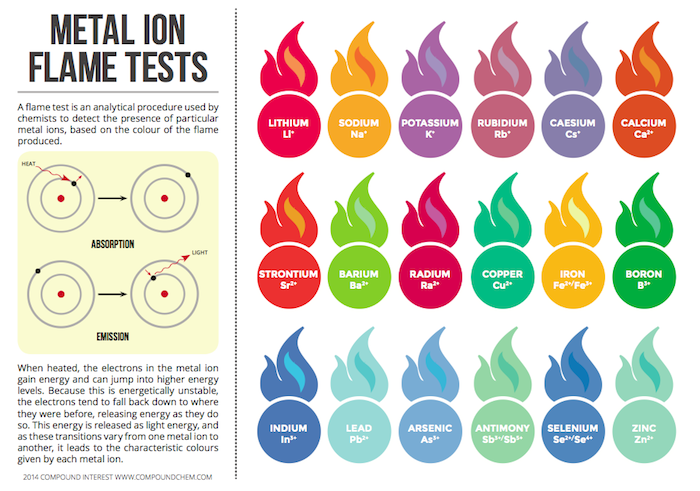
Back in your school days there was probably an experiment where you placed a small amount of a compound into a flame and observed it's colour. This is the flame test and depending on the colour observed it can tell you what elements are present.
Scientifically put, A flame test is an analytic procedure used in chemistry to detect the presence of certain elements, primarily metal ions, based on each element's characteristic emission spectrum. The colour of flames in general also depends on temperature.
The test involves introducing a sample of the element or compound to a hot, non-luminous flame, and observing the colour of the flame that results. The idea of the test is that sample atoms evaporate and since they are hot, they emit light when being in flame.
The flame test is relatively quick and simple to perform, and can be carried out with the basic equipment found in most chemistry laboratories. However, the range of elements positively detectable under these conditions is small, as the test relies on the subjective experience of the experimenter rather than any objective measurements. The test has difficulty detecting small concentrations of some elements, while too strong a result may be produced for certain others, which tends to cause fainter colours to not appear.
The table above from www.compoundchem.com shows the range of colours chemicals produce. These tests work better for some metal ions than other; in particular, those ions shown on the bottom row of the infographic are generally quite faint and hard to distinguish. Sodium’s flame colour is also very strong, and can easily mask the colours of other metal ions.
For more information and more pictures visit:-
http://www.compoundchem.com/2014/02/06/metal-ion-flame-test-colours-chart/
http://en.wikipedia.org/wiki/Flame_test
Scientifically put, A flame test is an analytic procedure used in chemistry to detect the presence of certain elements, primarily metal ions, based on each element's characteristic emission spectrum. The colour of flames in general also depends on temperature.
The test involves introducing a sample of the element or compound to a hot, non-luminous flame, and observing the colour of the flame that results. The idea of the test is that sample atoms evaporate and since they are hot, they emit light when being in flame.
The flame test is relatively quick and simple to perform, and can be carried out with the basic equipment found in most chemistry laboratories. However, the range of elements positively detectable under these conditions is small, as the test relies on the subjective experience of the experimenter rather than any objective measurements. The test has difficulty detecting small concentrations of some elements, while too strong a result may be produced for certain others, which tends to cause fainter colours to not appear.
![]() |
| Metal Ion Flame Tests-Click to enlarge |
For more information and more pictures visit:-
http://www.compoundchem.com/2014/02/06/metal-ion-flame-test-colours-chart/
http://en.wikipedia.org/wiki/Flame_test
Labels:
barium,
caesium,
calcium,
chemicals,
chemistry,
colour,
flame,
flame test,
ions,
laboratory,
lithium,
metals,
nature,
potassium,
rubidium,
sodium,
strontium
Friday, 15 August 2014
What is Brownian Motion?
The term 'Brownian motion' (or 'Brownian movement') refers
to the apparently random, haphazard movement of microscopic particles which are
suspended in a fluid - (a liquid or a gas) resulting from their collision with
the quick atoms or molecules in the gas or liquid.
Although a number of earlier
workers had observed this phenomenon, it was first described, and therefore
named after, the British botanist, Robert Brown, who was studying pollen grains
in 1827. Brown was an accomplished microscopist. It was he who, for example,
first identified the naked ovule in the gymnospermae; this is a difficult
observation to make even with a modern instrument.
Brown was attempting to further
his work on the mechanisms of fertilisation in flowering plants and was looking
at pollen. He believed that he would be
able to examine the pollen grains more effectively through his microscope if
they were suspended in water, a technique known as 'water-immersion'. To his
annoyance, he observed that the pollen grains danced continuously and erratically
around in the water, thus interfering with his observations. From these
observations he satisfied himself that the movement:
'arose neither from currents in
the fluid, nor from its gradual evaporation, but belonged to the particle
itself'.
Decades later, Albert Einstein
published a paper in 1905 that explained in precise detail how the motion that
Brown had observed was a result of the pollen being moved by individual water
molecules.
Despite all of this knowledge,
scientists continue to be fascinated by the origin and nature of Brownian
motion, which is still imperfectly understood. Articles concerning the
mathematics of Brownian motion continue to be published in contemporary physics
journals.
For more information visit:-
http://en.wikipedia.org/wiki/Brownian_motion
Friday, 1 August 2014
Strontium
Strontium has the atomic symbol Sr and the atomic number 38. It is a soft silver-white or yellowish (when oxidised) metallic element that is even more chemically reactive than its neighbour calcium.
Strontium is a grey, silvery metal that is softer than calcium and even more reactive toward water, with which it reacts on contact to produce strontium hydroxide and hydrogen gas. Finely powdered strontium metal ignites spontaneously in air at room temperature. Most of us will be familiar with strontium because strontium salts are commonly used in fireworks and flares to give a bright (some might say blinding) red color to flames.
Strontium is named after Strontian, a village in Scotland near which the mineral was first discovered in 1790. Strontium is the 15th most abundant element on Earth, but because of its reactivity, strontium is not found roaming freely in the wild: it occurs in minerals, mostly in strontianite and celestite.
Because its nucleus is very nearly the same size as that of calcium, the body mistakenly takes up strontium and incorporates it into bones and tooth enamel in the place of calcium. Surprisingly, this is not a health problem and in fact, it can provide a health benefit. For example, in clinical trials, the drug strontium ranelate was found to aid bone growth, increase bone density, and lessen vertebral, peripheral, and hip fractures in women.
The radioactive isotope, 90Sr, is common in radioactive fallout. Since radioactive fallout doesn't respect national borders, it falls upon all living things regardless of nationality or species, contaminating water, food and even the air that we all breathe. This isotope is quite dangerous and can cause a variety of leukæmias, bone cancer and other debilitating bone diseases. Perhaps ironically, Strontium-90 is also used to treat cancer.
For more information visit:-
http://www.theguardian.com/science/punctuated-equilibrium/2011/nov/18/1?guni=Article:in%20body%20link
http://en.wikipedia.org/wiki/Strontium
Strontium is a grey, silvery metal that is softer than calcium and even more reactive toward water, with which it reacts on contact to produce strontium hydroxide and hydrogen gas. Finely powdered strontium metal ignites spontaneously in air at room temperature. Most of us will be familiar with strontium because strontium salts are commonly used in fireworks and flares to give a bright (some might say blinding) red color to flames.
Strontium is named after Strontian, a village in Scotland near which the mineral was first discovered in 1790. Strontium is the 15th most abundant element on Earth, but because of its reactivity, strontium is not found roaming freely in the wild: it occurs in minerals, mostly in strontianite and celestite.
Because its nucleus is very nearly the same size as that of calcium, the body mistakenly takes up strontium and incorporates it into bones and tooth enamel in the place of calcium. Surprisingly, this is not a health problem and in fact, it can provide a health benefit. For example, in clinical trials, the drug strontium ranelate was found to aid bone growth, increase bone density, and lessen vertebral, peripheral, and hip fractures in women.
The radioactive isotope, 90Sr, is common in radioactive fallout. Since radioactive fallout doesn't respect national borders, it falls upon all living things regardless of nationality or species, contaminating water, food and even the air that we all breathe. This isotope is quite dangerous and can cause a variety of leukæmias, bone cancer and other debilitating bone diseases. Perhaps ironically, Strontium-90 is also used to treat cancer.
For more information visit:-
http://www.theguardian.com/science/punctuated-equilibrium/2011/nov/18/1?guni=Article:in%20body%20link
http://en.wikipedia.org/wiki/Strontium
Friday, 25 July 2014
A Solar Eclipse
A
solar eclipse is a type of eclipse that occurs when the Moon passes between the
Sun and Earth, and the Moon fully or partially blocks ("occults") the
Sun. This can happen only at new moon, when the Sun and the Moon are inconjunction as seen from Earth in an alignment referred to as syzygy. In a
total eclipse, the disk of the Sun is fully obscured by the Moon. In partial
and annular eclipses only part of the Sun is obscured.
If the Moon were in a perfectly circular orbit, a little closer to the Earth, and in the same orbital plane, there would be total solar eclipses every single month. However, the Moon's orbit is inclined (tilted) at more than 5 degrees to Earth's orbit around the Sun (see ecliptic) so its shadow at new moon usually misses Earth.
For more information visit:-
http://en.wikipedia.org/wiki/Solar_eclipse
http://h2g2.com/approved_entry/A143812
If the Moon were in a perfectly circular orbit, a little closer to the Earth, and in the same orbital plane, there would be total solar eclipses every single month. However, the Moon's orbit is inclined (tilted) at more than 5 degrees to Earth's orbit around the Sun (see ecliptic) so its shadow at new moon usually misses Earth.
Earth's orbit is called the ecliptic
plane as the Moon's orbit must cross this plane in order for an eclipse (both
solar as well as lunar) to occur. In addition, the Moon's actual orbit is
elliptical, often taking it far enough away from Earth that its apparent size
is not large enough to block the Sun totally. The orbital planes cross each
year at a line of nodes resulting in at least two, and up to five, solar
eclipses occurring each year; no more than two of which can be total
eclipses.
However, total solar eclipses are rare at any particular
location because totality exists only along a narrow path on Earth's surface
traced by the Moon's shadow or umbra.
Special eye protection or indirect viewing techniques must
be used when viewing a solar eclipse to avoid eye damage.
When at a spot from which a 'total eclipse' is
visible, an observer can see a number of exciting effects. One such effect occasionally seen is Baily's
Beads where a sequence of spots of light appears along the edge of the Moon.
This is caused by the sun shining through the valleys of the Moon's mountainous
regions
The following table shows the upcoming total solar eclipses for the next few years:
| Date | Region Visible |
|---|---|
| 20 March 2015 | North Atlantic regions, Faroe Islands and the North Pole |
| 9 March 2016 | Indonesia |
| 21 August 2017 | Parts of the mid- and west USA |
| 2 July 2019 | central Argentina, Chile, the Tuamotus (French Polynesia), parts of the South Pacific Ocean |
Friday, 11 July 2014
Xenon
Xenon is a noble gas (or inert gas) with the symbol, Xe, and the atomic number, 54. Xenon is a clear and colourless, and odorless gas that is quite heavy. Xenon gas is 4.5 times heavier than Earth's atmosphere (which consists of a mixture of a number of gaseous elements and compounds). This element's mass comes from its nucleus, which contains 54 protons and a varying (but similar) number of neutrons. Xenon has 17 naturally-occurring isotopes (the most for any element), eight of which are stable, the most for any element, except tin, which has ten.
Tiny amounts of two xenon isotopes, xenon-133 and xenon-135, leak from nuclear reprocessing and power plants, but are released in higher amounts after a nuclear explosion of accident, such as what occurred at Fukushima. Thus, monitoring xenon's isotopes can ensure compliance with international nuclear test-ban treaties and also to detect whether rogue nations are testing their own nuclear weapons.
Xenon was discovered in England by the Scottish chemist William Ramsay and English chemist Morris Travers on July 12, 1898, shortly after their discovery of the elements krypton and neon. They found xenon in the residue left over from evaporating components of liquid air.
During the 1930s, American engineer Harold Edgerton began exploring strobe light technology for high speed photography. This led him to the invention of the xenon flash lamp, in which light is generated by sending a brief electrical current through a tube filled with xenon gas. In 1934, Edgerton was able to generate flashes as brief as one microsecond with this method.
Xenon is obtained commercially as a byproduct of the separation of air into oxygen and nitrogen.
For more information visit:-
http://en.wikipedia.org/wiki/Xenon
http://www.theguardian.com/science/grrlscientist/2012/mar/16/1?guni=Article:in%20body%20link
![]() |
| Xenon discharge tube |
Tiny amounts of two xenon isotopes, xenon-133 and xenon-135, leak from nuclear reprocessing and power plants, but are released in higher amounts after a nuclear explosion of accident, such as what occurred at Fukushima. Thus, monitoring xenon's isotopes can ensure compliance with international nuclear test-ban treaties and also to detect whether rogue nations are testing their own nuclear weapons.
Xenon was discovered in England by the Scottish chemist William Ramsay and English chemist Morris Travers on July 12, 1898, shortly after their discovery of the elements krypton and neon. They found xenon in the residue left over from evaporating components of liquid air.
During the 1930s, American engineer Harold Edgerton began exploring strobe light technology for high speed photography. This led him to the invention of the xenon flash lamp, in which light is generated by sending a brief electrical current through a tube filled with xenon gas. In 1934, Edgerton was able to generate flashes as brief as one microsecond with this method.
Xenon as well as being used in flash lamps and arc lamps is
also used as a general anaesthetic. Although it is expensive, anesthesia machines that can deliver xenon are about to appear on the European market, because advances in recovery and recycling of xenon have made it economically viable.
The first excimer laser design used a xenon
dimer molecule (Xe2) as its lasing medium, and the earliest laser designs used
xenon flash lamps as pumps. Xenon is also being used to search for hypothetical
weakly interacting massive particles and as the propellant for ion thrusters in
spacecraft. It is also used in car headlights.
For more information visit:-
http://en.wikipedia.org/wiki/Xenon
http://www.theguardian.com/science/grrlscientist/2012/mar/16/1?guni=Article:in%20body%20link
Friday, 13 June 2014
Pyroclastic flows
Pyroclastic flows are high-density mixtures of hot, dry rock fragments and hot gases that move away from the vent that erupted them at high speeds. They may result from the explosive eruption of molten or solid rock fragments, or both. They may also result from the nonexplosive eruption of lava when parts of dome or a thick lava flow collapses down a steep slope. Most pyroclastic flows consist of two parts: a basal flow of coarse fragments that moves along the ground, and a turbulent cloud of ash that rises above the basal flow. Ash may fall from this cloud over a wide area downwind from the pyroclastic flow.
Pyroclastic flows can reach speeds moving away from a volcano of up to 700 km/h (450 mph). The gas can reach temperatures of about 1,000 °C (1,830 °F). Pyroclastic flows normally hug the ground and travel downhill, or spread laterally under gravity. Their speed depends upon the density of the current, the volcanic output rate, and the gradient of the slope. They are a common and devastating result of certain explosive volcanic eruptions.
A pyroclastic flow will destroy nearly everything in its path. With rock fragments ranging in size from ash to boulders traveling across the ground at speeds typically greater than 80 km per hour, pyroclastic flows knock down, shatter, bury or carry away nearly all objects and structures in their way. The extreme temperatures of rocks and gas inside pyroclastic flows can cause combustible material to burn, especially petroleum products, wood, vegetation, and houses.
Testimonial evidence from the 1883 eruption of Krakatoa, supported by experimental evidence, shows that pyroclastic flows can cross significant bodies of water. One flow reached the Sumatran coast as much as 48 km away.
The towns of Pompeii and Herculaneum, Italy, for example, were engulfed by pyroclastic surges in 79 AD with many lives lost.
For more information and some video clips visit:-
http://www.geo.mtu.edu/volcanoes/hazards/primer/pyro.html
http://en.wikipedia.org/wiki/Pyroclastic_flow
http://volcanoes.usgs.gov/hazards/pyroclasticflow/
Pyroclastic flows can reach speeds moving away from a volcano of up to 700 km/h (450 mph). The gas can reach temperatures of about 1,000 °C (1,830 °F). Pyroclastic flows normally hug the ground and travel downhill, or spread laterally under gravity. Their speed depends upon the density of the current, the volcanic output rate, and the gradient of the slope. They are a common and devastating result of certain explosive volcanic eruptions.
A pyroclastic flow will destroy nearly everything in its path. With rock fragments ranging in size from ash to boulders traveling across the ground at speeds typically greater than 80 km per hour, pyroclastic flows knock down, shatter, bury or carry away nearly all objects and structures in their way. The extreme temperatures of rocks and gas inside pyroclastic flows can cause combustible material to burn, especially petroleum products, wood, vegetation, and houses.
Testimonial evidence from the 1883 eruption of Krakatoa, supported by experimental evidence, shows that pyroclastic flows can cross significant bodies of water. One flow reached the Sumatran coast as much as 48 km away.
![]() |
| Pyroclastic flows sweep down the flanks of Mayon Volcano, Philippines, in 1984 |
The towns of Pompeii and Herculaneum, Italy, for example, were engulfed by pyroclastic surges in 79 AD with many lives lost.
![]() |
| "Garden of the Fugitives". Plaster casts of victims still in situ; many casts are in the Archaeological Museum of Naples. |
http://www.geo.mtu.edu/volcanoes/hazards/primer/pyro.html
http://en.wikipedia.org/wiki/Pyroclastic_flow
http://volcanoes.usgs.gov/hazards/pyroclasticflow/
Labels:
ash,
earth,
explosion,
Krakatoa,
mt st Helens,
nature,
Pompeii,
pumice,
pyroclastic flow,
rocks,
Sumatra,
vent,
volcano,
volcanoes
Friday, 6 June 2014
Antimony
Antimony is a chemical element with symbol Sb (from Latin: stibium) and atomic number 51. A lustrous grey metalloid, it is found in nature mainly as the sulfide mineral stibnite (Sb2S3).
Antimony compounds have been known since ancient times and were used for cosmetics. Nowadays Antimony is mainly used as its trioxide in making flame-proofing compounds and in certain alloys. The Egyptians had a hieroglyph for Antimony......
Antimony has no known biological role, but it is a potent toxin, with effects that are similar to arsenic poisoning. When ingested, antimony strongly bonds to sulfur-containing enzymes, thereby inactivating them. Antimony is even more toxic when inhaled as the gas, stibine, SbH3. Poisoning by antimony ingestion manifests as gastric distress, and large doses cause vomiting, and kidney and liver damage, followed by death a few days later.
It was thought that Mozart was a victim of poisoning at the hand of rival composer, Antonio Salieri, although historians don't give this hypothesis any credence. It is far more likely that Mozart was poisoned by his doctors. A heavy drinker, Mozart was known to also overindulge in the popular hangover cure of the day that contains antimony, tartar emetic, C4H4KO7Sb, which was provided by his doctors.
For some time, China has been the largest producer of antimony and its compounds, with most production coming from the Xikuangshan Mine in Hunan. The industrial methods to produce antimony are roasting and subsequent carbothermal reduction or direct reduction of stibnite with iron.
For more information visit:-
http://www.theguardian.com/science/grrlscientist/2012/feb/24/1?guni=Article:in%20body%20link
http://en.wikipedia.org/wiki/Antimony
Antimony compounds have been known since ancient times and were used for cosmetics. Nowadays Antimony is mainly used as its trioxide in making flame-proofing compounds and in certain alloys. The Egyptians had a hieroglyph for Antimony......
Antimony has no known biological role, but it is a potent toxin, with effects that are similar to arsenic poisoning. When ingested, antimony strongly bonds to sulfur-containing enzymes, thereby inactivating them. Antimony is even more toxic when inhaled as the gas, stibine, SbH3. Poisoning by antimony ingestion manifests as gastric distress, and large doses cause vomiting, and kidney and liver damage, followed by death a few days later.
It was thought that Mozart was a victim of poisoning at the hand of rival composer, Antonio Salieri, although historians don't give this hypothesis any credence. It is far more likely that Mozart was poisoned by his doctors. A heavy drinker, Mozart was known to also overindulge in the popular hangover cure of the day that contains antimony, tartar emetic, C4H4KO7Sb, which was provided by his doctors.
![]() |
| Stibnite |
For some time, China has been the largest producer of antimony and its compounds, with most production coming from the Xikuangshan Mine in Hunan. The industrial methods to produce antimony are roasting and subsequent carbothermal reduction or direct reduction of stibnite with iron.
For more information visit:-
http://www.theguardian.com/science/grrlscientist/2012/feb/24/1?guni=Article:in%20body%20link
http://en.wikipedia.org/wiki/Antimony
Labels:
alloy,
antimony,
chemistry,
cosmetic,
element,
Mozart,
nature,
Periodic table,
poison,
sb,
stibnite,
sulphur
Friday, 16 May 2014
Magnesium
Magnesium has the atomic number 12 and is an alkaline earth metal with the symbol Mg. It is a common element, the eighth-most-abundant element in the Earth's crust and ninth in the known universe as a whole.
Magnesium is the fourth-most-common element in the Earth as
a whole (behind iron, oxygen and silicon), making up 13% of the planet's mass
and a large fraction of the planet's mantle.
The free element (metal) is not found naturally on Earth, as it is highly reactive (though once produced, it is coated in a thin layer of oxide (see passivation), which partly masks this reactivity). The free metal burns with a characteristic brilliant-white light, making it a useful ingredient in flares. You probably remember burning Magnesium Ribbon in school. Some of the light that burning magnesium produces is in the ultraviolet range. Just as ultraviolet light will burn your skin, it will also burn the retinas of your eyes if they are not protected, hence not looking directly at the light or using suitable safety eyewear.
Since magnesium is less dense than aluminium, these alloys are prized for their relative lightness and strength.
Magnesium has many uses, but most of us are familiar with aluminium-magnesium alloys, which are often found in cell phones and other electronic gadgets that must be strong yet light weight. Gardeners and tropical fish hobbyists are also very familiar with magnesium, since plants need it to grow (a magnesium deficiency is indicated by yellow leaves). Animals need small amounts of magnesium to support proper bodily functions too.
For more information visit:-
http://en.wikipedia.org/wiki/Magnesium
http://www.theguardian.com/science/punctuated-equilibrium/2011/may/13/1?guni=Article:in%20body%20link
The free element (metal) is not found naturally on Earth, as it is highly reactive (though once produced, it is coated in a thin layer of oxide (see passivation), which partly masks this reactivity). The free metal burns with a characteristic brilliant-white light, making it a useful ingredient in flares. You probably remember burning Magnesium Ribbon in school. Some of the light that burning magnesium produces is in the ultraviolet range. Just as ultraviolet light will burn your skin, it will also burn the retinas of your eyes if they are not protected, hence not looking directly at the light or using suitable safety eyewear.
Since magnesium is less dense than aluminium, these alloys are prized for their relative lightness and strength.
Magnesium has many uses, but most of us are familiar with aluminium-magnesium alloys, which are often found in cell phones and other electronic gadgets that must be strong yet light weight. Gardeners and tropical fish hobbyists are also very familiar with magnesium, since plants need it to grow (a magnesium deficiency is indicated by yellow leaves). Animals need small amounts of magnesium to support proper bodily functions too.
For more information visit:-
http://en.wikipedia.org/wiki/Magnesium
http://www.theguardian.com/science/punctuated-equilibrium/2011/may/13/1?guni=Article:in%20body%20link
Friday, 7 February 2014
Back in 1984
On this day in 1984....
The first untethered spacewalk was made by American Bruce McCandless II on February 7, 1984, during Challenger mission STS-41-B, utilising the Manned Maneuvering Unit. He was subsequently joined by Robert L. Stewart during the 5 hour 55 minute spacewalk. Such a self-contained spacewalk was first attempted by Eugene Cernan in 1966 on Gemini 9A, but Cernan could not reach the maneuvering unit without tiring.
The Manned Maneuvering Unit (MMU) is an astronaut propulsion unit that was used by NASA on three Space Shuttle missions in 1984. The MMU allowed the astronauts to perform untethered EVA spacewalks at a distance from the shuttle. The MMU was used in practice to retrieve a pair of faulty communications satellites, Westar VI and Palapa B2. Following the third mission the unit was retired from use. A smaller successor, the Simplified Aid for EVA Rescue (SAFER), was first flown in 1994, and is intended for emergency use only.
While orbiting around the Earth at a speed of 17,500 miles per hour, McCandless floated from the cargo bay into outer space, 150 nautical miles above Earth, an experience he described as "a heck of a big leap." Mission specialist Robert L. Stewart, an Army lieutenant colonel, also flew the MMU on shuttle mission 41-B.
While flying the MMU, these men were in a journalistic phrase of the time "human satellites." They checked out the equipment, maneuvered within the cargo bay, flew away from and back to the orbiter, performed docking exercises, recharged the MMU nitrogen tanks, and collected engineering data. The MMU, according to Martin Marietta's post mission report, "performed as expected and no anomalies were reported.
Gaseous nitrogen was used as the propellant for the MMU. Two aluminium tanks with Kevlar wrappings contained 5.9 kilograms of nitrogen each, enough propellant for a six-hour EVA depending on the amount of manoeuvring done. Typical MMU delta-v (velocity change) capability was about 80 feet per second (24.4 m/s).
There were 24 nozzle thrusters placed at different locations on the MMU. To operate the propulsion system, the astronaut used his fingertips to manipulate hand controllers at the ends of the MMU's two arms. The right controller produced rotational acceleration for roll, pitch, and yaw. The left controller produced translational acceleration for moving forward-back, up-down, and left-right. Coordination of the two controllers produced intricate movements in the unit. Once a desired orientation was achieved, the astronaut could engage an automatic attitude-hold function that maintained the inertial attitude of the unit in flight. This freed both hands for work.
Yet the MMU has not been used since 1984. There are several reasons for this. First, most extravehicular activities were effective without use of the MMU. Tethers, safety grips, hand bars, and other restraints allowed astronauts to work in the open cargo bay. Furthermore, the maneuverability of the Space Shuttle itself and the utility of the shuttle's robotic manipulator arm had proved capable of rescuing satellites-the primary function for which the MMU had been designed.
For more information visit:-
http://history.nasa.gov/SP-4219/Chapter13.html
http://en.wikipedia.org/wiki/Manned_Maneuvering_Unit
The first untethered spacewalk was made by American Bruce McCandless II on February 7, 1984, during Challenger mission STS-41-B, utilising the Manned Maneuvering Unit. He was subsequently joined by Robert L. Stewart during the 5 hour 55 minute spacewalk. Such a self-contained spacewalk was first attempted by Eugene Cernan in 1966 on Gemini 9A, but Cernan could not reach the maneuvering unit without tiring.
![]() |
| Untethered U.S. astronaut Bruce McCandless uses a manned maneuvering unit. photo taken by Robert "Hoot" Gibson |
The Manned Maneuvering Unit (MMU) is an astronaut propulsion unit that was used by NASA on three Space Shuttle missions in 1984. The MMU allowed the astronauts to perform untethered EVA spacewalks at a distance from the shuttle. The MMU was used in practice to retrieve a pair of faulty communications satellites, Westar VI and Palapa B2. Following the third mission the unit was retired from use. A smaller successor, the Simplified Aid for EVA Rescue (SAFER), was first flown in 1994, and is intended for emergency use only.
While orbiting around the Earth at a speed of 17,500 miles per hour, McCandless floated from the cargo bay into outer space, 150 nautical miles above Earth, an experience he described as "a heck of a big leap." Mission specialist Robert L. Stewart, an Army lieutenant colonel, also flew the MMU on shuttle mission 41-B.
While flying the MMU, these men were in a journalistic phrase of the time "human satellites." They checked out the equipment, maneuvered within the cargo bay, flew away from and back to the orbiter, performed docking exercises, recharged the MMU nitrogen tanks, and collected engineering data. The MMU, according to Martin Marietta's post mission report, "performed as expected and no anomalies were reported.
Gaseous nitrogen was used as the propellant for the MMU. Two aluminium tanks with Kevlar wrappings contained 5.9 kilograms of nitrogen each, enough propellant for a six-hour EVA depending on the amount of manoeuvring done. Typical MMU delta-v (velocity change) capability was about 80 feet per second (24.4 m/s).
There were 24 nozzle thrusters placed at different locations on the MMU. To operate the propulsion system, the astronaut used his fingertips to manipulate hand controllers at the ends of the MMU's two arms. The right controller produced rotational acceleration for roll, pitch, and yaw. The left controller produced translational acceleration for moving forward-back, up-down, and left-right. Coordination of the two controllers produced intricate movements in the unit. Once a desired orientation was achieved, the astronaut could engage an automatic attitude-hold function that maintained the inertial attitude of the unit in flight. This freed both hands for work.
Yet the MMU has not been used since 1984. There are several reasons for this. First, most extravehicular activities were effective without use of the MMU. Tethers, safety grips, hand bars, and other restraints allowed astronauts to work in the open cargo bay. Furthermore, the maneuverability of the Space Shuttle itself and the utility of the shuttle's robotic manipulator arm had proved capable of rescuing satellites-the primary function for which the MMU had been designed.
For more information visit:-
http://history.nasa.gov/SP-4219/Chapter13.html
http://en.wikipedia.org/wiki/Manned_Maneuvering_Unit
Friday, 31 January 2014
A word in your shell like.....
Ever put a sea shell to your ear and listened to the sea? You've probably done it when you were young but have you ever wondered what it was you were listening to?
There are a number of ideas about what actually makes the 'wave' sound when you put a shell to your ear. One suggestion is that you're hearing the echo of your heart beating and the blood rushing around your body, in particular the blood vessels in your ear. But that's simply not true, because if you ran about a lot before putting the shell to your ear there would be a definite difference in the intensity of the 'waves' you hear. Why? Well, exercise of any sort increases you heart rate hence the waves would be louder, or more frequent, in time with the faster beating of your heart.
Another explanation is that the wave sound is created by air flowing through the shell, and this may have a little to do with it as the sound becomes louder when you lift the shell slightly away from your ear. However, if you put your ear to a shell in a soundproof room (where there is no ambient noise, but air is still cycling around the shell), the wave sound is noticeably missing. So, it must have something to do with outside noise.
When you hold up a shell to your ear, you block out direct noise to your ear. However, the shell captures any atmospheric noise, which then resonates inside the shell. This resonating chamber needs some noise to work with, but otherwise works regardless of whether your surroundings are noisy or not. However, it stands to reason that the louder the environment around you, the louder the sound inside the shell - as more sound waves are 'bouncing', for want of a better term, around the chamber. These frequencies are garbled by the walls of the chamber and become like radio static to us, as our ear is not finely tuned enough to distinguish every nuance. Thus you get that shhhhhh sound, like waves breaking on the sea shore.
The rushing sound that one hears is in fact the noise of the surrounding environment, resonating within the cavity of the shell. The same effect can be produced with any resonant cavity, such as an empty cup or even by simply cupping one's hand over one's ear. The similarity of the noise produced by the resonator to that of the oceans is due to the resemblance between ocean movements and airflow.
Noise from outside the shell also can change the intensity of the sound you hear inside the shell. You can look at the shell as a resonating chamber. When sound from outside enters the shell, it bounces around, thus creating an audible noise. So, the louder the environment you are in, the louder the ocean-like sound will be.
For more information visit:-
http://en.wikipedia.org/wiki/Seashell_resonance
http://h2g2.com/approved_entry/A46714665#conversations
There are a number of ideas about what actually makes the 'wave' sound when you put a shell to your ear. One suggestion is that you're hearing the echo of your heart beating and the blood rushing around your body, in particular the blood vessels in your ear. But that's simply not true, because if you ran about a lot before putting the shell to your ear there would be a definite difference in the intensity of the 'waves' you hear. Why? Well, exercise of any sort increases you heart rate hence the waves would be louder, or more frequent, in time with the faster beating of your heart.
Another explanation is that the wave sound is created by air flowing through the shell, and this may have a little to do with it as the sound becomes louder when you lift the shell slightly away from your ear. However, if you put your ear to a shell in a soundproof room (where there is no ambient noise, but air is still cycling around the shell), the wave sound is noticeably missing. So, it must have something to do with outside noise.
When you hold up a shell to your ear, you block out direct noise to your ear. However, the shell captures any atmospheric noise, which then resonates inside the shell. This resonating chamber needs some noise to work with, but otherwise works regardless of whether your surroundings are noisy or not. However, it stands to reason that the louder the environment around you, the louder the sound inside the shell - as more sound waves are 'bouncing', for want of a better term, around the chamber. These frequencies are garbled by the walls of the chamber and become like radio static to us, as our ear is not finely tuned enough to distinguish every nuance. Thus you get that shhhhhh sound, like waves breaking on the sea shore.
The rushing sound that one hears is in fact the noise of the surrounding environment, resonating within the cavity of the shell. The same effect can be produced with any resonant cavity, such as an empty cup or even by simply cupping one's hand over one's ear. The similarity of the noise produced by the resonator to that of the oceans is due to the resemblance between ocean movements and airflow.
Noise from outside the shell also can change the intensity of the sound you hear inside the shell. You can look at the shell as a resonating chamber. When sound from outside enters the shell, it bounces around, thus creating an audible noise. So, the louder the environment you are in, the louder the ocean-like sound will be.
For more information visit:-
http://en.wikipedia.org/wiki/Seashell_resonance
http://h2g2.com/approved_entry/A46714665#conversations
Friday, 24 January 2014
Cobalt!
Cobalt is a chemical element with symbol Co and atomic number 27. Like nickel, cobalt in the Earth's crust is found only in chemically combined form, save for small deposits found in alloys of natural meteoric iron. The free element, produced by reductive smelting, is a hard, lustrous, silver-grey metal.
Cobalt-based blue pigments (cobalt blue) have been used since ancient times for jewellery and paints, and to tint glass blue, but the colour was later thought by alchemists to be due to the known metal bismuth. Miners had long used the name kobold ore (German for goblin ore) for some of the blue-pigment producing minerals; they were named because they were poor in known metals, and gave poisonous arsenic-containing fumes upon smelting. In 1735, such ores were found to be reducible to a new metal (the first discovered since ancient times), and this was ultimately named for the kobold.
Cobalt is primarily used as the metal, in the preparation of magnetic, wear-resistant and high-strength alloys. Its compounds cobalt silicate and cobalt(II) aluminate (CoAl2O4, cobalt blue) give a distinctive deep blue color to glass, ceramics, inks, paints and varnishes.
Free cobalt (the native metal) is not found in on Earth, except as recently delivered in meteoric iron (see below). Though the element is of medium abundance, natural compounds of cobalt are numerous. Small amounts of cobalt compounds are found in most rocks, soil, plants, and animals.
Cobalt forms many useful alloys. It is alloyed with iron, nickel, and other metals to form Alnico, an alloy with exceptional magnetic strength. Cobalt, chromium, and tungsten may be alloyed to form Stellite, which is used for high-temperature, high-speed cutting tools and dies. Cobalt is used in magnet steels and stainless steels. It is used in electroplating because of its hardness and resistance to oxidation. Cobalt salts are used to impart permanent brilliant blue colours to glass, pottery, enamels, tiles, and porcelain. Cobalt is used to make Sevre's and Thenard's blue. A cobalt chloride solution is used to make a sympathetic ink. Cobalt is essential for nutrition in many animals. Cobalt-60 is an important gamma source, tracer, and radiotherapeutic agent.
For more information visit:-
http://en.wikipedia.org/wiki/Cobalt
http://www.theguardian.com/science/punctuated-equilibrium/2011/sep/02/1?guni=Article:in%20body%20link
Cobalt-based blue pigments (cobalt blue) have been used since ancient times for jewellery and paints, and to tint glass blue, but the colour was later thought by alchemists to be due to the known metal bismuth. Miners had long used the name kobold ore (German for goblin ore) for some of the blue-pigment producing minerals; they were named because they were poor in known metals, and gave poisonous arsenic-containing fumes upon smelting. In 1735, such ores were found to be reducible to a new metal (the first discovered since ancient times), and this was ultimately named for the kobold.
Cobalt is primarily used as the metal, in the preparation of magnetic, wear-resistant and high-strength alloys. Its compounds cobalt silicate and cobalt(II) aluminate (CoAl2O4, cobalt blue) give a distinctive deep blue color to glass, ceramics, inks, paints and varnishes.
![]() |
| Cobalt blue tinted glass |
Free cobalt (the native metal) is not found in on Earth, except as recently delivered in meteoric iron (see below). Though the element is of medium abundance, natural compounds of cobalt are numerous. Small amounts of cobalt compounds are found in most rocks, soil, plants, and animals.
Cobalt forms many useful alloys. It is alloyed with iron, nickel, and other metals to form Alnico, an alloy with exceptional magnetic strength. Cobalt, chromium, and tungsten may be alloyed to form Stellite, which is used for high-temperature, high-speed cutting tools and dies. Cobalt is used in magnet steels and stainless steels. It is used in electroplating because of its hardness and resistance to oxidation. Cobalt salts are used to impart permanent brilliant blue colours to glass, pottery, enamels, tiles, and porcelain. Cobalt is used to make Sevre's and Thenard's blue. A cobalt chloride solution is used to make a sympathetic ink. Cobalt is essential for nutrition in many animals. Cobalt-60 is an important gamma source, tracer, and radiotherapeutic agent.
For more information visit:-
http://en.wikipedia.org/wiki/Cobalt
http://www.theguardian.com/science/punctuated-equilibrium/2011/sep/02/1?guni=Article:in%20body%20link
Labels:
bismuth,
Co,
cobalt,
earth,
elements,
goblin ore,
kobold,
nature,
Periodic table,
stellite
Friday, 17 January 2014
18 years ago today - the Kobe Earthquake - Japan
Eighteen years ago to the day the Kobe earthquake shook Japan. The Great Hanshin earthquake occurred on Tuesday, January 17, 1995, at 05:46 JST in the southern part of Japan. It measured 6.8 on the moment magnitude scale (USGS), and Mj7.3 (adjusted from 7.2) on JMA magnitude scale. The tremors lasted for approximately 20 seconds. The focus of the earthquake was located 16 km beneath its epicentre, on the northern end of Awaji Island, 20 km away from the city of Kobe.
An earthquake is a quick release of energy in the Earth’s crust, creating seismic waves. The Earth’s crust is made up of tectonic plates. The tectonic plate edges move against each other all the time, but sometimes they get stuck. When this happens energy builds up to a point of rupture and the seismic energy is released.
The depth of an earthquake is very important. If it is shallow it will cause much more structural damage to buildings than a deep one. On the Earth’s surface an earthquake will manifest itself by shaking buildings and the ground moving. If an earthquake occurs at sea it can move and displace the seabed. The water on the seabed of an ocean or large lake is normally very still, with waves only occurring near the surface, but if the seabed moves it can cause a deep and harmful that can result in a tsunami as happened in Japan in 2011.
In the Kobe earthquake, approximately 6,434 people lost their lives (final estimate as of December 22, 2005); about 4,600 of them were from Kobe.
The Great Hanshin earthquake belonged to a third type, called an "inland shallow earthquake". Earthquakes of this type occur along active faults. Even at lower magnitudes, they can be very destructive because they often occur near populated areas and because their hypocenters are located less than 20 km below the surface. The Great Hanshin earthquake began north of the island of Awaji, which lies just south of Kobe. It spread toward the southwest along the Nojima Fault on Awaji and toward the northeast along the Suma and Suwayama faults, which run through the center of Kobe. Observations of deformations in these faults suggest that the area was subjected to east-west compression, which is consistent with previously known crustal movements.
The earthquake proved to be a major wake-up call for Japanese disaster prevention authorities. Japan installed rubber blocks under bridges to absorb the shock and rebuilt buildings further apart to prevent them from falling like dominoes. The national government changed its disaster response policies in the wake of the earthquake, and its response to the 2004 Chūetsu earthquake was significantly faster and more effective. The earthquake and tsunami of 2011 though was much larger than anything that had been seen before causing almost 16,000 deaths. There was little that could be done to stop such a force of nature.
A large amount of data was collected after the tsunami of 2011 that provides "the possibility to model in great detail what happened during the rupture of an earthquake." The effect of this data is expected to be felt across other disciplines as well, and this disaster will "provide unprecedented information about how buildings hold up under long periods of shaking – and thus how to build them better.
Earthquakes can strike at any time and are unpredictable in their nature. Fortunately these types of earthquake are not that common. Early warning systems are in place for many countries around earthquake hot spots so as to try and give people time to get to safety.
See also:-
http://en.wikipedia.org/wiki/Japan_tsunami
http://en.wikipedia.org/wiki/Kobe_earthquake
http://www.bbc.co.uk/learningzone/clips/a-geological-explanation-of-earthquakes/6736.html
An earthquake is a quick release of energy in the Earth’s crust, creating seismic waves. The Earth’s crust is made up of tectonic plates. The tectonic plate edges move against each other all the time, but sometimes they get stuck. When this happens energy builds up to a point of rupture and the seismic energy is released.
The depth of an earthquake is very important. If it is shallow it will cause much more structural damage to buildings than a deep one. On the Earth’s surface an earthquake will manifest itself by shaking buildings and the ground moving. If an earthquake occurs at sea it can move and displace the seabed. The water on the seabed of an ocean or large lake is normally very still, with waves only occurring near the surface, but if the seabed moves it can cause a deep and harmful that can result in a tsunami as happened in Japan in 2011.
In the Kobe earthquake, approximately 6,434 people lost their lives (final estimate as of December 22, 2005); about 4,600 of them were from Kobe.
![]() |
| A section of the Nojima Fault |
The Great Hanshin earthquake belonged to a third type, called an "inland shallow earthquake". Earthquakes of this type occur along active faults. Even at lower magnitudes, they can be very destructive because they often occur near populated areas and because their hypocenters are located less than 20 km below the surface. The Great Hanshin earthquake began north of the island of Awaji, which lies just south of Kobe. It spread toward the southwest along the Nojima Fault on Awaji and toward the northeast along the Suma and Suwayama faults, which run through the center of Kobe. Observations of deformations in these faults suggest that the area was subjected to east-west compression, which is consistent with previously known crustal movements.
The earthquake proved to be a major wake-up call for Japanese disaster prevention authorities. Japan installed rubber blocks under bridges to absorb the shock and rebuilt buildings further apart to prevent them from falling like dominoes. The national government changed its disaster response policies in the wake of the earthquake, and its response to the 2004 Chūetsu earthquake was significantly faster and more effective. The earthquake and tsunami of 2011 though was much larger than anything that had been seen before causing almost 16,000 deaths. There was little that could be done to stop such a force of nature.
A large amount of data was collected after the tsunami of 2011 that provides "the possibility to model in great detail what happened during the rupture of an earthquake." The effect of this data is expected to be felt across other disciplines as well, and this disaster will "provide unprecedented information about how buildings hold up under long periods of shaking – and thus how to build them better.
Earthquakes can strike at any time and are unpredictable in their nature. Fortunately these types of earthquake are not that common. Early warning systems are in place for many countries around earthquake hot spots so as to try and give people time to get to safety.
See also:-
http://en.wikipedia.org/wiki/Japan_tsunami
http://en.wikipedia.org/wiki/Kobe_earthquake
http://www.bbc.co.uk/learningzone/clips/a-geological-explanation-of-earthquakes/6736.html
Subscribe to:
Posts (Atom)