Total Lab Supplies - Everything for your laboratory

Total Lab Supplies - Everything for your laboratory
Our Head Office in St Helens
Showing posts with label sodium. Show all posts

Tuesday, 22 August 2017

On this day in science history: the first U.S. patent for a liquid soap was issued

In 1865, the first U.S. patent for a liquid soap was issued to William Sheppard of New York City (No. 49,561). The patent described his "discovery that by the addition of comparatively small quantities of common soap to a large quantity of spirits of ammonia or hartshorn is thickened to the consistency of molasses, and a liquid soap is obtained of superior detergent qualities." The proportions given were to dissolve one pound of common soap in water or steam, and then add 100-lbs of ammonia such that the liquid thickens to the consistency of molasses. The product was expected to be useful for both domestic and manufacturing purposes. (Hartshorn is an ancient name for an aqueous solution of ammonia).

Decorative soaps, by Phanton at English Wikipedia (Transferred from en.wikipedia to Commons.) [Public domain], via Wikimedia Commons
So, how does soap clean?

Action of soap

When used for cleaning, soap allows insoluble particles to become soluble in water, so they can then be rinsed away. For example: oil/fat is insoluble in water, but when a couple of drops of dish soap are added to the mixture, the oil/fat dissolves in the water. The insoluble oil/fat molecules become associated inside micelles, tiny spheres formed from soap molecules with polar hydrophilic (water-attracting) groups on the outside and encasing a lipophilic (fat-attracting) pocket, which shields the oil/fat molecules from the water making it soluble. Anything that is soluble will be washed away with the water.

Effect of the alkali

The type of alkali metal used determines the kind of soap product. Sodium soaps, prepared from sodium hydroxide, are firm, whereas potassium soaps, derived from potassium hydroxide, are softer or often liquid. Historically, potassium hydroxide was extracted from the ashes of bracken or other plants. Lithium soaps also tend to be hard—these are used exclusively in greases.

Effects of fats

Soaps are derivatives of fatty acids. Traditionally they have been made from triglycerides (oils and fats). Triglyceride is the chemical name for the triesters of fatty acids and glycerin. Tallow, i.e., rendered beef fat, is the most available triglyceride from animals. Its saponified product is called sodium tallowate. Typical vegetable oils used in soap making are palm oil, coconut oil, olive oil, and laurel oil. Each species offers quite different fatty acid content and hence, results in soaps of distinct feel. The seed oils give softer but milder soaps. Soap made from pure olive oil is sometimes called Castile soap or Marseille soap, and is reputed for being extra mild. The term "Castile" is also sometimes applied to soaps from a mixture of oils, but a high percentage of olive oil.

For more information visit:-


Tuesday, 18 April 2017

Mission control: salty diet makes you hungry, not thirsty

We've all heard it: eating salty foods makes you thirstier. But what sounds like good nutritional advice turns out to be an old-wives' tale. In a study carried out during a simulated mission to Mars, an international group of scientists has found exactly the opposite to be true. "Cosmonauts" who ate more salt retained more water, weren't as thirsty, and needed more energy.

Salt shaker, by Dubravko Sorić SoraZG on Flickr [CC BY 2.0 (http://creativecommons.org/licenses/by/2.0)], via Wikimedia Commons
For some reason, no one had ever carried out a long-term study to determine the relationship between the amount of salt in a person's diet and his drinking habits. Scientists have known that increasing a person's salt intake stimulates the production of more urine - it has simply been assumed that the extra fluid comes from drinking. Not so fast! say researchers from the German Aerospace Center (DLR), the Max Delbrück Center for Molecular Medicine (MDC), Vanderbilt University and colleagues around the world. Recently they took advantage of a simulated mission to Mars to put the old adage to the test. Their conclusions appear in two papers in the current issue of The Journal of Clinical Investigation.

What does salt have to do with Mars? Nothing, really, except that on a long space voyage conserving every drop of water might be crucial. A connection between salt intake and drinking could affect your calculations - you wouldn't want an interplanetary traveler to die because he liked an occasional pinch of salt on his food. The real interest in the simulation, however, was that it provided an environment in which every aspect of a person's nutrition, water consumption, and salt intake could be controlled and measured.

The studies were carried out by Natalia Rakova (MD, PhD) of the Charité and MDC and her colleagues. The subjects were two groups of 10 male volunteers sealed into a mock spaceship for two simulated flights to Mars. The first group was examined for 105 days; the second over 205 days. They had identical diets except that over periods lasting several weeks, they were given three different levels of salt in their food.

The results confirmed that eating more salt led to a higher salt content in urine - no surprise there. Nor was there any surprise in a correlation between amounts of salt and overall quantity of urine. But the increase wasn't due to more drinking - in fact, a salty diet caused the subjects to drink less. Salt was triggering a mechanism to conserve water in the kidneys.

Before the study, the prevailing hypothesis had been that the charged sodium and chloride ions in salt grabbed onto water molecules and dragged them into the urine. The new results showed something different: salt stayed in the urine, while water moved back into the kidney and body. This was completely puzzling to Prof. Jens Titze, MD of the University of Erlangen and Vanderbilt University Medical Center and his colleagues. "What alternative driving force could make water move back?" Titze asked.

Experiments in mice hinted that urea might be involved. This substance is formed in muscles and the liver as a way of shedding nitrogen. In mice, urea was accumulating in the kidney, where it counteracts the water-drawing force of sodium and chloride. But synthesizing urea takes a lot of energy, which explains why mice on a high-salt diet were eating more. Higher salt didn't increase their thirst, but it did make them hungrier. Also the human "cosmonauts" receiving a salty diet complained about being hungry.

The project revises scientists' view of the function of urea in our bodies. "It's not solely a waste product, as has been assumed," Prof. Friedrich C. Luft, MD of the Charité and MDC says. "Instead, it turns out to be a very important osmolyte - a compound that binds to water and helps transport it. Its function is to keep water in when our bodies get rid of salt. Nature has apparently found a way to conserve water that would otherwise be carried away into the urine by salt."

The new findings change the way scientists have thought about the process by which the body achieves water homeostasis - maintaining a proper amount and balance. That must happen whether a body is being sent to Mars or not. "We now have to see this process as a concerted activity of the liver, muscle and kidney," says Jens Titze.

"While we didn't directly address blood pressure and other aspects of the cardiovascular system, it's also clear that their functions are tightly connected to water homeostasis and energy metabolism."

For more information visit:-


Friday, 26 September 2014

Flamin' hot colours!

Back in your school days there was probably an experiment where you placed a small amount of a compound into a flame and observed it's colour.  This is the flame test and depending on the colour observed it can tell you what elements are present.


Scientifically put, A flame test is an analytic procedure used in chemistry to detect the presence of certain elements, primarily metal ions, based on each element's characteristic emission spectrum. The colour of flames in general also depends on temperature.

The test involves introducing a sample of the element or compound to a hot, non-luminous flame, and observing the colour of the flame that results. The idea of the test is that sample atoms evaporate and since they are hot, they emit light when being in flame.

The flame test is relatively quick and simple to perform, and can be carried out with the basic equipment found in most chemistry laboratories. However, the range of elements positively detectable under these conditions is small, as the test relies on the subjective experience of the experimenter rather than any objective measurements. The test has difficulty detecting small concentrations of some elements, while too strong a result may be produced for certain others, which tends to cause fainter colours to not appear.


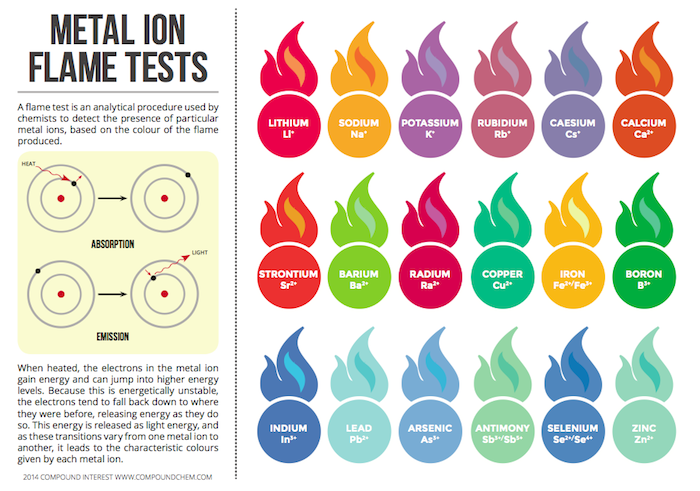
Metal Ion Flame Tests-Click to enlarge
The table above from www.compoundchem.com shows the range of colours chemicals produce.  These tests work better for some metal ions than other; in particular, those ions shown on the bottom row of the infographic are generally quite faint and hard to distinguish. Sodium’s flame colour is also very strong, and can easily mask the colours of other metal ions.

For more information and more pictures visit:-
http://www.compoundchem.com/2014/02/06/metal-ion-flame-test-colours-chart/
http://en.wikipedia.org/wiki/Flame_test

Friday, 19 September 2014

Sodium Hypochlorite


Sodium hypochlorite is a chemical compound with the formula NaClO. It is composed of a sodium cation (Na+) and a hypochlorite anion (ClO−); it may also be viewed as the sodium salt of hypochlorous acid. When dissolved in water it is commonly known as bleach or liquid bleach, and is frequently used as a disinfectant or a bleaching agent.


Click to enlarge


Potassium hypochlorite was first produced in 1789 by Claude Louis Berthollet in his laboratory on the quay Javel in Paris, France, by passing chlorine gas through a solution of potash lye. The resulting liquid, known as "Eau de Javel" ("Javel water"), was a weak solution of potassium hypochlorite. Antoine Labarraque replaced potash lye by the cheaper soda lye, thus obtaining sodium hypochlorite (Eau de Labarraque).

Various methods have been used since to produce this but the modern method, the Hooker process, is the only one producing this in any bulk capacity.

Sodium Hypochlorite has many uses as can be seen above:-


In bleach cleaning products and to remove stains.
In Swimming pools as a disinfectant.
In Antibacterial sprays
To neutralise nerve agents
To reduce skin damage - using very low concentrations.

Sodium Hypochlorite although used in household bleach is not the only component.  There is often Sodium Hydroxide and Calcium Hypochlorite amongst others.  it must be remembered not to mix household cleaning products as some may contain hydrochloric acid. If these are mixed with bleach, it can react with sodium hypochlorite, and form toxic chlorine gas

Visit the following for more information:-
http://www.compoundchem.com/2014/07/06/sodium-hypochlorite-bleach-swimming-pools-cleaning-products/
http://en.wikipedia.org/wiki/Sodium_hypochlorite