Total Lab Supplies - Everything for your laboratory

Total Lab Supplies - Everything for your laboratory
Our Head Office in St Helens
Showing posts with label metals. Show all posts

Tuesday, 1 August 2017

On this day in science history: oxygen was identified

In 1774, Joseph Priestley, British Presbyterian minister and chemist, identified a gas which he called "dephlogisticated air" - later known as oxygen. Priestley found that mercury heated in air became coated with "red rust of mercury," which, when heated separately, was converted back to mercury with "air" given off. Studying this "air" given off, he observed that candles burned very brightly in it. Also, a mouse in a sealed vessel with it could breathe it much longer than ordinary air. A strong believer in the phlogiston theory, Priestley considered it to be "air from which the phlogiston had been removed." Further experiments convinced him that ordinary air is one fifth dephlogisticated air, the rest considered by him to be phlogiston.

Joseph Priestley, by Charles Turner [Public domain], via Wikimedia Commons
However, oxygen was in fact first discovered earlier, by Swedish pharmacist Carl Wilhelm Scheele. He had produced oxygen gas by heating mercuric oxide and various nitrates in 1771–2. Scheele called the gas "fire air" because it was the only known supporter of combustion, and wrote an account of this discovery in a manuscript he titled Treatise on Air and Fire, which he sent to his publisher in 1775. That document was published in 1777. 

Because Priestly published his findings first, he is usually given priority in the discovery.

The French chemist Antoine Laurent Lavoisier later claimed to have discovered the new substance independently. Priestley visited Lavoisier in October 1774 and told him about his experiment and how he liberated the new gas. Scheele also posted a letter to Lavoisier on September 30, 1774 that described his discovery of the previously unknown substance, but Lavoisier never acknowledged receiving it (a copy of the letter was found in Scheele's belongings after his death). Long before this, one of the first known experiments on the relationship between combustion and air was conducted by the 2nd century BCE Greek writer on mechanics, Philo of Byzantium. In his work Pneumatica, Philo observed that inverting a vessel over a burning candle and surrounding the vessel's neck with water resulted in some water rising into the neck. Philo incorrectly surmised that parts of the air in the vessel were converted into the classical element fire and thus were able to escape through pores in the glass. Many centuries later Leonardo da Vinci built on Philo's work by observing that a portion of air is consumed during combustion and respiration.

In the late 17th century, Robert Boyle proved that air is necessary for combustion. English chemist John Mayow (1641–1679) refined this work by showing that fire requires only a part of air that he called spiritus nitroaereus. In one experiment, he found that placing either a mouse or a lit candle in a closed container over water caused the water to rise and replace one-fourteenth of the air's volume before extinguishing the subjects. From this he surmised that nitroaereus is consumed in both respiration and combustion.

Mayow observed that antimony increased in weight when heated, and inferred that the nitroaereus must have combined with it. He also thought that the lungs separate nitroaereus from air and pass it into the blood and that animal heat and muscle movement result from the reaction of nitroaereus with certain substances in the body. Accounts of these and other experiments and ideas were published in 1668 in his work Tractatus duo in the tract "De respiratione".

Robert Hooke, Ole Borch, Mikhail Lomonosov, and Pierre Bayen all produced oxygen in experiments in the 17th and the 18th century but none of them recognized it as a chemical element. This may have been in part due to the prevalence of the philosophy of combustion and corrosion called the phlogiston theory, which was then the favored explanation of those processes.

Established in 1667 by the German alchemist J. J. Becher, and modified by the chemist Georg Ernst Stahl by 1731, phlogiston theory stated that all combustible materials were made of two parts. One part, called phlogiston, was given off when the substance containing it was burned, while the dephlogisticated part was thought to be its true form, or calx.

Highly combustible materials that leave little residue, such as wood or coal, were thought to be made mostly of phlogiston; non-combustible substances that corrode, such as iron, contained very little. Air did not play a role in phlogiston theory, nor were any initial quantitative experiments conducted to test the idea; instead, it was based on observations of what happens when something burns, that most common objects appear to become lighter and seem to lose something in the process. The fact that a substance like wood gains overall weight in burning was hidden by the buoyancy of the gaseous combustion products.

This theory, while it was on the right track, was unfortunately set up backwards. Rather than combustion or corrosion occurring as a result of the decomposition of phlogiston compounds into their base elements with the phlogiston being lost to the air, it is in fact the result of oxygen from the air combining with the base elements to produce oxides. Indeed, one of the first clues that the phlogiston theory was incorrect was that metals gain weight in rusting (when they were supposedly losing phlogiston).

For more information visit:-


Tuesday, 25 August 2015

How we know what lies at Earth’s core

Humans have been all over the Earth. We've conquered the lands, flown through the air and dived to the deepest trenches in the ocean. We've even been to the Moon. But we've never been to the planet's core.

We haven't even come close. The central point of the Earth is over 6,000km down, and even the outermost part of the core is nearly 3,000 km below our feet. The deepest hole we've ever created on the surface is the Kola Superdeep Borehole in Russia, and it only goes down a pitiful 12.3 km.

All the familiar events on Earth also happen close to the surface. The lava that spews from volcanoes first melts just a few hundred kilometres down. Even diamonds, which need extreme heat and pressure to form, originate in rocks less than 500km deep.

What's down below all that is shrouded in mystery. It seems unfathomable. And yet, we know a surprising amount about the core. We even have some idea about how it formed billions of years ago – all without a single physical sample. This is how the core was revealed.

One good way to start is to think about the mass of the Earth, says Simon Redfern of the University of Cambridge in the UK.

We can estimate Earth's mass by observing the effect of the planet's gravity on objects at the surface. It turns out that the mass of the Earth is 5.9 sextillion tonnes: that's 59 followed by 20 zeroes.

There's no sign of anything that massive at the surface.

"The density of the material at the Earth's surface is much lower than the 
average density of the whole Earth, so that tells us there's something much denser," says Redfern. "That's the first thing."

Essentially, most of the Earth's mass must be located towards the centre of the planet. The next step is to ask which heavy materials make up the core.

The answer here is that it's almost certainly made mostly of iron. The core is thought to be around 80% iron, though the exact figure is up for debate.

The main evidence for this is the huge amount of iron in the universe around us. It is one of the ten most common elements in our galaxy, and is frequently found in meteorites.

Given how much there is of it, iron is much less common at the surface of the Earth than we might expect. So the theory is that when Earth formed 4.5 billion years ago, a lot of iron worked its way down to the core.

That's where most of the mass is, and it's where most of the iron must be too. Iron is a relatively dense element under normal conditions, and under the extreme pressure at the Earth's core it would be crushed to an even higher density, so an iron core would account for all that missing mass.

But wait a minute. How did that iron get down there in the first place?
The iron must have somehow gravitated – literally – towards the centre of the Earth. But it's not immediately obvious how.

Most of the rest of the Earth is made up of rocks called silicates, and molten iron struggles to travel through them. Rather like how water on a greasy surface forms droplets, the iron clings to itself in little reservoirs, refusing to spread out and flow.

A possible solution was discovered in 2013 by Wendy Mao of Stanford University in California and her colleagues. They wondered what happened when the iron and silicate were both exposed to extreme pressure, as happens deep in the earth.

By pinching both substances extremely tightly using diamonds, they were able to force molten iron through silicate.

"The pressure actually changes the properties of how iron interacts with the silicate," says Mao. "At higher pressures a 'melt network' is formed."

This suggests the iron was gradually squeezed down through the rocks of the Earth over millions of years, until it reached the core.

At this point you might be wondering how we know the size of the core. What makes scientists think it begins 3000km down? There's a one-word answer: seismology.

When an earthquake happens, it sends shockwaves throughout the planet. Seismologists record these vibrations. It's as if we hit one side of the planet with a gigantic hammer, and listened on the other side for the noise.

"There was a Chilean earthquake in the 1960s that generated a huge amount of data," says Redfern. "All the seismic stations dotted all over the Earth recorded the arrival of the tremors from that earthquake."

Depending on the route those vibrations take, they pass through different bits of the Earth, and this affects how they "sound" at the other end.

Early in the history of seismology, it was realised that some vibrations were going missing. These "S-waves" were expected to show up on one side of the Earth after originating on the other, but there was no sign of them.

The reason for this was simple. S-waves can only reverberate through solid material, and can't make it through liquid.

They must have come up against something molten in the centre of the Earth. By mapping the S-waves' paths, it turned out that rocks became liquid around 3000km down.

That suggested the entire core was molten. But seismology had another surprise in store.

In the 1930s, a Danish seismologist named Inge Lehmann noticed that another kind of waves, called P-waves, unexpectedly travelled through the core and could be detected on the other side of the planet.

She came up with a surprising explanation: the core is divided into two layers. The "inner" core, which begins around 5,000km down, was actually solid. It was only the "outer" core above it that was molten.

Lehmann's idea was eventually confirmed in 1970, when more sensitive seismographs found that P-waves really were travelling through the core and, in some cases, being deflected off it at angles. Sure enough, they still ended up on the other side of the planet.

It's not just earthquakes that sent useful shockwaves through the Earth. In fact, seismology owes a lot of its success to the development of nuclear weapons.

A nuclear detonation also creates waves in the ground, so nations use seismology to listen out for weapons tests. During the Cold War this was seen as hugely important, so seismologists like Lehmann got a lot of encouragement.

Rival countries found out about each other's nuclear capabilities and along the way we learned more and more about the core of the Earth. Seismology is still used to detect nuclear detonations today.

We can now draw a rough picture of the Earth's structure. There is a molten outer core, which begins roughly halfway to the planet's centre, and within it is the solid inner core with a diameter of 1,220 km.

But there is a lot more to try and tease out, especially about the inner core. For starters, how hot is it?

This turns out to be quite tricky to determine, and baffled scientists until quite recently, says Lidunka Vočadlo of University College London in the UK. We can't put a thermometer down there, so the only solution is to create the correct crushing pressure in the lab.

In 2013 a team of French researchers produced the best estimate to date. They subjected pure iron to pressures a little over half that at the core, and extrapolated from there. They concluded that the melting point of pure iron at core temperatures is around 6,230 °C. The presence of other materials would bring the core's melting point down a bit, to around 6,000 °C. But that's still as hot as the surface of the Sun.

A bit like a toasty jacket potato, Earth's core has stayed warm thanks to heat retained from the formation of the planet. It also gets heat from friction as denser materials shift around, as well as from the decay of radioactive elements. Still, it is cooling by about 100 °C every billion years.

Knowing the temperature is useful, because it affects the speed at which vibrations travel through the core. That is handy, because there is something odd about the vibrations.

P-waves travel unexpectedly slowly as they go through the inner core – slower than they would if it was made of pure iron.

"Wave velocities that the seismologists measure in earthquakes and whatnot are significantly lower [than] anything that we measure in an experiment or calculate on a computer," says Vočadlo. "Nobody as yet knows why that is."

That suggests there is another material in the mix.

It could well be another metal, called nickel. But scientists have estimated how seismic waves would travel through an iron-nickel alloy, and it doesn't quite fit the readings either.

Vočadlo and her colleagues are now considering whether there might be other elements down there too, like sulphur and silicon. So far, no-one has been able to come up with a theory for the inner core's composition that satisfies everyone. It's a Cinderella problem: no shoe will quite fit.

Vočadlo is trying to simulate the materials of the inner core on a computer. She hopes to find a combination of materials, temperatures and pressures that would slow down the seismic waves by the right amount.

She says the secret might lie in the fact that the inner core is nearly at its melting point. As a result, the precise properties of the materials might be different from what they would be if they were safely solid.

That could explain why the seismic waves pass through more slowly than expected.

"If that's the real effect, we would be able to reconcile the mineral physics results with the seismological results," says Vocadlo. "People have not been able to do that yet."

There are plenty of riddles about the earth's core still to solve. But without ever digging to those impossible depths, scientists have figured out a great deal about what is happening thousands of kilometres beneath us.

Those hidden processes in the depths of the Earth are crucial to our daily lives, in a way many of us don't realise.

Earth has a powerful magnetic field, and that is all thanks to the partially molten core. The constant movement of molten iron creates an electrical current inside the planet, and that in turn generates a magnetic field that reaches far out into space.

The magnetic field helps to shield us from harmful solar radiation. If the core of the Earth wasn't the way it is, there would be no magnetic field, and we would have all sorts of problems to contend with.

None of us will ever set eyes on the core, but it's good to know it's there.

For more information visit:-


Friday, 26 September 2014

Flamin' hot colours!

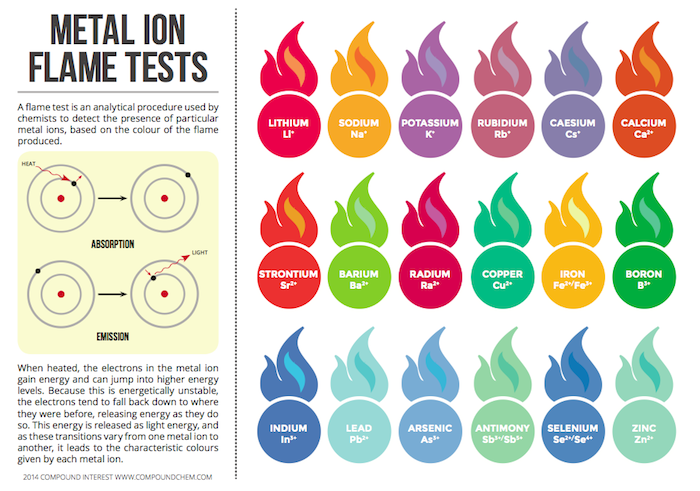
Back in your school days there was probably an experiment where you placed a small amount of a compound into a flame and observed it's colour.  This is the flame test and depending on the colour observed it can tell you what elements are present.


Scientifically put, A flame test is an analytic procedure used in chemistry to detect the presence of certain elements, primarily metal ions, based on each element's characteristic emission spectrum. The colour of flames in general also depends on temperature.

The test involves introducing a sample of the element or compound to a hot, non-luminous flame, and observing the colour of the flame that results. The idea of the test is that sample atoms evaporate and since they are hot, they emit light when being in flame.

The flame test is relatively quick and simple to perform, and can be carried out with the basic equipment found in most chemistry laboratories. However, the range of elements positively detectable under these conditions is small, as the test relies on the subjective experience of the experimenter rather than any objective measurements. The test has difficulty detecting small concentrations of some elements, while too strong a result may be produced for certain others, which tends to cause fainter colours to not appear.


Metal Ion Flame Tests-Click to enlarge
The table above from www.compoundchem.com shows the range of colours chemicals produce.  These tests work better for some metal ions than other; in particular, those ions shown on the bottom row of the infographic are generally quite faint and hard to distinguish. Sodium’s flame colour is also very strong, and can easily mask the colours of other metal ions.

For more information and more pictures visit:-
http://www.compoundchem.com/2014/02/06/metal-ion-flame-test-colours-chart/
http://en.wikipedia.org/wiki/Flame_test

Friday, 25 May 2012

Properties of Metals


Metal
Specific Gravity
Specific Heat
Melting Point deg. C
Coefficient of Linear Expansion
Atomic Weight
Atomic Volume
Symbol
Aluminum
2.70
0.218
657
0.0000231
27.1
10.04
Al
Antimony
6.62
0.051
630
0.0000105
120.2
18.1
Sb
Arsenic
5.72
0.081
450
0.0000055
75.0
13.1
As
Barium
3.78
0.068
850
-
137.4
36.3
Ba
Bismuth
9.80
0.030
266
0.000014
208.0
21.2
Bi
Cadmium
8.64
0.056
322
0.000027
112.4
13.0
Cd
Caesium
1.87
0.048
26
-
132.8
71.0
Cs
Calcium
1.55
0.152
780
-
40.1
25.8
Ca
Cerium
6.68
0.045
623
-
140.2
21.0
Ce
Chromium
6.80
0.120
1550
-
52.0
7.6
Cr
Cobalt
8.50
0.103
1490
0.0000123
59.0
6.9
Co
Columbium
12.70
0.071
1950
-
93.5
7.4
Cb
Copper
8.93
0.093
1084
0.0000167
63.6
7.1
Cu
Gallium
5.90
0.079
80
-
69.9
11.8
Ga
Glucinum
1.93
0.506
-
-
9.1
4.7
Gl
Gold
19.32
0.031
1065
0.0000136
197.2
10.2
Au
Indium
7.42
0.057
155
0.0000417
114.8
15.5
In
Iridium
22.42
0.033
2300
0.0000065
193.1
8.6
Ir
Iron
7.86
0.116
1505
0.0000116
55.9
7.1
Fe
Lanthanum
6.1
0.045
810
-
139.0
22.8
La
Lead
11.35
0.031
327
0.000027
207.1
18.2
Pb
Lithium
0.54
0.941
186
-
7.0
13.0
Li
Magnesium
1.74
0.250
650
0.0000269
24.3
14.0
Mg
Manganese
8.00
0.120
1207
-
55.0
6.9
Mn
Mercury
13.60
0.032
39
0.0000610
200.0
14.7
Hg
Molybdenum
9.0
0.072
2500
-
96.0
10.7
Mo
Nickel
8.80
0.108
1451
0.0000127
58.7
6.7
Ni
Osmium
22.48
0.031
2500
0.0000065
190.9
8.5
Os
Palladium
11.50
0.059
1535
0.0000117
106.7
9.3
Pd
Platinum
21.4
0.032
1755
0.0000089
195.2
9.1
Pt
Potassium
0.86
0.170
62
0.0000841
39.1
45.5
K
Rhodium
12.10
0.058
1970
0.0000085
103.9
8.5
Rh
Rubidium
1.53
0.079
38
-
85.5
55.9
Rb
Ruthenium
12.26
0.061
1950
0.0000096
101.7
8.3
Ru
Silver
10.53
0.056
961
0.0000192
107.9
10.2
Ag
Sodium
0.97
0.290
97
0.0000710
23.0
23.7
Na
Strontium
2.54
-
800
-
87.6
34.5
Sr
Tantalum
16.6
0.033
2910
0.0000097
181.0
10.9
Ta
Tellurium
6.25
0.049
452
0.0000067
127.5
20.4
Te
Thallium
11.85
0.033
303
0.0000302
204.0
17.2
Tl
Thorium
11.00
0.028
1690
-
232.4
21.1
Th
Tin
7.29
0.055
232
0.0000203
119.0
16.3
Sn
Titanium
4.87
0.130
1800
-
48.1
9.9
Ti
Tungsten
19.10
0.034
3100
-
184.0
9.6
W
Uranium
18.70
0.028
-
-
238.5
12.7
U
Vanadium
5.50
0.115
1680
-
51.1
9.3
V
Yttrium
3.80
-
-
-
89.0
23.4
Yt
Zinc
7.15
0.094
419
0.0000274
65.4
9.1
Zn
Zirconium
6.40
0.066
1500
-
90.6
14.1
Zr
* Atomic volume = Atomic weight ÷Specific Gravity. By atomic volume is meant the volume in cubic centimeters which a combining weight in grammes of the element occupies. In textbooks and papers, the density is usually given instead of the specific volume, which is its reciprocal, i.e. to find the atomic volume, the atomic weight is divided by the density.