Total Lab Supplies - Everything for your laboratory

Total Lab Supplies - Everything for your laboratory
Our Head Office in St Helens
Showing posts with label ions. Show all posts

Tuesday, 18 April 2017

Mission control: salty diet makes you hungry, not thirsty

We've all heard it: eating salty foods makes you thirstier. But what sounds like good nutritional advice turns out to be an old-wives' tale. In a study carried out during a simulated mission to Mars, an international group of scientists has found exactly the opposite to be true. "Cosmonauts" who ate more salt retained more water, weren't as thirsty, and needed more energy.

Salt shaker, by Dubravko Sorić SoraZG on Flickr [CC BY 2.0 (http://creativecommons.org/licenses/by/2.0)], via Wikimedia Commons
For some reason, no one had ever carried out a long-term study to determine the relationship between the amount of salt in a person's diet and his drinking habits. Scientists have known that increasing a person's salt intake stimulates the production of more urine - it has simply been assumed that the extra fluid comes from drinking. Not so fast! say researchers from the German Aerospace Center (DLR), the Max Delbrück Center for Molecular Medicine (MDC), Vanderbilt University and colleagues around the world. Recently they took advantage of a simulated mission to Mars to put the old adage to the test. Their conclusions appear in two papers in the current issue of The Journal of Clinical Investigation.

What does salt have to do with Mars? Nothing, really, except that on a long space voyage conserving every drop of water might be crucial. A connection between salt intake and drinking could affect your calculations - you wouldn't want an interplanetary traveler to die because he liked an occasional pinch of salt on his food. The real interest in the simulation, however, was that it provided an environment in which every aspect of a person's nutrition, water consumption, and salt intake could be controlled and measured.

The studies were carried out by Natalia Rakova (MD, PhD) of the Charité and MDC and her colleagues. The subjects were two groups of 10 male volunteers sealed into a mock spaceship for two simulated flights to Mars. The first group was examined for 105 days; the second over 205 days. They had identical diets except that over periods lasting several weeks, they were given three different levels of salt in their food.

The results confirmed that eating more salt led to a higher salt content in urine - no surprise there. Nor was there any surprise in a correlation between amounts of salt and overall quantity of urine. But the increase wasn't due to more drinking - in fact, a salty diet caused the subjects to drink less. Salt was triggering a mechanism to conserve water in the kidneys.

Before the study, the prevailing hypothesis had been that the charged sodium and chloride ions in salt grabbed onto water molecules and dragged them into the urine. The new results showed something different: salt stayed in the urine, while water moved back into the kidney and body. This was completely puzzling to Prof. Jens Titze, MD of the University of Erlangen and Vanderbilt University Medical Center and his colleagues. "What alternative driving force could make water move back?" Titze asked.

Experiments in mice hinted that urea might be involved. This substance is formed in muscles and the liver as a way of shedding nitrogen. In mice, urea was accumulating in the kidney, where it counteracts the water-drawing force of sodium and chloride. But synthesizing urea takes a lot of energy, which explains why mice on a high-salt diet were eating more. Higher salt didn't increase their thirst, but it did make them hungrier. Also the human "cosmonauts" receiving a salty diet complained about being hungry.

The project revises scientists' view of the function of urea in our bodies. "It's not solely a waste product, as has been assumed," Prof. Friedrich C. Luft, MD of the Charité and MDC says. "Instead, it turns out to be a very important osmolyte - a compound that binds to water and helps transport it. Its function is to keep water in when our bodies get rid of salt. Nature has apparently found a way to conserve water that would otherwise be carried away into the urine by salt."

The new findings change the way scientists have thought about the process by which the body achieves water homeostasis - maintaining a proper amount and balance. That must happen whether a body is being sent to Mars or not. "We now have to see this process as a concerted activity of the liver, muscle and kidney," says Jens Titze.

"While we didn't directly address blood pressure and other aspects of the cardiovascular system, it's also clear that their functions are tightly connected to water homeostasis and energy metabolism."

For more information visit:-


Friday, 26 September 2014

Flamin' hot colours!

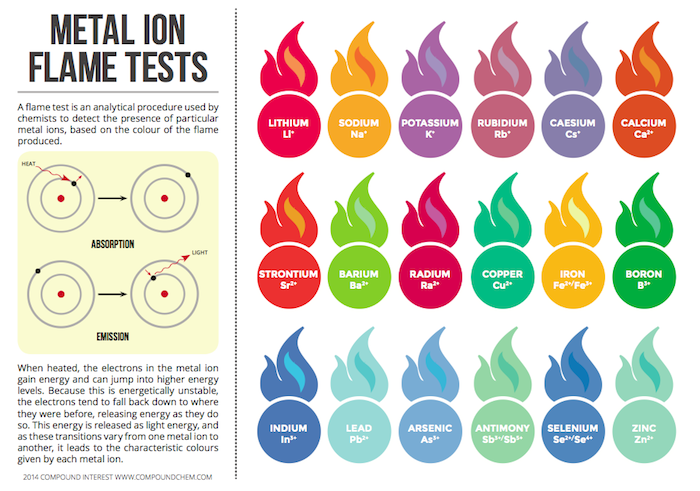
Back in your school days there was probably an experiment where you placed a small amount of a compound into a flame and observed it's colour.  This is the flame test and depending on the colour observed it can tell you what elements are present.


Scientifically put, A flame test is an analytic procedure used in chemistry to detect the presence of certain elements, primarily metal ions, based on each element's characteristic emission spectrum. The colour of flames in general also depends on temperature.

The test involves introducing a sample of the element or compound to a hot, non-luminous flame, and observing the colour of the flame that results. The idea of the test is that sample atoms evaporate and since they are hot, they emit light when being in flame.

The flame test is relatively quick and simple to perform, and can be carried out with the basic equipment found in most chemistry laboratories. However, the range of elements positively detectable under these conditions is small, as the test relies on the subjective experience of the experimenter rather than any objective measurements. The test has difficulty detecting small concentrations of some elements, while too strong a result may be produced for certain others, which tends to cause fainter colours to not appear.


Metal Ion Flame Tests-Click to enlarge
The table above from www.compoundchem.com shows the range of colours chemicals produce.  These tests work better for some metal ions than other; in particular, those ions shown on the bottom row of the infographic are generally quite faint and hard to distinguish. Sodium’s flame colour is also very strong, and can easily mask the colours of other metal ions.

For more information and more pictures visit:-
http://www.compoundchem.com/2014/02/06/metal-ion-flame-test-colours-chart/
http://en.wikipedia.org/wiki/Flame_test

Friday, 9 August 2013

Distilled or Deionised Water? What's the difference?

Many laboratory staff ask for purified water and use the terms distilled and deionised interchangeably.  However the actual products are different and are produced differently.

Most commonly now deionised water is supplied when people ask for purified water.

Purified water is water that is mechanically filtered or processed to be cleaned for consumption. Distilled water and deionised (DI) water have been the most common forms of purified water, but water can also be purified by other processes including Reverse osmosis, carbon filtration, microfiltration, ultrafiltration, ultraviolet oxidation, or electrodialysis.

Distilled water is produced by a process of distillation and has an electrical conductivity of not more than 11 µS/cm and total dissolved solids of less than 10 mg/litre.  Distillation involves boiling the water and then condensing the vapour into a clean container, leaving solid contaminants behind. Distillation produces very pure water. A white or yellowish mineral scale is left in the distillation apparatus, which requires regular cleaning. Distillation alone does not guarantee the absence of bacteria in drinking water unless containers are also sterilized. For many procedures more economical alternatives are available such as deionised water and, is used in place of distilled water.

Double distillation - Double-distilled water is prepared by double distillation of water. Historically, it was the de facto standard for highly purified laboratory water for biochemistry and, by the method of trace analysis until combination methods of purification became widespread.

A water still (Stuart Merit W4000)


Deionisation - Deionised water, also known as demineralised water, is water that has had its mineral ions removed, such as cations like sodium, calcium, iron, and copper, and anions such as chloride and sulfate. Deionisation is a chemical process that uses specially manufactured ion-exchange resins which exchange hydrogen ion and hydroxide ion for dissolved minerals, which then recombine to form water. Because the majority of water impurities are dissolved salts, deionisation produces a high purity water that is generally similar to distilled water, and this process is quick and without scale buildup. However, deionisation does not significantly remove uncharged organic molecules, viruses or bacteria, except by incidental trapping in the resin. Specially made strong base anion resins can remove Gram-negative bacteria. Deionisation can be done continuously and inexpensively using electrodeionisation.

Purite Labwater Deioniser


Outside of the laboratory deionised or distilled water is used to top us lead-acid car batteries although many units are now sealed.  Purified water is also used in freshwater and marine aquariums. As it doesn't contain impurities such as copper and chlorine, it helps to keep fish free from diseases and avoids the build-up of algae on aquarium plants due to its lack of phosphate and silicate.

Deionised water is available from P&R Labpak in small through to large containers!  We can also supply equipment if you need to make your own.

To read more on water:-
https://en.wikipedia.org/wiki/Deionised_water
http://www.prlabs.co.uk/lab-supplies.php?N=ANALYST-40-WITH-BOOST-PUMP&Id=40933
http://www.prlabs.co.uk/lab-supplies.php?N=STILL-MERIT-MODEL-W4000&Id=45943