Total Lab Supplies - Everything for your laboratory

Total Lab Supplies - Everything for your laboratory
Our Head Office in St Helens
Showing posts with label flame test. Show all posts

Friday, 20 March 2015

Copper Sulphate

Copper (II) sulfate, also known as cupric sulfate or copper sulphate, is the chemical compound with the chemical formula CuSO4. This salt exists as a series of compounds that differ in their degree of hydration. The anhydrous form is a pale green or grey-white powder, whereas the pentahydrate (CuSO4·5H2O), the most commonly encountered salt, is bright blue.
Copper Sulphate Crystals
Copper sulphate is normally produced industrially by treating copper metal with hot concentrated sulphuric acid.  Laboratories generally purchase their own - eg here.

At 650 °C (1,202 °F), copper (II) sulphate decomposes into copper (II) oxide (CuO) and sulphur trioxide (SO3).  Its blue colour is due to water of hydration. When heated in an open flame the crystals are dehydrated and turn greyish-white.
 
Copper sulphate pentahydrate is a fungicide.  Mixed with lime it is called Bordeaux mixture and used to control fungus on grapes, melons, and other berries.  Its use as a herbicide is not agricultural, but instead for control of invasive aquatic plants and the roots of plants near pipes containing water. It is used in swimming pools as an algicide. A dilute solution of copper sulphate is used to treat aquarium fish for parasitic infections.
 
Several chemical tests utilize copper sulphate. It is used in Fehling's solution and Benedict's solution to test for reducing sugars, which reduce the soluble blue copper(II) sulphate to insoluble red copper(I) oxide. Copper(II) sulphate is also used in the Biuret reagent to test for proteins.

Copper sulphate is a commonly included chemical in children's chemistry sets and is often used to grow crystals as can be seen here.

The chemical is also used in flame tests - again which can be seen here.

In 2008, the artist Roger Hiorns filled an abandoned waterproofed council flat in London with 75,000 litres of copper sulphate solution. The solution was left to crystallize for several weeks before the flat was drained, leaving crystal-covered walls, floors and ceilings. The work is titled Seizure.


For more information visit:-
http://en.wikipedia.org/wiki/Copper(II)_sulphate
http://prlabpak.blogspot.co.uk/2014/09/flamin-hot-colours.html
http://prlabpak.blogspot.co.uk/2012/09/making-chemical-garden.html

Friday, 26 September 2014

Flamin' hot colours!

Back in your school days there was probably an experiment where you placed a small amount of a compound into a flame and observed it's colour.  This is the flame test and depending on the colour observed it can tell you what elements are present.


Scientifically put, A flame test is an analytic procedure used in chemistry to detect the presence of certain elements, primarily metal ions, based on each element's characteristic emission spectrum. The colour of flames in general also depends on temperature.

The test involves introducing a sample of the element or compound to a hot, non-luminous flame, and observing the colour of the flame that results. The idea of the test is that sample atoms evaporate and since they are hot, they emit light when being in flame.

The flame test is relatively quick and simple to perform, and can be carried out with the basic equipment found in most chemistry laboratories. However, the range of elements positively detectable under these conditions is small, as the test relies on the subjective experience of the experimenter rather than any objective measurements. The test has difficulty detecting small concentrations of some elements, while too strong a result may be produced for certain others, which tends to cause fainter colours to not appear.


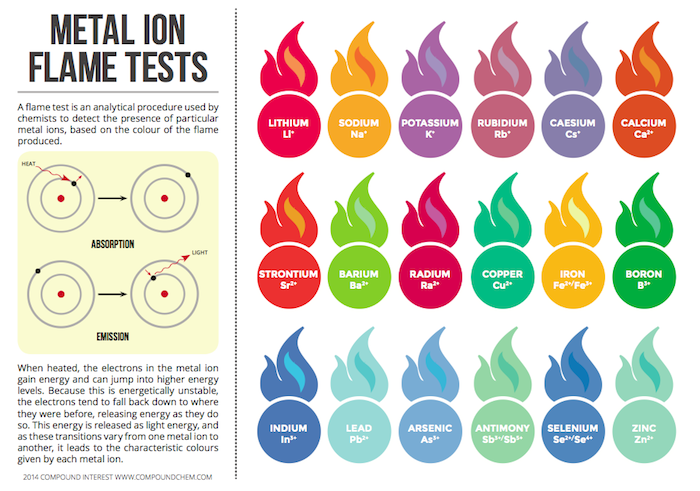
Metal Ion Flame Tests-Click to enlarge
The table above from www.compoundchem.com shows the range of colours chemicals produce.  These tests work better for some metal ions than other; in particular, those ions shown on the bottom row of the infographic are generally quite faint and hard to distinguish. Sodium’s flame colour is also very strong, and can easily mask the colours of other metal ions.

For more information and more pictures visit:-
http://www.compoundchem.com/2014/02/06/metal-ion-flame-test-colours-chart/
http://en.wikipedia.org/wiki/Flame_test

Friday, 18 October 2013

The Bunsen Burner

Robert Wilhelm Bunsen (1811-1899), a German chemist and inventor is credited with inventing the Bunsen burner, a gas burner used in scientific laboratories.

With Gustav R. Kirchhoff they pioneered work with spectrum analysis, inventing the spectroscope to detect chemicals by the colours they give off when burning. Using this instrument, they discovered the elements caesium (1860) and rubidium (1861).

Bunsen improved the efficiency of blast furnaces after observing gases escaping from them and devising a method of gas analysis. His other inventions include the ice calorimeter, a filter pump, a zinc-carbon electric cell, and the magnesium light. With Sir Henry Roscoe he did important work in the field of photochemistry.

The Bunsen Burner is used for heating chemicals, boiling water, sterilising small objects, preparing microscopic slides, bending glass tubing, and many other purposes.

The Bunsen burner consists of a straight metal tube, about five inches (13 cm) long, fastened to a stand. The bottom is connected by rubber tubing to a source of illuminating gas. Adjustable openings at the base of the burner admit air. The mixture of gas and air produces a very hot flame. Nozzles of various types can be fitted to the top of the burner to control the flame's shape.

Bunsen burner flames depend on air flow in the throat holes (on the burner side, not the needle valve for gas flow): 1. air hole closed (safety flame used for lighting or default), 2. air hole slightly open, 3. air hole half open, 4. hole almost fully open (roaring blue flame).


Flame Test

This is a method of detecting the presence of certain metals by the colours they give off in the flame of a Bunsen burner. A platinum or nichrome wire is dipped in a powder or solution of the compound to be tested, and the compound is then placed in the flame. Barium gives a green flame; calcium, orange; caesium, blue; copper, greenish blue; potassium, violet.

If more than one metal is present, the test is unreliable as one colour obscures another. Except in rough, preliminary analyses, the flame test is little used by chemists. There are more precise methods of identifying elements.

Other burners based on the same principle exist. The most important alternatives to the Bunsen burner are:

Teclu burner
The lower part of its tube is conical, with a round screw nut below its base. The gap, set by the distance between the nut and the end of the tube, regulates the influx of the air in a way similar to the open slots of the Bunsen burner. The Teclu burner provides better mixing of air and fuel and can achieve higher flame temperatures than the Bunsen burner.

Teclu Burner
Meker burner
The lower part of its tube has more openings with larger total cross-section, admitting more air and facilitating better mixing of air and gas. The tube is wider and its top is covered with a wire grid. The grid separates the flame into an array of smaller flames with a common external envelope, and also prevents flashback to the bottom of the tube, which is a risk at high air-to-fuel ratios and limits the maximum rate of air intake in a conventional Bunsen burner. Flame temperatures of up to 1100–1200 °C (2000–2200 °F) are achievable if properly used. The flame also burns without noise, unlike the Bunsen or Teclu burners
Meker Burner

For more information visit:-
http://science.howstuffworks.com/dictionary/famous-scientists/chemists/robert-wilhelm-bunsen-info.htm

http://en.wikipedia.org/wiki/Bunsen_burner

http://www.prlabs.co.uk