Total Lab Supplies - Everything for your laboratory

Total Lab Supplies - Everything for your laboratory
Our Head Office in St Helens
Showing posts with label lithium. Show all posts

Tuesday, 22 August 2017

On this day in science history: the first U.S. patent for a liquid soap was issued

In 1865, the first U.S. patent for a liquid soap was issued to William Sheppard of New York City (No. 49,561). The patent described his "discovery that by the addition of comparatively small quantities of common soap to a large quantity of spirits of ammonia or hartshorn is thickened to the consistency of molasses, and a liquid soap is obtained of superior detergent qualities." The proportions given were to dissolve one pound of common soap in water or steam, and then add 100-lbs of ammonia such that the liquid thickens to the consistency of molasses. The product was expected to be useful for both domestic and manufacturing purposes. (Hartshorn is an ancient name for an aqueous solution of ammonia).

Decorative soaps, by Phanton at English Wikipedia (Transferred from en.wikipedia to Commons.) [Public domain], via Wikimedia Commons
So, how does soap clean?

Action of soap

When used for cleaning, soap allows insoluble particles to become soluble in water, so they can then be rinsed away. For example: oil/fat is insoluble in water, but when a couple of drops of dish soap are added to the mixture, the oil/fat dissolves in the water. The insoluble oil/fat molecules become associated inside micelles, tiny spheres formed from soap molecules with polar hydrophilic (water-attracting) groups on the outside and encasing a lipophilic (fat-attracting) pocket, which shields the oil/fat molecules from the water making it soluble. Anything that is soluble will be washed away with the water.

Effect of the alkali

The type of alkali metal used determines the kind of soap product. Sodium soaps, prepared from sodium hydroxide, are firm, whereas potassium soaps, derived from potassium hydroxide, are softer or often liquid. Historically, potassium hydroxide was extracted from the ashes of bracken or other plants. Lithium soaps also tend to be hard—these are used exclusively in greases.

Effects of fats

Soaps are derivatives of fatty acids. Traditionally they have been made from triglycerides (oils and fats). Triglyceride is the chemical name for the triesters of fatty acids and glycerin. Tallow, i.e., rendered beef fat, is the most available triglyceride from animals. Its saponified product is called sodium tallowate. Typical vegetable oils used in soap making are palm oil, coconut oil, olive oil, and laurel oil. Each species offers quite different fatty acid content and hence, results in soaps of distinct feel. The seed oils give softer but milder soaps. Soap made from pure olive oil is sometimes called Castile soap or Marseille soap, and is reputed for being extra mild. The term "Castile" is also sometimes applied to soaps from a mixture of oils, but a high percentage of olive oil.

For more information visit:-


Tuesday, 22 November 2016

Why Lithium-ion Batteries Catch Fire

Why have some of Samsung’s phones been catching fire? Check out the infographic below to find out.

Source: Compound Interest 

So, who invented the lithium battery? 

Lithium batteries were proposed by M Stanley Whittingham, now at Binghamton University, while working for Exxon in the 1970s. Whittingham used titanium(IV) sulfide and lithium metal as the electrodes. However, this rechargeable lithium battery could never be made practical. Titanium disulfide was a poor choice, since it has to be synthesized under completely sealed conditions. This is extremely expensive (it cost $1000 per kilo for titanium disulfide raw material in the 1970s).

When exposed to air, titanium disulfide reacts to form hydrogen sulfide compounds, which have an unpleasant odour. For this, and other reasons, Exxon discontinued development of Whittingham's lithium-titanium disulfide battery. Batteries with metallic lithium electrodes presented safety issues, as lithium is a highly reactive element; it burns in normal atmospheric conditions because of the presence of water and oxygen. As a result, research moved to develop batteries where, instead of metallic lithium, only lithium compounds are present, being capable of accepting and releasing lithium ions.

Reversible intercalation in graphite and intercalation into cathodic oxides was discovered in the 1970s by J. O. Besenhard at TU Munich. Besenhard proposed its application in lithium cells. Electrolyte decomposition and solvent co-intercalation into graphite were severe early drawbacks for battery life.

There were two main trends in the research and development of electrode materials for lithium ion rechargeable batteries. One was the approach from the field of electrochemistry centering on graphite intercalation compounds, and the other was the approach from the field of new nano-carbonaceous materials.

History described above is based on the former stand point. On the other hand, in the recent interview article concerning the first stage of scientific research activity directly related to the LIB developments, it is stated that looking at the major streams in research development, the negative-electrode of today’s lithium ion rechargeable battery has its origins in PAS (polyacenic semiconductive material) discovered by Professor Tokio Yamabe and later Shjzukuni Yata at the beginning of 1980’s. The seed of this technology, furthermore, was the discovery of conductive polymers by Professor Hideki Shirakawa and his group, and it could also be seen as having started from the polyacetylene lithium ion battery developed by MacDiarmid and Heeger et al.

For more information visit:-

Tuesday, 19 April 2016

Unexpected discovery leads to a better battery

An unexpected discovery has led to a rechargeable battery that's as inexpensive as conventional car batteries, but has a much higher energy density. The new battery could become a cost-effective, environmentally friendly alternative for storing renewable energy and supporting the power grid.

A team based at the Department of Energy's Pacific Northwest National Laboratory identified this energy storage gem after realizing the new battery works in a different way than they had assumed. 

The journal Nature Energy published a paper today that describes the battery.

"The idea of a rechargeable zinc-manganese battery isn't new; researchers have been studying them as an inexpensive, safe alternative to lithium-ion batteries since the late 1990s," said PNNL Laboratory Fellow Jun Liu, the paper's corresponding author. "But these batteries usually stop working after just a few charges. Our research suggests these failures could have occurred because we failed to control chemical equilibrium in rechargeable zinc-manganese energy storage systems."

A range of different batteries
After years of focusing on rechargeable lithium-ion batteries, researchers are used to thinking about the back-and-forth shuttle of lithium ions. Lithium-ion batteries store and release energy through a process called intercalation, which involves lithium ions entering and exiting microscopic spaces in between the atoms of a battery's two electrodes.

This concept is so engrained in energy storage research that when PNNL scientists, collaborating with the University of Washington, started considering a low-cost, safe alternative to lithium-ion batteries - a rechargeable zinc-manganese oxide battery - they assumed zinc would similarly move in and out of that battery's electrodes.

After a battery of tests, the team was surprised to realize their device was undergoing an entirely different process. Instead of simply moving the zinc ions around, their zinc-manganese oxide battery was undergoing a reversible chemical reaction that converted its active materials into entirely new ones.

Liu and his colleagues started investigating rechargeable zinc-manganese batteries because they are attractive on paper. They can be as inexpensive as the lead-acid batteries because they use abundant, inexpensive materials (zinc and manganese). And the battery's energy density can exceed lead-acid batteries. The PNNL scientists hoped they could produce a better-performing battery by digging deeper into the inner workings of the zinc-manganese oxide battery.

So they built their own battery with a negative zinc electrode, a positive manganese dioxide electrode and a water-based electrolyte in between the two. They put small, button-sized test batteries through the wringer, repeatedly charging and discharging them. As others had found before them, their test battery quickly lost its ability to store energy after just a few charging cycles. But why?

To find out, they first performed a detailed chemical and structural analysis of the electrolyte and electrode materials. They were surprised to not find evidence of zinc interacting with manganese oxide during the battery's charge and discharge processes, as they had initially expected would happen. The unexpected finding led them to wonder if the battery didn't undergo a simple intercalation process as they had previously thought. Perhaps the zinc-manganese battery is less like a lithium-ion battery and more like the traditional lead-acid battery, which also relies on chemical conversion reactions.

To dig deeper, they examined the electrodes with several advanced instruments with a variety of scientific techniques, including Transmission Electron Microscopy, Nuclear Magnetic Resonance and X-Ray Diffraction. The instruments used were located at both PNNL and the Environmental Molecular Sciences Laboratory (EMSL), a DOE Office of Science user facility located at PNNL. 

Combining these techniques revealed manganese oxide was reversibly reacting with protons from the water-based electrolyte, which created a new material, zinc hydroxyl sulfate.

Typically, zinc-manganese oxide batteries significantly lose storage capacity after just a few cycles. This happens because manganese from the battery's positive electrode begins to sluff off, making the battery's active material inaccessible for energy storage. But after some manganese dissolves into the electrolyte, the battery gradually stabilizes and the storage capacity levels out, though at a much lower level.

The team used the new knowledge to prevent this manganese sluff-off. Knowing the battery underwent chemical conversions, they determined the rate of manganese dissolution could be slowed down by increasing the electrolyte's initial manganese concentration.

So they added manganese ions to the electrolyte in a new test battery and put the revised battery through another round of tests. This time around, the test battery was able to reach a storage capacity of285 milliAmpere-hours per gram of manganese oxide over 5,000 cycles, while retaining 92 percent of its initial storage capacity.

"This research shows equilibrium needs to be controlled during a chemical conversion reaction to improve zinc-manganese oxide battery performance," Liu said. "As a result, zinc-manganese oxide batteries could be a more viable solution for large-scale energy storage than the lithium-ion and lead-acid batteries used to support the grid today."

The team will continue their studies of the zinc-manganese oxide battery's fundamental operations. Now that they've learned the products of the battery's chemical conversion reactions, they will move on to identify the various in-between steps to create those products. They will also tinker with the battery's electrolyte to see how additional changes affect its operation.

This research was supported by DOE's Office of Science and used resources at the Environmental Molecular Sciences Laboratory (EMSL), a DOE Office of Science user facility located at PNNL.

For more information visit:-


Friday, 26 September 2014

Flamin' hot colours!

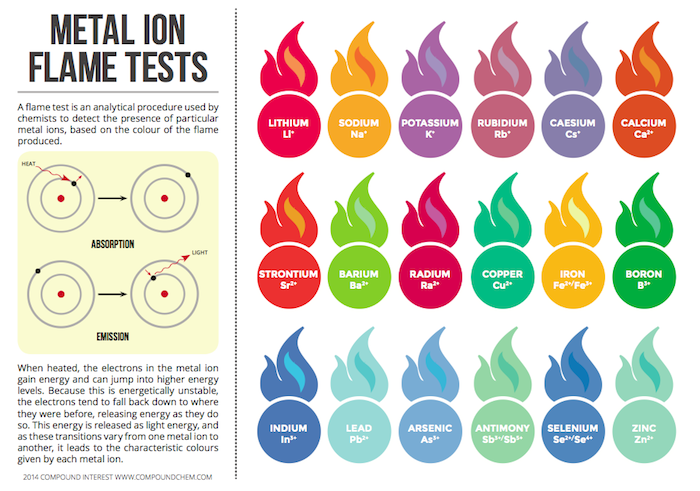
Back in your school days there was probably an experiment where you placed a small amount of a compound into a flame and observed it's colour.  This is the flame test and depending on the colour observed it can tell you what elements are present.


Scientifically put, A flame test is an analytic procedure used in chemistry to detect the presence of certain elements, primarily metal ions, based on each element's characteristic emission spectrum. The colour of flames in general also depends on temperature.

The test involves introducing a sample of the element or compound to a hot, non-luminous flame, and observing the colour of the flame that results. The idea of the test is that sample atoms evaporate and since they are hot, they emit light when being in flame.

The flame test is relatively quick and simple to perform, and can be carried out with the basic equipment found in most chemistry laboratories. However, the range of elements positively detectable under these conditions is small, as the test relies on the subjective experience of the experimenter rather than any objective measurements. The test has difficulty detecting small concentrations of some elements, while too strong a result may be produced for certain others, which tends to cause fainter colours to not appear.


Metal Ion Flame Tests-Click to enlarge
The table above from www.compoundchem.com shows the range of colours chemicals produce.  These tests work better for some metal ions than other; in particular, those ions shown on the bottom row of the infographic are generally quite faint and hard to distinguish. Sodium’s flame colour is also very strong, and can easily mask the colours of other metal ions.

For more information and more pictures visit:-
http://www.compoundchem.com/2014/02/06/metal-ion-flame-test-colours-chart/
http://en.wikipedia.org/wiki/Flame_test

Friday, 23 August 2013

Lithium


Lithium (from Greek lithos 'stone') is a chemical element with symbol Li and atomic number 3. It is a soft, silver-white metal belonging to the alkali metal group of chemical elements. Under standard conditions it is the lightest metal and the least dense solid element. Like all alkali metals, lithium is highly reactive and flammable. For this reason, it is typically stored in mineral oil. When cut open, lithium exhibits a metallic lustre, but contact with moist air corrodes the surface quickly to a dull silvery grey, then black tarnish. Because of its high reactivity, lithium never occurs freely in nature, and instead, only appears in compounds, which are usually ionic.
 
Lithium is so soft it can be cut with scissors and it's so light that it floats on water. But it's also extremely reactive so it doesn't stay shiny or silvery very long. For this reason, it is never found "in the wild" in its pure elemental form (on earth). Similar to helium, lithium has many uses, not the least of which are lithium-ion batteries, soldering flux and, since it burns a brilliant scarlet colour, it provides those spectacular red colours to fireworks. Lithium's medicinal uses are among its most important attributes: it is critically important as a mood stabilizer for hundreds of thousands of people who find relief from the worst symptoms of bipolar disorder. Lithium also lessens symptoms for some migraine sufferers and for some who experience cluster headaches. How it works in the body remains elusive.
 
Trace amounts of lithium are present in all organisms. The element serves no apparent vital biological function, since animals and plants survive in good health without it. Non-vital functions have not been ruled out.

Applications
  • Ceramics and glass - Lithium oxide is a widely used flux for processing silica, reducing the melting point and viscosity of the material and leading to glazes of improved physical properties
  • Electrical and electronics - Commonly used in batteries
  • Lubricating greases
  • Metallurgy
  • Pyrotechnics - Fireworks
  • Medicine
For more information on Lithium visit:-
http://www.guardian.co.uk/science/punctuated-equilibrium/2011/feb/18/1
http://en.wikipedia.org/wiki/Lithium