Total Lab Supplies - Everything for your laboratory

Total Lab Supplies - Everything for your laboratory
Our Head Office in St Helens
Showing posts with label laboratory. Show all posts

Friday, 22 February 2019

Hotplate Safety

Total Lab Supplies offer a wide range of hotplates and hotplate/stirrers.  The Stuart range is well known in laboratories and they offer some good advice on the operation of these units.

  • Do not use hotplates to heat inflammable liquids.
  • Never lift or carry a hotplate until it has been switched off and allowed to cool for at least 30 minutes. A hot warning light will give guidance.
  • A hotplate should be carried using both hands with the fingers under the side edges.
  • Never move or carry a unit with containers on the top plate or while still connected to the mains supply.
  • There is a danger of liquid spillage if containers are over-filled and stirred at high speed. Always build stirrer speed slowly and never stir more rapidly than necessary
  • NEVER place a cold glass vessel onto a hotplate which is already hot.

When using a ceramic hotplates like the Stuart UC152 at temperatures over 180ÂșC, the base of any equipment used must not make contact with the ceramic plate outside the Hot Zone or heated plate area.

The use of a Stuart SCT1 temperature controller allows accurate temperature control of aqueous and oil based samples in the laboratory and can be used in two different modes, as a precise temperature controller from 20 to 200°C or as a digital thermometer from -4 to 325°C.

Care when preparing media
Take particular care when heating liquids having a high viscosity. Viscous liquids can act as thermal insulators and can cause thermal breakage of the glassware. This is very important with media solutions as the viscosity will usually increase as the temperature rises.

  • Check that the stirring action is sufficient to agitate the whole of the liquid.  Unstirred areas in the liquid can result in uneven heat transfer and “hot spots” in the glassware. This can induce thermal stress and so cause failure.
  • Check the stirring action regularly to ensure that it remains adequate as the viscosity of the solution increases.
  • Always use the largest magnetic follower possible and if necessary, use a mechanical overhead stirrer.
  • Do not use glass vessels with thick walls, e.g. Pyrex Heavy Duty Ware or standard beakers and flasks having capacities of 5 litres or greater.
  • NEVER heat glass bottles on a hotplate.
  • Ensure that the heat is built up slowly to avoid localised overheating.
  • Ensure the glassware is completely free from scratches or other defects.
  • Place the hotplate in a tray large enough to contain the liquid in the event of glassware failure.
  • Wear the appropriate safety clothing e.g. gloves, goggles, protective apron etc.

Following these guidelines using a stirrer/hotplate should ensure trouble free use.

 For all your hotplate/stirrer needs please get in touch

Friday, 2 January 2015

Happy New Year

Happy New Year!!
 
P&R Labpak are open for business on Monday 5th January but would like to wish all it's customers and contacts a very Happy New Year for 2015.

 
Normal blog posts will commence 9th January.


Friday, 26 September 2014

Flamin' hot colours!

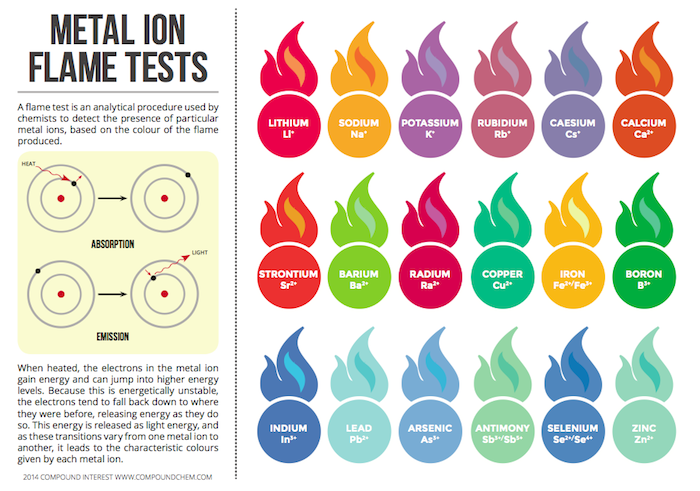
Back in your school days there was probably an experiment where you placed a small amount of a compound into a flame and observed it's colour.  This is the flame test and depending on the colour observed it can tell you what elements are present.


Scientifically put, A flame test is an analytic procedure used in chemistry to detect the presence of certain elements, primarily metal ions, based on each element's characteristic emission spectrum. The colour of flames in general also depends on temperature.

The test involves introducing a sample of the element or compound to a hot, non-luminous flame, and observing the colour of the flame that results. The idea of the test is that sample atoms evaporate and since they are hot, they emit light when being in flame.

The flame test is relatively quick and simple to perform, and can be carried out with the basic equipment found in most chemistry laboratories. However, the range of elements positively detectable under these conditions is small, as the test relies on the subjective experience of the experimenter rather than any objective measurements. The test has difficulty detecting small concentrations of some elements, while too strong a result may be produced for certain others, which tends to cause fainter colours to not appear.


Metal Ion Flame Tests-Click to enlarge
The table above from www.compoundchem.com shows the range of colours chemicals produce.  These tests work better for some metal ions than other; in particular, those ions shown on the bottom row of the infographic are generally quite faint and hard to distinguish. Sodium’s flame colour is also very strong, and can easily mask the colours of other metal ions.

For more information and more pictures visit:-
http://www.compoundchem.com/2014/02/06/metal-ion-flame-test-colours-chart/
http://en.wikipedia.org/wiki/Flame_test

Friday, 18 July 2014

How does a Laboratory Balance or Scale work?

There are two basic types of electronic balance designs.

1. Electromagnetic balancing type
2. Electrical resistance wire type (load cell type)


These are based on different principles, but both have neither directly measures mass. They measure the force that acts downward on the pan. This force is converted to an electrical signal and displayed on a digital display.
 

As a means of measuring force, the electromagnetic balance method uses the electromagnetic force generated from a magnet and coil, whereas the electrical resistance wire method uses the change in resistance value of a strain gauge attached to a piece of metal that bends in response to a force.
 
 
So why do electronic balances display mass values when that is not what they measure? It's because the reference standards for mass are weights, which are placed on a pan to inform the electronic balance that a given force is equivalent to a given number of grams, which is used for conversion. Consequently, electronic balances that do not perform this conversion accurately cannot display accurate mass values.

Readability and accuracy are not the same thing?
The readability of a balance is the smallest quantity that the balance will display. Accuracy is the difference between the known weight of a sample and the displayed weight. The accuracy of a balance can be measured only when the balance is in its operating environment

Location of the Balance

The precision and reproducibility of weighing results is closely associated with the location of the balance. To ensure that your balance can work under the best conditions, please observe the following guidelines:

Weighing bench
  • Stable (lab bench, lab table, stone bench).  Your weighing bench should not sag when work is carried out on it and should transfer as few vibrations as possible.
  • Antimagnetic (no steel plate).
  • Protected against electrostatic charges (no plastic or glass).
  • Wall or floor installation.  The weighing bench should be fixed either to the floor or on the wall.  Mounting the bench on both places at once transfers vibrations from wall and floor.
  • Reserved for the balance.

The place of installation and the weighing bench must be stable enough that the balance display does not change when someone leans on the table or steps up to the weighing station. Do not use soft pads underneath, such as writing mats.  It is better to position the balance directly over the legs of the bench, since the area is subject to the fewest vibrations.
 
The article above is a very brief outline of laboratory balances or scales.  many factors affect the weighing accuracy besides location - eg temperature, humidity etc..Visit the last link below to download a complete guide to weighing.

For more information visit:-
http://www.shimadzu.com/an/hplc/support/lib/lctalk/66/66lab.html
http://electronics.howstuffworks.com/everyday-tech/digital-scale.htm
http://www.prlabs.co.uk/news/article.php?Id=140

Friday, 27 June 2014

Potassium Hydroxide.

Potassium hydroxide is an inorganic compound with the formula KOH, commonly called caustic potash.

Potassium Hydroxide is noteworthy as the precursor to most soft and liquid soaps as well as numerous potassium-containing chemicals.

Potassium hydroxide can be found in pure form by reacting sodium hydroxide with impure potassium. Potassium hydroxide is usually sold as white or translucent pellets, sometimes yellow, which will become tacky in air because KOH is hygroscopic. Consequently, KOH typically contains varying amounts of water (as well as carbonates).

Its dissolution in water is strongly exothermic, meaning the process gives off significant heat. Concentrated aqueous solutions are sometimes called potassium lyes. Even at high temperatures, solid KOH does not dehydrate readily.

Potassium hydroxide has many uses:-
  • Precursor to other potassium compounds, eg fertilisers
  • Manufacture of biodiesel
  • Manufacture of soft soaps
  • As an electrolyte
  • Cleaning and disinfection
  • As a main active ingredient in chemical "cuticle removers" used in manicure treatments
Health information
  • Potassium Hydroxide is highly corrosive and contact can severely irritate and burn the skin and eyes leading to damage
  • Potassium Hydroxide can affect you when inhaled and by passing through the skin
  • Contact can irritate the nose and throat
  • Inhaling can irritate the lungs causing a build up of fluid
  • Exposure can cause headaches, dizziness, nausea and vomiting
  • It may cause skin allergy.

All health and safety data information must be followed when using this chemical

Tuesday, 10 December 2013

Christmas Closure

P&R Labpak closes on Tuesday 24th December 2013 and re-opens on 2nd January 2014. There will be no deliveries during this period.


P&R Labpak would like to take this opportunity now to thank you for your custom this year, and look forward to continuing our relationships in 2014.

We hope you've enjoyed our blog posts over the last year and hope you will continue to read them in future.  If you want us to feature anything or try and answer a question for you then let us know.

Remember to LIKE us on Facebook and subscribe to our Twitter feed too!

Thursday, 4 July 2013

Sustainability!!

Everyone wants to be greener and help the environment but it's not always easy.  There is a trend to buy more economical products for the laboratory.  We use less energy overall remembering to turn lights and equipment off.  But what else can we do?

Now you can help just by buying VWR Collection products that you may well buy anyway!  And if you don't why not give them a try?

If you buy £1000 of VWR Collection products then VWR will have 10 trees planted in your name and match that donation.  You'll also get a certificate of your contribution to global reforestation!

Read the flyer on our webpage for more information on what to do.  Visit http://www.prlabs.co.uk/news/article.php?Id=194

Let's see how many trees we can plant!

Terms and geographical limitations apply to this particular offer.