Total Lab Supplies - Everything for your laboratory

Total Lab Supplies - Everything for your laboratory
Our Head Office in St Helens
Showing posts with label strontium. Show all posts

Friday, 26 September 2014

Flamin' hot colours!

Back in your school days there was probably an experiment where you placed a small amount of a compound into a flame and observed it's colour.  This is the flame test and depending on the colour observed it can tell you what elements are present.


Scientifically put, A flame test is an analytic procedure used in chemistry to detect the presence of certain elements, primarily metal ions, based on each element's characteristic emission spectrum. The colour of flames in general also depends on temperature.

The test involves introducing a sample of the element or compound to a hot, non-luminous flame, and observing the colour of the flame that results. The idea of the test is that sample atoms evaporate and since they are hot, they emit light when being in flame.

The flame test is relatively quick and simple to perform, and can be carried out with the basic equipment found in most chemistry laboratories. However, the range of elements positively detectable under these conditions is small, as the test relies on the subjective experience of the experimenter rather than any objective measurements. The test has difficulty detecting small concentrations of some elements, while too strong a result may be produced for certain others, which tends to cause fainter colours to not appear.
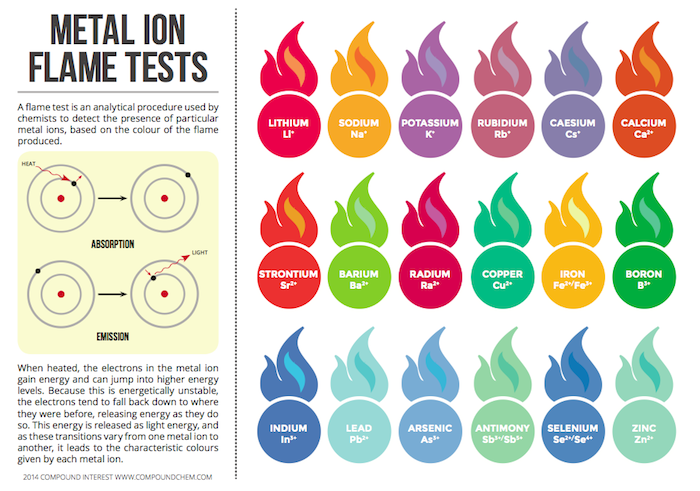

Metal Ion Flame Tests-Click to enlarge
The table above from www.compoundchem.com shows the range of colours chemicals produce.  These tests work better for some metal ions than other; in particular, those ions shown on the bottom row of the infographic are generally quite faint and hard to distinguish. Sodium’s flame colour is also very strong, and can easily mask the colours of other metal ions.

For more information and more pictures visit:-
http://www.compoundchem.com/2014/02/06/metal-ion-flame-test-colours-chart/
http://en.wikipedia.org/wiki/Flame_test

Friday, 1 August 2014

Strontium

Strontium has the atomic symbol Sr and the atomic number 38. It is a soft silver-white or yellowish (when oxidised) metallic element that is even more chemically reactive than its neighbour calcium.

Strontium is a grey, silvery metal that is softer than calcium and even more reactive toward water, with which it reacts on contact to produce strontium hydroxide and hydrogen gas.  Finely powdered strontium metal ignites spontaneously in air at room temperature. Most of us will be familiar with strontium because strontium salts are commonly used in fireworks and flares to give a bright (some might say blinding) red color to flames.

Strontium is named after Strontian, a village in Scotland near which the mineral was first discovered in 1790.  Strontium is the 15th most abundant element on Earth, but because of its reactivity, strontium is not found roaming freely in the wild: it occurs in minerals, mostly in strontianite and celestite.

Because its nucleus is very nearly the same size as that of calcium, the body mistakenly takes up strontium and incorporates it into bones and tooth enamel in the place of calcium. Surprisingly, this is not a health problem and in fact, it can provide a health benefit. For example, in clinical trials, the drug strontium ranelate was found to aid bone growth, increase bone density, and lessen vertebral, peripheral, and hip fractures in women.

The radioactive isotope, 90Sr, is common in radioactive fallout. Since radioactive fallout doesn't respect national borders, it falls upon all living things regardless of nationality or species, contaminating water, food and even the air that we all breathe. This isotope is quite dangerous and can cause a variety of leukæmias, bone cancer and other debilitating bone diseases. Perhaps ironically, Strontium-90 is also used to treat cancer.

For more information visit:-
http://www.theguardian.com/science/punctuated-equilibrium/2011/nov/18/1?guni=Article:in%20body%20link
http://en.wikipedia.org/wiki/Strontium