Total Lab Supplies - Everything for your laboratory

Total Lab Supplies - Everything for your laboratory
Our Head Office in St Helens
Showing posts with label element. Show all posts

Friday, 20 July 2018

Caesium

Cæsium is a soft, silvery-gold alkali metal with the symbol Cs and atomic number 55.


It has a melting point of 28°C (82°F), which means it will be liquid on a warm summer day, and revert to a solid later that night after the ambient temperature cools. Cæsium is just one of five elemental metals that are liquids at or near room temperature.


Its name comes from the Latin word for sky-blue because when burned, cæsium turns the flame a lovely blue colour.

Since the 1990s, the largest application of the element has been as caesium formate for drilling fluids, but it has a range of applications in the production of electricity, in electronics, and in chemistry. The radioactive isotope caesium-137 has a half-life of about 30 years and is used in medical applications, industrial gauges, and hydrology. Nonradioactive caesium compounds are only mildly toxic, but the pure metal's tendency to react explosively with water means that caesium is considered a hazardous material, and the radioisotopes present a significant health and ecological hazard in the environment.

Caesium is also know for its use in atomic clocks and use the electromagnetic transitions in the hyperfine structure of caesium-133 atoms as a reference point. The first accurate caesium clock was built by Louis Essen in 1955 at the National Physical Laboratory in the UK. 

These clocks measure frequency with an error of 2 to 3 parts in 1014, which corresponding to an accuracy of 2 nanoseconds per day, or one second in 1.4 million years. The latest versions are more accurate than 1 part in 1015, about 1 second in 20 million years.  The Caesium standard is the primary standard for standards-compliant time and frequency measurements. Caesium clocks regulate the timing of cell phone networks and the Internet.

For more information visit
https://en.wikipedia.org/wiki/Caesium
https://www.theguardian.com/science/grrlscientist/2012/mar/23/1

Tuesday, 1 August 2017

On this day in science history: oxygen was identified

In 1774, Joseph Priestley, British Presbyterian minister and chemist, identified a gas which he called "dephlogisticated air" - later known as oxygen. Priestley found that mercury heated in air became coated with "red rust of mercury," which, when heated separately, was converted back to mercury with "air" given off. Studying this "air" given off, he observed that candles burned very brightly in it. Also, a mouse in a sealed vessel with it could breathe it much longer than ordinary air. A strong believer in the phlogiston theory, Priestley considered it to be "air from which the phlogiston had been removed." Further experiments convinced him that ordinary air is one fifth dephlogisticated air, the rest considered by him to be phlogiston.

Joseph Priestley, by Charles Turner [Public domain], via Wikimedia Commons
However, oxygen was in fact first discovered earlier, by Swedish pharmacist Carl Wilhelm Scheele. He had produced oxygen gas by heating mercuric oxide and various nitrates in 1771–2. Scheele called the gas "fire air" because it was the only known supporter of combustion, and wrote an account of this discovery in a manuscript he titled Treatise on Air and Fire, which he sent to his publisher in 1775. That document was published in 1777. 

Because Priestly published his findings first, he is usually given priority in the discovery.

The French chemist Antoine Laurent Lavoisier later claimed to have discovered the new substance independently. Priestley visited Lavoisier in October 1774 and told him about his experiment and how he liberated the new gas. Scheele also posted a letter to Lavoisier on September 30, 1774 that described his discovery of the previously unknown substance, but Lavoisier never acknowledged receiving it (a copy of the letter was found in Scheele's belongings after his death). Long before this, one of the first known experiments on the relationship between combustion and air was conducted by the 2nd century BCE Greek writer on mechanics, Philo of Byzantium. In his work Pneumatica, Philo observed that inverting a vessel over a burning candle and surrounding the vessel's neck with water resulted in some water rising into the neck. Philo incorrectly surmised that parts of the air in the vessel were converted into the classical element fire and thus were able to escape through pores in the glass. Many centuries later Leonardo da Vinci built on Philo's work by observing that a portion of air is consumed during combustion and respiration.

In the late 17th century, Robert Boyle proved that air is necessary for combustion. English chemist John Mayow (1641–1679) refined this work by showing that fire requires only a part of air that he called spiritus nitroaereus. In one experiment, he found that placing either a mouse or a lit candle in a closed container over water caused the water to rise and replace one-fourteenth of the air's volume before extinguishing the subjects. From this he surmised that nitroaereus is consumed in both respiration and combustion.

Mayow observed that antimony increased in weight when heated, and inferred that the nitroaereus must have combined with it. He also thought that the lungs separate nitroaereus from air and pass it into the blood and that animal heat and muscle movement result from the reaction of nitroaereus with certain substances in the body. Accounts of these and other experiments and ideas were published in 1668 in his work Tractatus duo in the tract "De respiratione".

Robert Hooke, Ole Borch, Mikhail Lomonosov, and Pierre Bayen all produced oxygen in experiments in the 17th and the 18th century but none of them recognized it as a chemical element. This may have been in part due to the prevalence of the philosophy of combustion and corrosion called the phlogiston theory, which was then the favored explanation of those processes.

Established in 1667 by the German alchemist J. J. Becher, and modified by the chemist Georg Ernst Stahl by 1731, phlogiston theory stated that all combustible materials were made of two parts. One part, called phlogiston, was given off when the substance containing it was burned, while the dephlogisticated part was thought to be its true form, or calx.

Highly combustible materials that leave little residue, such as wood or coal, were thought to be made mostly of phlogiston; non-combustible substances that corrode, such as iron, contained very little. Air did not play a role in phlogiston theory, nor were any initial quantitative experiments conducted to test the idea; instead, it was based on observations of what happens when something burns, that most common objects appear to become lighter and seem to lose something in the process. The fact that a substance like wood gains overall weight in burning was hidden by the buoyancy of the gaseous combustion products.

This theory, while it was on the right track, was unfortunately set up backwards. Rather than combustion or corrosion occurring as a result of the decomposition of phlogiston compounds into their base elements with the phlogiston being lost to the air, it is in fact the result of oxygen from the air combining with the base elements to produce oxides. Indeed, one of the first clues that the phlogiston theory was incorrect was that metals gain weight in rusting (when they were supposedly losing phlogiston).

For more information visit:-


Tuesday, 16 August 2016

What are Olympic medals made of?

So, the Olympic medals are made of gold, silver and bronze right? Wrong! Pure gold medals would cost an awful lot, so what are the medals really made from? 

The graphic below looks at the different metals used.

Graphic: Compound Interest

So, what of real gold? Let’s find out more:

Gold is a chemical element with the symbol Au (from Latin: aurum) and the atomic number 79. In its purest form, it is a bright, slightly reddish yellow, dense, soft, malleable and ductile metal. Chemically, gold is a transition metal and a group 11 element. It is one of the least reactive chemical elements, and is solid under standard conditions. The metal therefore occurs often in free elemental (native) form, as nuggets or grains, in rocks, in veins and in alluvial deposits. It occurs in a solid solution series with the native element silver (as electrum) and also naturally alloyed with copper and palladium. Less commonly, it occurs in minerals as gold compounds, often with tellurium (gold tellurides).

Gold's atomic number of 79 makes it one of the higher atomic number elements that occur naturally in the universe. It is thought to have been produced in supernova nucleosynthesis and from the collision of neutron stars and to have been present in the dust from which the Solar System formed. Because the Earth was molten when it was just formed, almost all of the gold present in the early Earth probably sank into the planetary core. Therefore, most of the gold that is present today in the Earth's crust and mantle is thought to have been delivered to Earth later, by asteroid impacts during the Late Heavy Bombardment, about 4 billion years ago.

Gold resists attack by individual acids, but aqua regia (literally "royal water", a mixture of nitric acid and hydrochloric acid) can dissolve it. The acid mixture causes the formation of a soluble tetrachloroaurate anion. It is insoluble in nitric acid, which dissolves silver and base metals, a property that has long been used to refine gold and to confirm the presence of gold in metallic objects, giving rise to the term acid test. Gold also dissolves in alkaline solutions of cyanide, which are used in mining and electroplating. Gold dissolves in mercury, forming amalgam alloys, but this is not a chemical reaction.

Gold is a precious metal used for coinage, jewellery, and other arts throughout recorded history. In the past, a gold standard was often implemented as a monetary policy within and between nations, but gold coins ceased to be minted as a circulating currency in the 1930s, and the world gold standard was abandoned for a fiat currency system after 1976. The historical value of gold was rooted in its relative rarity, easy handling and minting, easy smelting and fabrication, resistance to corrosion and other chemical reactions (nobility), and distinctive colour.

The world consumption of new gold produced is about 50% in jewellery, 40% in investments, and 10% in industry. Gold's high malleability, ductility, resistance to corrosion and most other chemical reactions, and conductivity of electricity have led to its continued use in corrosion resistant electrical connectors in all types of computerized devices (its chief industrial use). Gold is also used in infrared shielding, coloured glass production, gold leafing, and tooth restoration. Certain gold salts are still used as anti-inflammatories in medicine.

For more information visit:-


Tuesday, 9 February 2016

On this day in history – an atom of the element 112 was created

In 1996, only a little more than a year after they created element 111, a team of German scientists led by Peter Armbruster at the Gesellschaft für schwerionenforschung (GSI) facility at Darmstadt, Germany, claimed to have created an atom of the element 112. Its nucleus has 112 protons and 166 neutrons, giving it a mass number of 277. As a new element it was named ununbium, symbol Uub, according to an internationally adopted system for naming new elements. This was based on the presence of one atom of the element made by accelerating zinc atoms to high speed and bombarding them into lead. When an atom of each fused to make the new nucleus, it lasted a fraction of a thousandth of a second before decaying, emitting an alpha particle to become a nucleus of element 110.

What is an element?

A chemical element or element is a species of atoms having the same number of protons in their atomic nuclei (i.e. the same atomic number, Z). There are 118 elements that have been identified, of which the first 94 occur naturally on Earth with the remaining 24 being synthetic elements. There are 80 elements that have at least one stable isotope and 38 that have exclusively radioactive isotopes, which decay over time into other elements. Iron is the most abundant element (by mass) making up the Earth, while oxygen is the most common element in the crust of the earth.

The Periodic Table, by Sandbh (Own work) via Wikimedia Commons
Chemical elements constitute all of the ordinary matter of the universe. However astronomical observations suggest that ordinary observable matter is only approximately 15% of the matter in the universe: the remainder is dark matter, the composition of which is unknown, but it is not composed of chemical elements. The two lightest elements, hydrogen and helium were mostly formed in the Big Bang and are the most common elements in the universe. The next three elements (lithium, beryllium and boron) were formed mostly by cosmic ray spallation, and are thus more rare than those that follow. Formation of elements with from six to twenty six protons occurred and continues to occur in main sequence stars via stellar nucleosynthesis. The high abundance of oxygen, silicon, and iron on Earth reflects their common production in such stars. Elements with greater than twenty-six protons are formed by supernova nucleosynthesis in supernovae, which, when they explode, blast these elements far into space as planetary nebulae, where they may become incorporated into planets when they are formed.

The term "element" is used for a kind of atom with a given number of protons (regardless of whether they are or they are not ionized or chemically bonded, e.g. hydrogen in water) as well as for a pure chemical substance consisting of a single element (e.g. hydrogen gas).

When different elements are chemically combined, with the atoms held together by chemical bonds, they form chemical compounds. Only a minority of elements are found uncombined as relatively pure minerals. Among the more common of such "native elements" are copper, silver, gold, carbon (as coal, graphite, or diamonds), and sulphur. All but a few of the most inert elements, such as noble gases and noble metals, are usually found on Earth in chemically combined form, as chemical compounds. While about 32 of the chemical elements occur on Earth in native uncombined forms, most of these occur as mixtures. For example, atmospheric air is primarily a mixture of nitrogen, oxygen, and argon, and native solid elements occur in alloys, such as that of iron and nickel.

The history of the discovery and use of the elements began with primitive human societies that found native elements like carbon, sulphur, copper and gold. Later civilizations extracted elemental copper, tin, lead and iron from their ores by smelting, using charcoal. Alchemists and chemists subsequently identified many more, with almost all of the naturally-occurring elements becoming known by 1900.

The properties of the chemical elements are summarized on the periodic table, which organizes the elements by increasing atomic number into rows ("periods") in which the columns ("groups") share recurring ("periodic") physical and chemical properties. Save for unstable radioactive elements with short half-lives, all of the elements are available industrially, most of them in high degrees of purity.

For more information visit:-

Friday, 3 April 2015

Stained and Coloured Glass

Stained glass can refer to coloured glass as a material or to works created from it - most commonly seen in the stained glass windows of churches and other buildings.  Coloured glass is also found in everyday life such as green wine bottles.


As a material stained glass is glass that has been coloured by adding metallic salts during its manufacture.

There are two main types of glass - soda lime glass - commonly used in beverage bottles and the like and borosilicate glass - used in laboratory glassware and also some domestic glassware such as oven proof dishes.

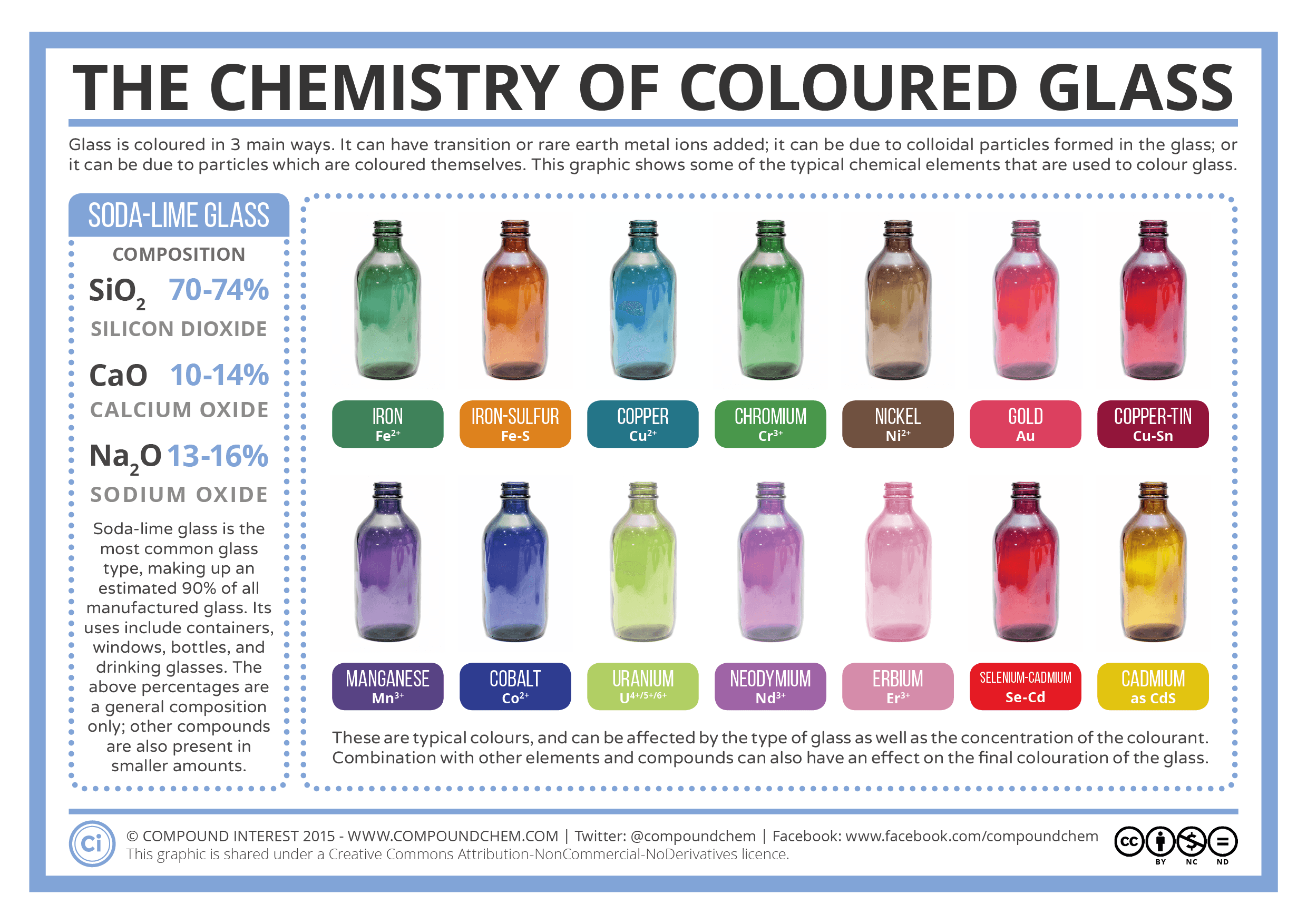
Coloured glass is made in a number of ways.  There are three main ways.

The first involves introducing metallic or rare earth metal oxides to the glass as mentioned above.

Silver compounds for example such as silver nitrate are used as stain applied to the surface of glass and fired on. They can produce a range of colours from orange-red to yellow. The way the glass is heated and cooled can significantly affect the colours produced by these compounds.

Another way is by formation of colloidal particles. This means particles of a substance are suspended throughout the glass. The particles scatter light of particular frequencies as it passes through the glass, causing colouration.

Gold gives a ruby red colour, and selenium gives a pink to intense red.

The final main way in which colour can be introduced is through the addition of already coloured particles to the glass. Examples of this type of colouration include milk glass and smoked glass; milk glass is achieved by adding tin oxide.

The infographic below from Compound Interest shows what chemicals are involved in the colour process.  Click for a larger image.


Click to enlarge
For more information visit:-
http://en.wikipedia.org/wiki/Stained_glass
http://www.compoundchem.com/2015/03/03/coloured-glass/

Friday, 6 February 2015

Boron!

Boron is a chemical element with symbol B and atomic number 5. It is a low-abundance element in both the Solar system and the Earth's crust and is concentrated on Earth by the water-solubility of its more common naturally occurring compounds, the borate minerals. These are mined industrially as evaporites, such as borax and kernite. The largest proven boron deposits are in Turkey, which is also the largest producer of boron minerals.


This rare element is a metalloid; which means that it can can act both as an acid and a base, and it also behaves as a semiconductor.  Boron never occurs in a pure state in the wild, and can only be purified with difficulty by chemists. Boron is a poor conductor of electricity, and is fairly non-reactive, although it is water soluble. The most common uses for boron-containing compounds includes a bleach for clothing, a swimming pool disinfectant and to produce green flames.

About half of global consumption of boron compounds is as additives for glass fibres in boron-containing fibreglass used for insulation or as structural materials. The next leading use is to make boron polymers and ceramics, that play specialised roles as high-strength lightweight structural and refractory materials. Borosilicate glass glassware is used for its greater strength and breakage resistance (thermal shock resistance) than ordinary soda lime glass.


For more information visit:-
http://en.wikipedia.org/wiki/Boron
http://www.theguardian.com/science/punctuated-equilibrium/2011/mar/11/1

Friday, 16 January 2015

Arsenic


Arsenic is a chemical element with symbol As and atomic number 33. Arsenic occurs in many minerals, usually in conjunction with sulphur and metals, and also as a pure elemental crystal. Arsenic is a metalloid. It can exist in various allotropes, although only the grey form has important use in industry.
 
Arsenic atoms can assume several different bonding patterns which are the basis of its allotropes, each of which has a different colour; metallic grey, yellow and black arsenic. Interestingly, using a hammer to bang on arsenide minerals releases a garlic-like odour, which is the result of toxic fumes created by the oxidation of arsenic to arsenic trioxide.

Arsenic is notoriously poisonous to multicellular life, although a few species of bacteria are able to use arsenic compounds as respiratory metabolites. Arsenic contamination of groundwater is a problem that affects millions of people across the world.
Historically, Arsenic was commonly used as a rodent poison in English households, and it was also a convenient murder weapon, particularly amongst the ruling classes as you may have read in various novels and non-fiction books. However, Victorian England used arsenic in a number of ways; it was incorporated into wallpaper to prevent the growth of mould during the dark, damp English winters, it was used as the green colouring in paints, candies and candles, and as a preservative in lace.

The main use of metallic arsenic is for alloying with lead. Lead components in car batteries are strengthened by the presence of a very small percentage of arsenic.

Widespread arsenic contamination of groundwater has led to a massive epidemic of arsenic poisoning in Bangladesh and neighbouring countries. It is estimated that approximately 57 million people in the Bengal basin are drinking groundwater with arsenic concentrations elevated above the World Health Organization's standard of 10 parts per billion (ppb).

More recently arsenic has been in the news for being found in rice.  Rice holds higher levels of arsenic than other grains and acts as one of nature’s “great scavengers of metallic compounds.” Unlike, millet or polenta, rice planted in arsenic-contaminated fields acts as a vacuum for the toxin.

Rice from different countries contain differing levels of arsenic.  It's recommended that rice is washed before cooking and rinsed afterwards to lessen the effects.

Currently, the FDA in America doesn't have safety levels for arsenic in rice. They've cautioned against making state-by-state or country-by country comparisons in Inorganic Arsenic levels for rice, citing the varying factors that can influence arsenic concentrations, such as soil composition, fertilizers, seasonal variability, and water-use practices.


Evidence-based public health advocates also recommend that, given the lack of regulation or labelling for arsenic in the U.S., children should eat no more than 1 to 1.5 servings per week of rice and should not drink rice milk as part of their daily diet before age 5. They also offer recommendations for adults and infants on how to limit arsenic exposure from rice, drinking water, and fruit juice.

A 2014 World Health Organization advisory conference will consider limits of 200–300 ppb for rice.  The proposed new EU recommendations will limit 200 parts of arsenic per billion for adults and just 100 ppb for children and babies.

For more information visit:-
http://en.wikipedia.org/wiki/Arsenic
http://www.theguardian.com/science/punctuated-equilibrium/2011/oct/14/1
https://time.com/3592399/arsenic-rice/
http://www.dailymail.co.uk/news/article-2817542/More-half-rice-products-exceed-new-EU-limits-ARSENIC.html

Friday, 14 November 2014

Platinum

Platinum has the chemical symbol Pt and atomic number 78. It’s a dense, malleable, ductile, highly unreactive, precious, grey-white transition metal. Its name is derived from the Spanish term platina, which is literally translated into "little silver”.


Platinum occurs in the wild as the pure element as well as alloyed with iridium, known as platiniridium.  It is one of the rarest elements in the Earth's crust with an average abundance of approximately 5 μg/kg.

In addition to its high density, resistance to oxidation and other desirable qualities, platinum is remarkably chemically unreactive. For these reasons, a 90-10% alloy of platinum-iridium is still used as the International Prototype Kilogram. Originally, this prototype kilogram was made of pure platinum, but iridium was added to increase its hardness while retaining platinum's many desirable qualities.

Platinum Nuggets


Platinum is used in catalytic converters, laboratory equipment, electrical contacts and electrodes, platinum resistance thermometers, dentistry equipment, and jewellery. Being a heavy metal, it leads to health issues upon exposure to its salts, but due to its corrosion resistance, it is not as toxic as some metals. Some compounds containing platinum are applied in chemotherapy against certain types of cancer.

Platinum;s resistance to wear and tarnish is well suited to its use in fine jewellery.


Platinum is obtained commercially as a by-product from nickel and copper mining and processing.  As an example, of the 245 tonnes of platinum sold in 2010, 113 tonnes were used for vehicle emissions control devices (46%), 76 tonnes for jewellery (31%). The remaining 35.5 tonnes went to various other minor applications, such as investment, electrodes, anticancer drugs, oxygen sensors, spark plugs and turbine engines.

For more information visit:-
http://www.theguardian.com/science/grrlscientist/2013/jan/11/1?guni=Article:in%20body%20link
http://en.wikipedia.org/wiki/Platinum


Friday, 3 October 2014

Zinc

Zinc is a metallic chemical element; it has the symbol Zn and atomic number 30. It is the first element of group 12 of the periodic table. It’s the 24th most abundant element in the Earth's crust and has five stable isotopes. The most common zinc ore is sphalerite (zinc blende), a zinc sulfide mineral. The largest mineable amounts are found in Australia, Asia, and the United States.


Brass, which is an alloy of copper and zinc, has been used since at least the 10th century BC.

Zinc is an essential mineral of "exceptional biologic and public health importance".  Zinc deficiency affects about two billion people in the developing world and is associated with many diseases.  In children it causes growth retardation, delayed sexual maturation, infection susceptibility, and diarrhoea, contributing to the death of about 800,000 children worldwide per year.

The metal is most commonly used as an anti-corrosion agent.  Galvanization, which is the coating of iron or steel to protect the metals against corrosion, is the most familiar form of using zinc in this way.  Zinc is more reactive than iron or steel and thus will attract almost all local oxidation until it completely corrodes away.  A protective surface layer of oxide and carbonate forms as the zinc corrodes.  This protection lasts even after the zinc layer is scratched but degrades through time as the zinc corrodes away.  The zinc is applied electrochemically or as molten zinc by hot-dip galvanizing or spraying. Galvanization is used on chain-link fencing, guard rails, suspension bridges, light posts, metal roofs, heat exchangers, and car bodies.

Zinc Oxide used in paint pigments

Zinc is useful for the human body and helps speed up the healing process after an injury.  It is also suspected of being beneficial to the body's immune system. Indeed, zinc deficiency may have effects on virtually all parts of the human immune system.

For more information visit:-
http://www.theguardian.com/science/punctuated-equilibrium/2011/sep/23/1?guni=Article:in%20body%20link
http://en.wikipedia.org/wiki/Zinc

Friday, 12 September 2014

Mercury


Mercury is a chemical element with the symbol Hg and atomic number 80. It is commonly known as quicksilver and was formerly named hydrargyrum (from Greek "hydr-" water and "argyros" silver)


Mercury is remarkable because it is the only metal that is liquid at room temperature. It is a dense, lustrous grey metal. Mercury is extremely rare in the Earth's crust and in the wild, it typically is concentrated near volcanically active areas, either as the pure metal or in a number of minerals.
 
Mercury is used in thermometers, barometers, manometers, sphygmomanometers, float valves, mercury switches, mercury relays, fluorescent lamps and other devices, though concerns about the element's toxicity have led to mercury thermometers and sphygmomanometers being largely phased out in clinical environments in favour of alternatives such as alcohol- or galinstan-filled glass thermometers and thermistor- or infrared-based electronic instruments.
The reason mercury was so popular is because it readily forms stable amalgams with a number of other metals, particularly silver and gold, making them workable at lower temperatures, and these amalgams have been the source of many instances of mercury poisoning.
Amalgam Filling
 
Biologists are quite interested in mercury because it is highly toxic to life, causing both acute and chronic poisoning. Mercury can be absorbed through the skin and mucous membranes and mercury vapors can be inhaled. Mercury is concentrated in the body over the lifetime of the individual, and it also becomes more concentrated when one animal eats another, which is how it moves up the food chain. This is the reason why the flesh of tuna, a long-lived apex predator in the oceans, contain such high levels of mercury.
For more information visit:-


Friday, 1 August 2014

Strontium

Strontium has the atomic symbol Sr and the atomic number 38. It is a soft silver-white or yellowish (when oxidised) metallic element that is even more chemically reactive than its neighbour calcium.

Strontium is a grey, silvery metal that is softer than calcium and even more reactive toward water, with which it reacts on contact to produce strontium hydroxide and hydrogen gas.  Finely powdered strontium metal ignites spontaneously in air at room temperature. Most of us will be familiar with strontium because strontium salts are commonly used in fireworks and flares to give a bright (some might say blinding) red color to flames.

Strontium is named after Strontian, a village in Scotland near which the mineral was first discovered in 1790.  Strontium is the 15th most abundant element on Earth, but because of its reactivity, strontium is not found roaming freely in the wild: it occurs in minerals, mostly in strontianite and celestite.

Because its nucleus is very nearly the same size as that of calcium, the body mistakenly takes up strontium and incorporates it into bones and tooth enamel in the place of calcium. Surprisingly, this is not a health problem and in fact, it can provide a health benefit. For example, in clinical trials, the drug strontium ranelate was found to aid bone growth, increase bone density, and lessen vertebral, peripheral, and hip fractures in women.

The radioactive isotope, 90Sr, is common in radioactive fallout. Since radioactive fallout doesn't respect national borders, it falls upon all living things regardless of nationality or species, contaminating water, food and even the air that we all breathe. This isotope is quite dangerous and can cause a variety of leukæmias, bone cancer and other debilitating bone diseases. Perhaps ironically, Strontium-90 is also used to treat cancer.

For more information visit:-
http://www.theguardian.com/science/punctuated-equilibrium/2011/nov/18/1?guni=Article:in%20body%20link
http://en.wikipedia.org/wiki/Strontium

Friday, 11 July 2014

Xenon

Xenon is a noble gas (or inert gas) with the symbol, Xe, and the atomic number, 54. Xenon is a clear and colourless, and odorless gas that is quite heavy. Xenon gas is 4.5 times heavier than Earth's atmosphere (which consists of a mixture of a number of gaseous elements and compounds). This element's mass comes from its nucleus, which contains 54 protons and a varying (but similar) number of neutrons. Xenon has 17 naturally-occurring isotopes (the most for any element), eight of which are stable, the most for any element, except tin, which has ten.
Xenon discharge tube

Tiny amounts of two xenon isotopes, xenon-133 and xenon-135, leak from nuclear reprocessing and power plants, but are released in higher amounts after a nuclear explosion of accident, such as what occurred at Fukushima. Thus, monitoring xenon's isotopes can ensure compliance with international nuclear test-ban treaties and also to detect whether rogue nations are testing their own nuclear weapons.

Xenon was discovered in England by the Scottish chemist William Ramsay and English chemist Morris Travers on July 12, 1898, shortly after their discovery of the elements krypton and neon. They found xenon in the residue left over from evaporating components of liquid air.

During the 1930s, American engineer Harold Edgerton began exploring strobe light technology for high speed photography. This led him to the invention of the xenon flash lamp, in which light is generated by sending a brief electrical current through a tube filled with xenon gas. In 1934, Edgerton was able to generate flashes as brief as one microsecond with this method.

Xenon as well as being used in flash lamps and arc lamps is also used as a general anaesthetic. Although it is expensive, anesthesia machines that can deliver xenon are about to appear on the European market, because advances in recovery and recycling of xenon have made it economically viable.
The first excimer laser design used a xenon dimer molecule (Xe2) as its lasing medium, and the earliest laser designs used xenon flash lamps as pumps. Xenon is also being used to search for hypothetical weakly interacting massive particles and as the propellant for ion thrusters in spacecraft.  It is also used in car headlights.
Xenon is obtained commercially as a byproduct of the separation of air into oxygen and nitrogen.

For more information visit:-
http://en.wikipedia.org/wiki/Xenon
http://www.theguardian.com/science/grrlscientist/2012/mar/16/1?guni=Article:in%20body%20link

Friday, 6 June 2014

Antimony

Antimony is a chemical element with symbol Sb (from Latin: stibium) and atomic number 51. A lustrous grey metalloid, it is found in nature mainly as the sulfide mineral stibnite (Sb2S3).
 

Antimony compounds have been known since ancient times and were used for cosmetics.  Nowadays Antimony is mainly used as its trioxide in making flame-proofing compounds and in certain alloys.  The Egyptians had a hieroglyph for Antimony......


Antimony has no known biological role, but it is a potent toxin, with effects that are similar to arsenic poisoning. When ingested, antimony strongly bonds to sulfur-containing enzymes, thereby inactivating them. Antimony is even more toxic when inhaled as the gas, stibine, SbH3. Poisoning by antimony ingestion manifests as gastric distress, and large doses cause vomiting, and kidney and liver damage, followed by death a few days later.

It was thought that Mozart was a victim of poisoning at the hand of rival composer, Antonio Salieri, although historians don't give this hypothesis any credence. It is far more likely that Mozart was poisoned by his doctors. A heavy drinker, Mozart was known to also overindulge in the popular hangover cure of the day that contains antimony, tartar emetic, C4H4KO7Sb, which was provided by his doctors.

Stibnite

For some time, China has been the largest producer of antimony and its compounds, with most production coming from the Xikuangshan Mine in Hunan. The industrial methods to produce antimony are roasting and subsequent carbothermal reduction or direct reduction of stibnite with iron.

For more information visit:-
http://www.theguardian.com/science/grrlscientist/2012/feb/24/1?guni=Article:in%20body%20link
http://en.wikipedia.org/wiki/Antimony


Friday, 21 February 2014

Lead.

Lead is a chemical element in the carbon group with symbol Pb (derived from the Latin: plumbum) and has the atomic number 82. It is a soft and malleable metal and has a bluish-white colour after being freshly cut, but soon tarnishes to a dull grey colour when exposed to air. It has a shiny chrome-silver luster when it is melted into a liquid.  Lead rarely occurs in its elemental form in the wild. It is typically found in ores along with copper, and in smaller quantities with zinc and silver.


Lead is used in building construction, lead-acid batteries, bullets and shot, weights, as part of solders, pewters, fusible alloys, and as a radiation shield.  It was also commonly used in pipes for many hundreds of years, giving rise to the English words, "plumbing", "plumber", "plumb", and "plumb-bob" -- words derived from the same Latin root with lead.


If ingested, lead is poisonous to animals, including humans. It damages the nervous system and causes brain disorders. Excessive lead also causes blood disorders in mammals. Like the element mercury, another heavy metal, lead is a neurotoxin that accumulates both in soft tissues and the bones. Lead poisoning has been documented from ancient Rome, ancient Greece, and ancient China.

Lead pigments were used in lead paint for white as well as yellow, orange, and red. Most uses have been discontinued due of the dangers of lead poisoning. Lead chromate is still in industrial use. Lead carbonate (white) is the traditional pigment for the priming medium for oil painting, but it has been largely displaced by the zinc and titanium oxide pigments. It was also quickly replaced in water-based painting mediums. Lead carbonate white was used by the Japanese geisha and in the West for face-whitening make-up, which was detrimental to health.

Tetraethyllead was used in leaded fuels to reduce engine knocking, but this practice has been phased out across many countries of the world in efforts to reduce toxic pollution that affected humans and the environment.

Lead is a highly poisonous metal (regardless if inhaled or swallowed), affecting almost every organ and system in the body. The main target for lead toxicity is the nervous system, both in adults and children. Long-term exposure of adults can result in decreased performance in some tests that measure functions of the nervous system. Long-term exposure to lead or its salts (especially soluble salts or the strong oxidant PbO2) can cause nephropathy, and colic-like abdominal pains. It may also cause weakness in fingers, wrists, or ankles.

For more information visit:-
http://en.wikipedia.org/wiki/Lead
http://www.theguardian.com/science/grrlscientist/2013/feb/15/1?guni=Article:in%20body%20link