Total Lab Supplies - Everything for your laboratory

Total Lab Supplies - Everything for your laboratory
Our Head Office in St Helens
Showing posts with label chemistry. Show all posts

Friday, 20 July 2018

Caesium

Cæsium is a soft, silvery-gold alkali metal with the symbol Cs and atomic number 55.


It has a melting point of 28°C (82°F), which means it will be liquid on a warm summer day, and revert to a solid later that night after the ambient temperature cools. Cæsium is just one of five elemental metals that are liquids at or near room temperature.


Its name comes from the Latin word for sky-blue because when burned, cæsium turns the flame a lovely blue colour.

Since the 1990s, the largest application of the element has been as caesium formate for drilling fluids, but it has a range of applications in the production of electricity, in electronics, and in chemistry. The radioactive isotope caesium-137 has a half-life of about 30 years and is used in medical applications, industrial gauges, and hydrology. Nonradioactive caesium compounds are only mildly toxic, but the pure metal's tendency to react explosively with water means that caesium is considered a hazardous material, and the radioisotopes present a significant health and ecological hazard in the environment.

Caesium is also know for its use in atomic clocks and use the electromagnetic transitions in the hyperfine structure of caesium-133 atoms as a reference point. The first accurate caesium clock was built by Louis Essen in 1955 at the National Physical Laboratory in the UK. 

These clocks measure frequency with an error of 2 to 3 parts in 1014, which corresponding to an accuracy of 2 nanoseconds per day, or one second in 1.4 million years. The latest versions are more accurate than 1 part in 1015, about 1 second in 20 million years.  The Caesium standard is the primary standard for standards-compliant time and frequency measurements. Caesium clocks regulate the timing of cell phone networks and the Internet.

For more information visit
https://en.wikipedia.org/wiki/Caesium
https://www.theguardian.com/science/grrlscientist/2012/mar/23/1

Friday, 8 June 2018

Why is Milk White?

Milk is mostly made up of water, with smaller amounts of fat, protein, minerals, and other compounds. Fats and water don’t usually mix, but in milk the fat and water form an emulsion. It is also a suspension of a multitude of different proteins in water.


The Chemistry of Milk - Click here for more.
In milk, proteins cluster together to form structures called micelles. These clusters grow from small clusters of calcium phosphate, which help hold them together. There are a number of different models of these micelles, with the exact structure still being subject to scrutiny.

It’s the protein micelles which give milk its white appearance. The micelles are on average about 150 nanometres in diameter, and this very small size means they are able to scatter light that hits them. The overall effect of this scattering by the huge number of micelles in milk is that it looks white.

For a fuller explanation and for more information please visit:-
http://www.compoundchem.com/2018/06/02/milk/

Friday, 18 May 2018

On this day...

In 1980, following a weeklong series of earthquakes and smaller explosions of ash and smoke, the long-dormant Mount St. Helens volcano erupted in Washington state, U.S., hurling ash 15,000 feet into the air and setting off mudslides and avalanches.

18/05/1980
An earthquake at 8:32:17 a.m. on Sunday, May 18, 1980, caused the entire weakened north face to slide away, creating the largest landslide ever recorded. This allowed the partly molten, high-pressure gas- and steam-rich rock in the volcano to suddenly explode northwards toward Spirit Lake in a hot mix of lava and pulverized older rock.

Approximately 57 people were killed directly.  Hundreds of square miles were reduced to wasteland, causing over a billion U.S. dollars in damage, thousands of animals were killed, and Mount St. Helens was left with a crater on its north side.


Lakes nearest to Mount St. Helens have been partly covered with felled trees for more than thirty years. This photograph was taken in 2012.

For more information visit:-
https://en.wikipedia.org/wiki/1980_eruption_of_Mount_St._Helens

Monday, 27 February 2017

The chemistry behind the 'Oscar'

A BIT of a mix up might have dinted the magical chemistry of the Oscars this year, but it didn’t damage the sheen on those golden statuettes! 

So, what exactly IS the chemistry behind the world’s most famous prize? Check out the graphic below to learn exactly WHAT goes into an Oscar statuette. 

Source: Compound Interest


So, who knew the statuette wasn’t made from REAL gold? And what is the history of Britannium? First produced in 1769 or 1770, Britannium metal was created by James Vickers after purchasing the formula from a dying friend. It was originally known as "Vickers White Metal" when made under contract by the Sheffield manufacturers Ebenezer Hancock and Richard Jessop. In 1776 James Vickers took over the manufacturing himself and remained as owner until his death in 1809, when the company passed to his son, John, and Son-in-Law, Elijah West. In 1836 the company was sold to John Vickers's nephew Ebenezer Stacey (the son of Hannah Vickers and John Stacey).

After the development of electroplating with silver in 1846, Britannia metal was widely used as the base metal for silver-plated household goods and cutlery. The abbreviation EPBM on such items denotes "electroplated Britannia metal". Britannia metal was generally used as a cheaper alternative to electroplated nickel silver (EPNS) which is more durable.

In his essay, A Nice Cup of Tea, writer George Orwell asserts that "britanniaware" teapots "produce inferior tea" (when compared to Chinaware).

For more information visit:-

http://www.compoundchem.com/2017/02/25/oscars/
http://www.prlabs.co.uk/lab-supplies.php?N=copper-1000ppm-for-icp&Id=60111
https://en.wikipedia.org/wiki/Britannia_metal


Tuesday, 7 February 2017

What makes popcorn pop? The chemistry of popcorn

We’ve all scoffed it in the cinema, but have you thought about the chemistry behind it?  Take a look at the graphic below to find out more about the compounds that give popcorn its flavour and aroma, as well as what makes it pop!

Source: Compound Interest 
So that’s the science! But what about the history of popcorn? 

Corn was first domesticated in Mexico 9,000 years ago.  Archaeologists have discovered that people have known about popcorn for thousands of years. In Mexico, for example, they’ve found remnants of popcorn that dates to around 3600 BC. Many historians even believe that popcorn is the first corn that humans even knew about. Popping of the kernels was achieved manually through the 19th century, being sold on the east coast of the USA under names such as 'Pearls' or 'Nonpareil'. The term 'popped corn' first appeared in John Russell Bartlett’s 1848 Dictionary of Americanisms. Popcorn is an ingredient in Cracker Jack, and in the early years of the product, it was popped by hand. 

Popcorn's accessibility increased rapidly in the 1890s with Charles Cretors' invention of the popcorn maker. Cretors, a Chicago candy store owner, created a number of steam powered machines for roasting nuts, and applied the technology to the corn kernels. By the turn of the century, Cretors had created and deployed street carts equipped with steam powered popcorn makers.

During the Great Depression, popcorn was fairly inexpensive at 5–10 cents a bag and became popular. Thus, while other businesses failed, the popcorn business thrived and became a source of income for many struggling farmers, including the Redenbacher family, namesake of the famous popcorn brand. During World War II, sugar rations diminished candy production, and Americans compensated by eating three times as much popcorn as they had before. The snack was popular at heaters, much to the initial displeasure of many of the theatre owners, who thought it distracted from the films. Their minds eventually changed, however, and in 1938 a Midwestern theatre owner named Glen W. Dickson installed popcorn machines in the lobbies of his theatres. The venture was a financial success, and the trend soon spread.

In 1970, Orville Redenbacher's namesake brand of popcorn was launched. In 1981, General Mills received the first patent for a microwave popcorn bag, with popcorn consumption seeing a sharp increase by tens of thousands of pounds in the years following.

At least six localities (all in the Midwestern United States) claim to be the "Popcorn Capital of the World;": Ridgway, Illinois; Valparaiso, Indiana; Van Buren, Indiana; Schaller, Iowa; Marion, Ohio; and North Loup, Nebraska. According to the USDA, corn used for popcorn production is specifically planted for this purpose; most is grown in Nebraska and Indiana, with increasing area in Texas.

As the result of an elementary school project, popcorn became the official state snack food of Illinois.

For more information visit: 


Tuesday, 17 January 2017

Simple fats, amino acids to explain how life began

Life is a process that originated 3.5 billion years ago. It emerged when the basic components of the cells that we know today, in other words, inanimate chemical molecules, gradually joined, merged, assembled themselves and interacted. At a given moment they became alive, or what amounts to the same thing, they turned into autonomous systems. As the years passed they gradually evolved until achieving their current complexity and diversity. A piece of research by the UPV/EHU is working on the start of this trajectory by studying how the chemical molecules assembled themselves so that life could begin.

A section of DNA. Zephyris at the English language Wikipedia [GFDL (http://www.gnu.org/copyleft/fdl.html) or CC-BY-SA-3.0 (http://creativecommons.org/licenses/by-sa/3.0/)], via Wikimedia Commons
DNA, RNA, proteins, membranes, sugars, …cells are made up of all kinds of components. In biology, and in the studies dealing with the origin of life specifically, it is very common to focus on one of these molecules and put forward hypotheses on how life originated by analysing the specific mechanisms related to it. "Basically, these studies are looking for the 'molecule of life', in other words, they set out to establish which was the most important molecule in making this milestone happen," said Kepa Ruiz-Mirazo, researcher in the Biophysics Unit and of the UPV/EHU's Department of Logic and Philosophy of Science. However, bearing in mind that "life involves activity among a huge variety of molecules and components, a change of approach has been taking place in recent years and research that takes into account various molecules at the same time is gaining strength," he added.

Besides emerging in favour of this fresh approach, Ruiz-Mirazo's group, in collaboration with the University of Montpellier, through an internship of the UPV/EHU PhD student Sara Murillo-Sánchez, has been able to show that interaction exists between some molecules and others. "Our group has expertise in research into membranes that are created in prebiotic environments, in other words, in the study of the dynamics that fatty acids, the precursors of current lipids, may have had. 

The Montpellier group for its part specialises in the synthesis of the first peptides. So when the knowledge of each group is put together, and when we experimentally blended the fatty acids and the amino acids, we could see that there was a strong synergy between them."

As they were able to see, the catalysis of the reaction took place when the fatty acids formed compartments. As they are in an aqueous medium, and due to the hydrophobic nature of lipids, they tend to join with each other and form closed compartments; in other words, they take on the function of a membrane; "at that time the membranes obviously weren't biological but chemical ones," explained Ruiz-Mirazo. In their experiments they were able to see that the conditions offered by these membranes are favourable for amino acids. "The Montpellier group had the prebiotic reactions of the formation of dipeptides very well characterised, so they were able to see that this reaction took place more efficiently in the presence of fatty acids," he added.

Besides demonstrating the synergy between fatty acids and amino acids, Ruiz-Mirazo believes it is very important to have conducted the study using basic chemical components, in other words, molecular precursors. "Life emerged out of these basic molecules; therefore, to study its origin we cannot start from the complex phospholipids that are found in today's membranes. We have demonstrated the formation of the first coming together and formation of chains on the basis of molecular precursors. Or to put it another way, we have demonstrated that it is possible to achieve diversity and complexity in biology by starting from chemistry."

In his studies, in addition to the experimental work, Ruiz-Mirazo is working in another two spheres so in the end he is studying the origin of life from three pillars or perspectives: "firstly, we have the experimental field; another is based on theoretical models and computational simulations, which we use to analyse the results obtained in the experiments, and the third is a little broader, because we are studying from the philosophical viewpoint what life is, the influence that the conception held about life exerts on the experimental field, since each conception leads you to carry out a specific type of experiment," he explained. "These three methodologies mutually feed each other: an idea that may emerge in the philosophical analysis leads you to carry out a new simulation, and the results of the simulations mark out the path for designing the experiments. Or the other way round. Most likely we will never manage to find the answer to how life began, but we are working on it: all of us living beings on Earth have the same origin and we want to know how it happened."

For more information visit:-


Tuesday, 13 December 2016

The Chemistry of Mummification

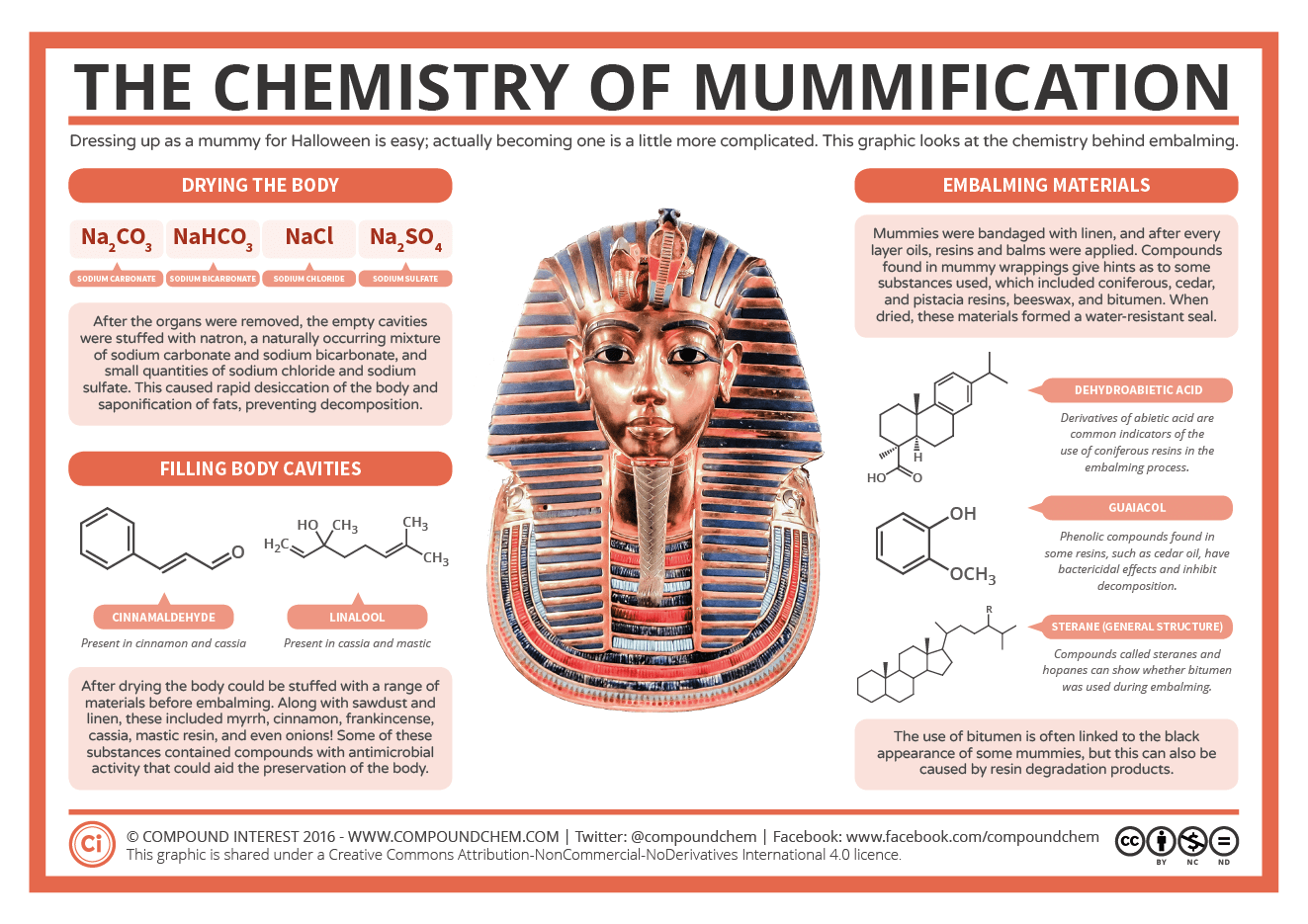
These days, when we think of the preservation of bodies, we think of cryogenics, but as we all know, the Ancient Egyptians were as fascinated with life after death as we are. Click on the infographic below to find out more about the chemistry of mummification.


It takes about 70 days to completely mummify a dead body and in Ancient Egypt there were no restrictions on who could be mummified, as long as you could pay! The Egyptians believed that when they died they would make a journey to another world where they would lead a new life. They would need all the things they had used when they were alive so their family would put those things in their grave. Egyptians paid vast amounts of money to have their bodies properly preserved. 

For more information visit:-


Tuesday, 26 July 2016

The chemistry of ice cream

Who doesn’t love ice cream? Especially when the sun is shining! But what is the science that lies behind ice cream making? Have a look at this graphic which takes a look at some of the ingredients that go into ice cream, and the important role they play in creating the finished product.

Graphic: Compound Interest 
Before the development of modern refrigeration, ice cream was a luxury reserved for special occasions. Making it was quite laborious; ice was cut from lakes and ponds during the winter and stored in holes in the ground, or in wood-frame or brick ice houses, insulated by straw. Many farmers and plantation owners, including U.S. Presidents George Washington and Thomas Jefferson, cut and stored ice in the winter for use in the summer. Frederic Tudor of Boston turned ice harvesting and shipping into a big business, cutting ice in New England and shipping it around the world.

Ice cream was made by hand in a large bowl placed inside a tub filled with ice and salt. This was called the pot-freezer method. French confectioners refined the pot-freezer method, making ice cream in a sorbetière (a covered pail with a handle attached to the lid). In the pot-freezer method, the temperature of the ingredients is reduced by the mixture of crushed ice and salt. The salt water is cooled by the ice, and the action of the salt on the ice causes it to (partially) melt, absorbing latent heat and bringing the mixture below the freezing point of pure water. The immersed container can also make better thermal contact with the salty water and ice mixture than it could with ice alone.

The hand-cranked churn, which also uses ice and salt for cooling, replaced the pot-freezer method. The exact origin of the hand-cranked freezer is unknown, but the first U.S. patent for one was #3254 issued to Nancy Johnson on 9 September 1843. The hand-cranked churn produced smoother ice cream than the pot freezer and did it quicker. Many inventors patented improvements on Johnson's design.

In Europe and early America, ice cream was made and sold by small businesses, mostly confectioners and caterers. Jacob Fussell of Baltimore, Maryland was the first to manufacture ice cream on a large scale. Fussell bought fresh dairy products from farmers in York County, Pennsylvania, and sold them in Baltimore. An unstable demand for his dairy products often left him with a surplus of cream, which he made into ice cream. He built his first ice cream factory in Seven Valleys, Pennsylvania, in 1851. Two years later, he moved his factory to Baltimore. Later, he opened factories in several other cities and taught the business to others, who operated their own plants. Mass production reduced the cost of ice cream and added to its popularity.

The development of industrial refrigeration by German engineer Carl von Linde during the 1870s eliminated the need to cut and store natural ice, and, when the continuous-process freezer was perfected in 1926, commercial mass production of ice cream and the birth of the modern ice cream industry was underway.

In modern times, a common method for producing ice cream at home is to use an ice cream maker, an electrical device that churns the ice cream mixture while cooled inside a household freezer. Some more expensive models have an inbuilt freezing element. A newer method is to add liquid nitrogen to the mixture while stirring it using a spoon or spatula for a few seconds; a similar technique, advocated by Heston Blumenthal as ideal for home cooks, is to add dry ice to the mixture while stirring for a few minutes. Some ice cream recipes call for making a custard, folding in whipped cream, and immediately freezing the mixture. Another method is to use a pre-frozen solution of salt and water, which gradually melts as the ice cream freezes.

For more information visit:

Wednesday, 29 June 2016

Today in Chemistry History – Emil Erlenmeyer’s Birthday

The Erlenmeyer flask is a piece of glassware most of us have likely used at some point. The tapered sides and narrow neck of this flask allow the contents of the flask to be mixed by swirling, without risk of spillage, making them suitable for titrations. By placing it under the buret and adding solvent and the indicator in Erlenmeyer flask. Such features similarly make the flask suitable for boiling liquids. Hot vapors condense on the upper section of the Erlenmeyer flask, reducing solvent loss. Erlenmeyer flasks' narrow necks can also support filter funnels.

As Compound Interest notes “The Erlenmeyer flask’s popularity lies in its utility. Its flat base means it isn’t easily toppled, unlike the round-bottomed flasks which can also be found in the laboratory. Its tapered, cone-like shape, coupled with its narrow neck, means that liquids inside it can be swirled without spilling easily. Additionally, the sides minimise loss of liquids from the flask when they are heated, as vapours condense on the sides. The narrow neck can also be plugged with a rubber or glass stopper.”

Who was Erlenmeyer?

Erlenmeyer was the son of Dr. Friedrich Erlenmeyer, a Protestant theologian. He enrolled in the University of Giessen to study medicine, but after attending lectures of Justus von Liebig changed to chemistry. In the summer of 1846 he went to Heidelberg for one year, and studied physics, botany and mineralogy, returning to Giessen in 1847. After serving as assistant to H. Will and then to Carl Remigius Fresenius, Erlenmeyer decided to devote himself to pharmaceutical chemistry. For this purpose he studied in Nassau, where he passed the state pharmaceutical examination, and shortly afterwards acquired an apothecary’s business, first at Katzenelnbogen and then in Wiesbaden. He became dissatisfied with pharmacy and returned to chemistry, finishing his doctorate at Giessen in 1850.


In 1855 he moved to Heidelberg and there converted a shed into a private laboratory. In 1857 he became privatdocent and his habilitation thesis "On the manufacture of the artificial manure known as superphosphate” contained a description of several crystalline substances which greatly interested Robert Bunsen. It was while at Heidelberg that Erlenmeyer was brought under the influence of August Kekulé, whose theoretical views he was one of the first to adopt. He was the first to suggest, in 1862, that double and triple bonds could form between carbon atoms, and he made other important contributions to the development of theories of molecular structure.

In 1863 he became associate professor at the University of Heidelberg. In 1868 he was hired as full professor in Munich to take charge of the laboratories of the new Munich Polytechnic School, a post which he held until his retirement from teaching in 1883.

His work mostly focused on theoretical chemistry, where he suggested the formula for naphthalene and formulated the Erlenmeyer rule: alcohols in which the hydroxyl group is attached directly to a double-bonded carbon atom become aldehydes or ketones.

Erlenmeyer’s practical investigations were concerned mostly with aliphatic compounds. In 1859 he synthesised aminohexoic acid and proceeded to study the general behaviour of albuminoids on hydrolysis. He worked out methods to determine the relative amounts of leucine and tyrosine, which are produced during the degradation of several substances of this class, and was the first (1860) to understand the nature of glycide and to suggest that this substance is related to glycerol in the same way as is metaphosphoric acid to orthophosphoric acid. In the following year he studied the action of hydroiodic acid on glycerol, and showed that the product was isopropyl- and not propyl iodide. His investigations of the higher alcohols produced during fermentation yielded the important proof that these alcohols do not belong to the normal series.

For more information visit:


Tuesday, 8 March 2016

Celebrating women in science on International Women’s Day: Dorothy Mary Hodgkin

Dorothy Mary Hodgkin OM FRS (12 May 1910 – 29 July 1994), known professionally as Dorothy Crowfoot Hodgkin or simply Dorothy Hodgkin, was a British biochemist who developed protein crystallography, for which she won the Nobel Prize in Chemistry in 1964.

She advanced the technique of X-ray crystallography, a method used to determine the three-dimensional structures of biomolecules. Among her most influential discoveries are the confirmation of the structure of penicillin that Ernst Boris Chain and Edward Abraham had previously surmised, demonstrating (contrary to scientific opinion at the time) that it contains a β-lactam ring. She also confirmed the structure of vitamin B12, for which she became the third woman to win the Nobel Prize in Chemistry.  In 1945, working with C. H. (Harry) Carlisle, she published the first such structure of a steroid, cholesteryl iodide (having worked with cholesteryls since the days of her doctoral studies). 

In 1948, Hodgkin first encountered vitamin B12 and created new crystals. Vitamin B12 had first been discovered by Merck earlier that year. Vitamin B12 had a structure at the time that was almost completely unknown, and when Hodgkin discovered it contained cobalt, she realized the structure actualization may be determined by x-ray crystallography analysis. The large size of the molecule, and that the atoms were largely unaccounted for - aside from cobalt - posed a challenge in structure analysis that hadn't been previously explored.

Molecular structure of vitamin B12, by NEUROtiker (Own work) [Public domain], via Wikimedia Commons

From these crystals, she deduced the presence of a ring structure because the crystals were pleochroic, a finding which she later confirmed using X-ray crystallography. The B12 study published by Hodgkin was described by Lawrence Bragg as being as significant "as breaking the sound barrier." Scientists from Merck had previously crystallised B12, but had published only refractive indices of the substance. The final structure of B12, for which Hodgkin was later awarded the Nobel Prize, was published in 1955.

In 1969, after 35 years of work and five years after winning the Nobel Prize, Hodgkin was able to decipher the structure of insulin. X-ray crystallography became a widely used tool and was critical in later determining the structures of many biological molecules where knowledge of structure is critical to an understanding of function. She is regarded as one of the pioneer scientists in the field of X-ray crystallography studies of biomolecules.

For more information visit:-


Tuesday, 26 January 2016

Breast milk protein could be used in fight against antibiotic resistance

An antibiotic developed from human breast milk could combat certain drug-resistant bacteria, British scientists have found.

Tackling antibiotic-resistant bacteria, known as superbugs, is a priority for the government. A panel set up by David Cameron forecast that they would cost 10 million lives and £700bn a year worldwide by 2050 if the problem went unchecked.

The breakthrough, by the National Physical Laboratory (NPL) and University College London, found that the minuscule fragment, less than a nanometre in width, is responsible for giving the protein its anti-microbial properties.

This is what makes breast milk so important in protecting infants from disease in their first months of life. The protein, called lactoferrin, effectively kills bacteria, fungi and even viruses on contact.

After identifying the fragment, scientists re-engineered it into a virus-like capsule that can recognise and target specific bacteria and damage them on contact, but without affecting any surrounding human cells.

The team suggested this could help the fight against antibiotic resistance by serving as “delivery vehicles” for cures. The capsules could even pave the way for treatments for previously incurable conditions such as sickle-cell disease, cystic fibrosis and Duchenne muscular dystrophy.

The Lactating Breast
When the baby sucks, a hormone called oxytoxin starts the milk flowing from the alveoli, through the ducts (milk canals) into the sacs (milk pools) behind the areola and finally into the baby's mouth.
In an interview with the Times, Dame Sally Davies, the chief medical officer for England, said governments and experts needed to do more to tackle the antibiotics issue. “We need on average 10 new antibiotics every decade. If others do not work with us, it’s not something we can sort on our own,” she said. “This is a global problem. I am optimistic about this. The science is crackable. It’s doable.”

Colin Garner, honorary professor of pharmacology at the University of York and head of the charity Antibiotic Research UK, said the situation was too urgent to wait for international consensus. “The pipeline of new drugs had dried up and the problem was on the brink of becoming intractable, he told the Times.

“My heart sinks when I hear the term ‘global initiative’. How long has it taken the world to come to a sort of consensus about climate change?” he said.

“The problem of antibiotic resistance will be at least as intractable, because each nation takes a different view of what is required.”

The NPL findings are reported in the Royal Society of Chemistry journal Chemical Science.

For more information visit:


Friday, 12 June 2015

The Chemistry of Stinging Nettles

Stinging nettles are a type of plant which have defensive hairs. Their stings hurt a lot. Stinging nettles can be found in all of America except Hawaii. They can also be found in most of Europe and in Asia. Nettles sting because the hairs on it contains poison. If nettles are heated the poison disappears, making it edible.


Click to enlarge
The excellent Compound Interest site once again shows us how something that has happened to most of us actually works.  The chemistry of stinging nettles and what can be done to counter act them.


Nettles have long been used for medicinal purposes.  Nettle leaf is a herb that has a long tradition of use as an adjuvant remedy in the treatment of arthritis in Germany. Nettle leaf extract contains active compounds that reduce TNF-α and other inflammatory cytokines. It has been demonstrated that nettle leaf lowers TNF-α levels by potently inhibiting the genetic transcription factor that activates TNF-α and IL-1B in the synovial tissue that lines the joint. 

Urtica dioica herb has been used in the traditional Austrian medicine internally (as tea or fresh leaves) for treatment of disorders of the kidneys and urinary tract, gastrointestinal tract, locomotor system, skin, cardio-vascular system, hemorrhage, flu, rheumatism and gout. 

Nettle is used in shampoo to control dandruff and is said to make hair more glossy, which is why some farmers include a handful of nettles with cattle feed. 

Nettle root extracts have been extensively studied in human clinical trials as a treatment for symptoms of benign prostatic hyperplasia (BPH). These extracts have been shown to help relieve symptoms compared to placebo both by themselves and when combined with other herbal medicines.
 
For more information visit:-

Friday, 3 April 2015

Stained and Coloured Glass

Stained glass can refer to coloured glass as a material or to works created from it - most commonly seen in the stained glass windows of churches and other buildings.  Coloured glass is also found in everyday life such as green wine bottles.


As a material stained glass is glass that has been coloured by adding metallic salts during its manufacture.

There are two main types of glass - soda lime glass - commonly used in beverage bottles and the like and borosilicate glass - used in laboratory glassware and also some domestic glassware such as oven proof dishes.

Coloured glass is made in a number of ways.  There are three main ways.

The first involves introducing metallic or rare earth metal oxides to the glass as mentioned above.

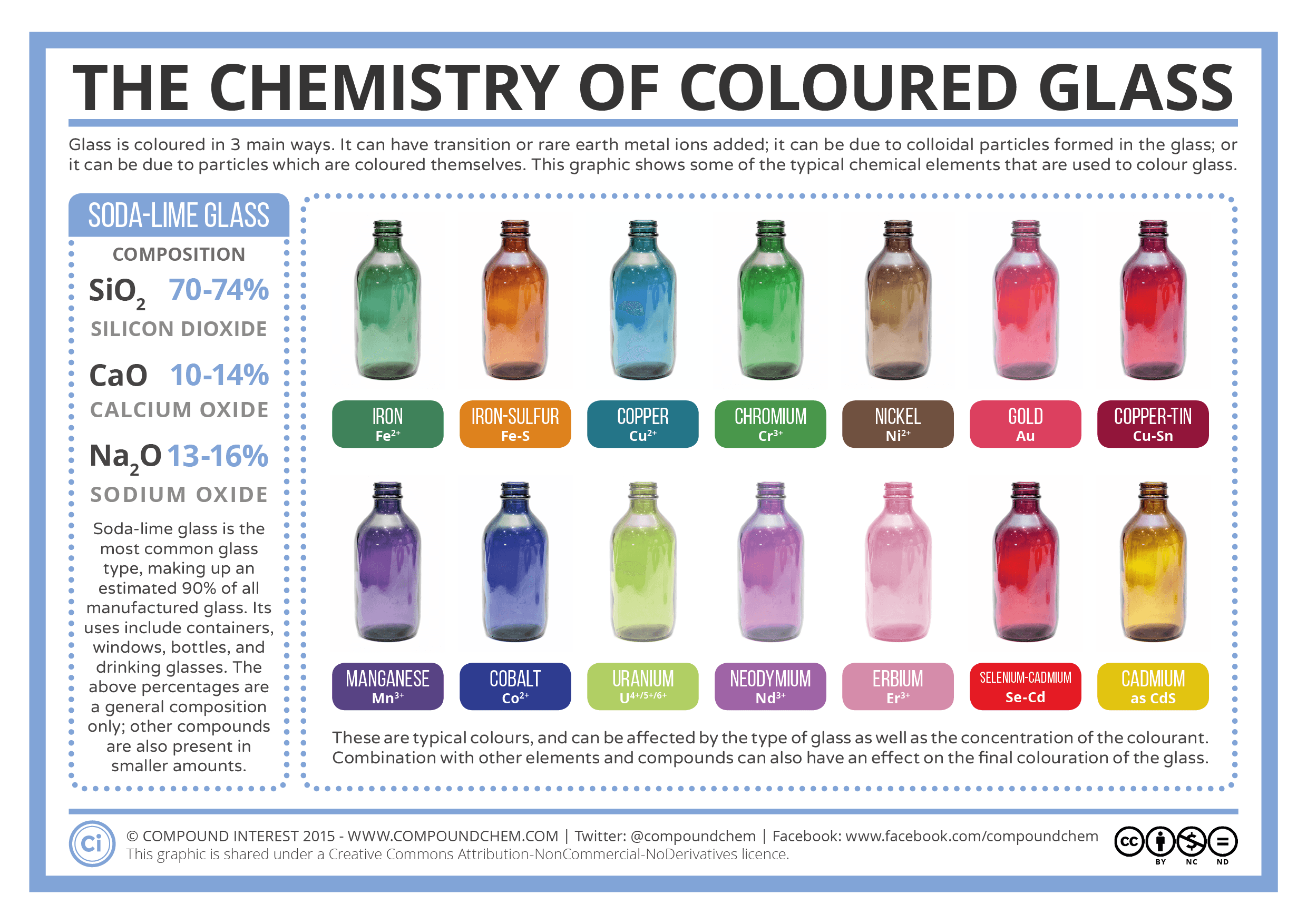
Silver compounds for example such as silver nitrate are used as stain applied to the surface of glass and fired on. They can produce a range of colours from orange-red to yellow. The way the glass is heated and cooled can significantly affect the colours produced by these compounds.

Another way is by formation of colloidal particles. This means particles of a substance are suspended throughout the glass. The particles scatter light of particular frequencies as it passes through the glass, causing colouration.

Gold gives a ruby red colour, and selenium gives a pink to intense red.

The final main way in which colour can be introduced is through the addition of already coloured particles to the glass. Examples of this type of colouration include milk glass and smoked glass; milk glass is achieved by adding tin oxide.

The infographic below from Compound Interest shows what chemicals are involved in the colour process.  Click for a larger image.


Click to enlarge
For more information visit:-
http://en.wikipedia.org/wiki/Stained_glass
http://www.compoundchem.com/2015/03/03/coloured-glass/

Friday, 20 March 2015

Copper Sulphate

Copper (II) sulfate, also known as cupric sulfate or copper sulphate, is the chemical compound with the chemical formula CuSO4. This salt exists as a series of compounds that differ in their degree of hydration. The anhydrous form is a pale green or grey-white powder, whereas the pentahydrate (CuSO4·5H2O), the most commonly encountered salt, is bright blue.
Copper Sulphate Crystals
Copper sulphate is normally produced industrially by treating copper metal with hot concentrated sulphuric acid.  Laboratories generally purchase their own - eg here.

At 650 °C (1,202 °F), copper (II) sulphate decomposes into copper (II) oxide (CuO) and sulphur trioxide (SO3).  Its blue colour is due to water of hydration. When heated in an open flame the crystals are dehydrated and turn greyish-white.
 
Copper sulphate pentahydrate is a fungicide.  Mixed with lime it is called Bordeaux mixture and used to control fungus on grapes, melons, and other berries.  Its use as a herbicide is not agricultural, but instead for control of invasive aquatic plants and the roots of plants near pipes containing water. It is used in swimming pools as an algicide. A dilute solution of copper sulphate is used to treat aquarium fish for parasitic infections.
 
Several chemical tests utilize copper sulphate. It is used in Fehling's solution and Benedict's solution to test for reducing sugars, which reduce the soluble blue copper(II) sulphate to insoluble red copper(I) oxide. Copper(II) sulphate is also used in the Biuret reagent to test for proteins.

Copper sulphate is a commonly included chemical in children's chemistry sets and is often used to grow crystals as can be seen here.

The chemical is also used in flame tests - again which can be seen here.

In 2008, the artist Roger Hiorns filled an abandoned waterproofed council flat in London with 75,000 litres of copper sulphate solution. The solution was left to crystallize for several weeks before the flat was drained, leaving crystal-covered walls, floors and ceilings. The work is titled Seizure.


For more information visit:-
http://en.wikipedia.org/wiki/Copper(II)_sulphate
http://prlabpak.blogspot.co.uk/2014/09/flamin-hot-colours.html
http://prlabpak.blogspot.co.uk/2012/09/making-chemical-garden.html

Friday, 6 March 2015

The smell of the earth!

Ever wondered what the smell of the earth is?  Maybe you've visited the countryside while farmers have been ploughing their fields and smelled it.  The smell is caused by Geosmin which is an organic compound with a distinct earthy aroma produced by a type of Actinobacteria.


Geosmin is produced by the bacteria Streptomyces, a genus of Actinobacteria and released when these microorganisms die.

Geosmin is a colourless liquid, with a boiling point of 270°C.  The human nose is extremely sensitive to geosmin and is able to detect it at concentrations as low as 5 parts per trillion.  It is the smell after a rainstorm when the ground is wet.

Geosmin is often responsible for unpleasant tastes in water supplies. Cyanobacteria (blue-green algae) and actinobacteria release geosmin when they die, and this can be absorbed by bottom-feeding freshwater fish such as carp and catfish. Geosmin combines with 2-methylisoborneol, which concentrates in the fatty skin and dark muscle tissues. Geosmin breaks down in acid conditions; hence, vinegar, lemon and other acidic ingredients are used in fish recipes to help reduce the muddy flavour.

Geosmin can sometimes be tasted in wine or drinking water.

It has also been suggested that camels can detect the smell of geosmin that had been released by Streptomyces miles away in wet ground, and track the geosmin to find an oasis; in return the camel could carry away and disperse the spores of the Streptomyces bacterium.


Soil is considered to be the "skin of the earth" and consists of a solid phase (minerals and organic matter) as well as a porous phase that holds gases and water.  It carries essential nutrients for plantlife and is a habitat for organisms that take part in decomposition of organic matter and the creation of a habitat for new organisms.

For more information visit:-
http://web.expasy.org/spotlight/back_issues/035/
http://en.wikipedia.org/wiki/Soil


Friday, 6 February 2015

Boron!

Boron is a chemical element with symbol B and atomic number 5. It is a low-abundance element in both the Solar system and the Earth's crust and is concentrated on Earth by the water-solubility of its more common naturally occurring compounds, the borate minerals. These are mined industrially as evaporites, such as borax and kernite. The largest proven boron deposits are in Turkey, which is also the largest producer of boron minerals.


This rare element is a metalloid; which means that it can can act both as an acid and a base, and it also behaves as a semiconductor.  Boron never occurs in a pure state in the wild, and can only be purified with difficulty by chemists. Boron is a poor conductor of electricity, and is fairly non-reactive, although it is water soluble. The most common uses for boron-containing compounds includes a bleach for clothing, a swimming pool disinfectant and to produce green flames.

About half of global consumption of boron compounds is as additives for glass fibres in boron-containing fibreglass used for insulation or as structural materials. The next leading use is to make boron polymers and ceramics, that play specialised roles as high-strength lightweight structural and refractory materials. Borosilicate glass glassware is used for its greater strength and breakage resistance (thermal shock resistance) than ordinary soda lime glass.


For more information visit:-
http://en.wikipedia.org/wiki/Boron
http://www.theguardian.com/science/punctuated-equilibrium/2011/mar/11/1

Friday, 16 January 2015

Arsenic


Arsenic is a chemical element with symbol As and atomic number 33. Arsenic occurs in many minerals, usually in conjunction with sulphur and metals, and also as a pure elemental crystal. Arsenic is a metalloid. It can exist in various allotropes, although only the grey form has important use in industry.
 
Arsenic atoms can assume several different bonding patterns which are the basis of its allotropes, each of which has a different colour; metallic grey, yellow and black arsenic. Interestingly, using a hammer to bang on arsenide minerals releases a garlic-like odour, which is the result of toxic fumes created by the oxidation of arsenic to arsenic trioxide.

Arsenic is notoriously poisonous to multicellular life, although a few species of bacteria are able to use arsenic compounds as respiratory metabolites. Arsenic contamination of groundwater is a problem that affects millions of people across the world.
Historically, Arsenic was commonly used as a rodent poison in English households, and it was also a convenient murder weapon, particularly amongst the ruling classes as you may have read in various novels and non-fiction books. However, Victorian England used arsenic in a number of ways; it was incorporated into wallpaper to prevent the growth of mould during the dark, damp English winters, it was used as the green colouring in paints, candies and candles, and as a preservative in lace.

The main use of metallic arsenic is for alloying with lead. Lead components in car batteries are strengthened by the presence of a very small percentage of arsenic.

Widespread arsenic contamination of groundwater has led to a massive epidemic of arsenic poisoning in Bangladesh and neighbouring countries. It is estimated that approximately 57 million people in the Bengal basin are drinking groundwater with arsenic concentrations elevated above the World Health Organization's standard of 10 parts per billion (ppb).

More recently arsenic has been in the news for being found in rice.  Rice holds higher levels of arsenic than other grains and acts as one of nature’s “great scavengers of metallic compounds.” Unlike, millet or polenta, rice planted in arsenic-contaminated fields acts as a vacuum for the toxin.

Rice from different countries contain differing levels of arsenic.  It's recommended that rice is washed before cooking and rinsed afterwards to lessen the effects.

Currently, the FDA in America doesn't have safety levels for arsenic in rice. They've cautioned against making state-by-state or country-by country comparisons in Inorganic Arsenic levels for rice, citing the varying factors that can influence arsenic concentrations, such as soil composition, fertilizers, seasonal variability, and water-use practices.


Evidence-based public health advocates also recommend that, given the lack of regulation or labelling for arsenic in the U.S., children should eat no more than 1 to 1.5 servings per week of rice and should not drink rice milk as part of their daily diet before age 5. They also offer recommendations for adults and infants on how to limit arsenic exposure from rice, drinking water, and fruit juice.

A 2014 World Health Organization advisory conference will consider limits of 200–300 ppb for rice.  The proposed new EU recommendations will limit 200 parts of arsenic per billion for adults and just 100 ppb for children and babies.

For more information visit:-
http://en.wikipedia.org/wiki/Arsenic
http://www.theguardian.com/science/punctuated-equilibrium/2011/oct/14/1
https://time.com/3592399/arsenic-rice/
http://www.dailymail.co.uk/news/article-2817542/More-half-rice-products-exceed-new-EU-limits-ARSENIC.html

Friday, 12 December 2014

Glow Sticks!

A glow stick is a self-contained, short-term light-source. It consists of a translucent plastic tube containing isolated substances that, when combined, make light through chemiluminescence, so it does not require an external energy source. The light cannot be turned off, and can be used only once. Glow sticks are often used for recreation, but may also be relied upon for light during military, police, fire, or Emergency operations.


Chemistry of Glow Stick Colours
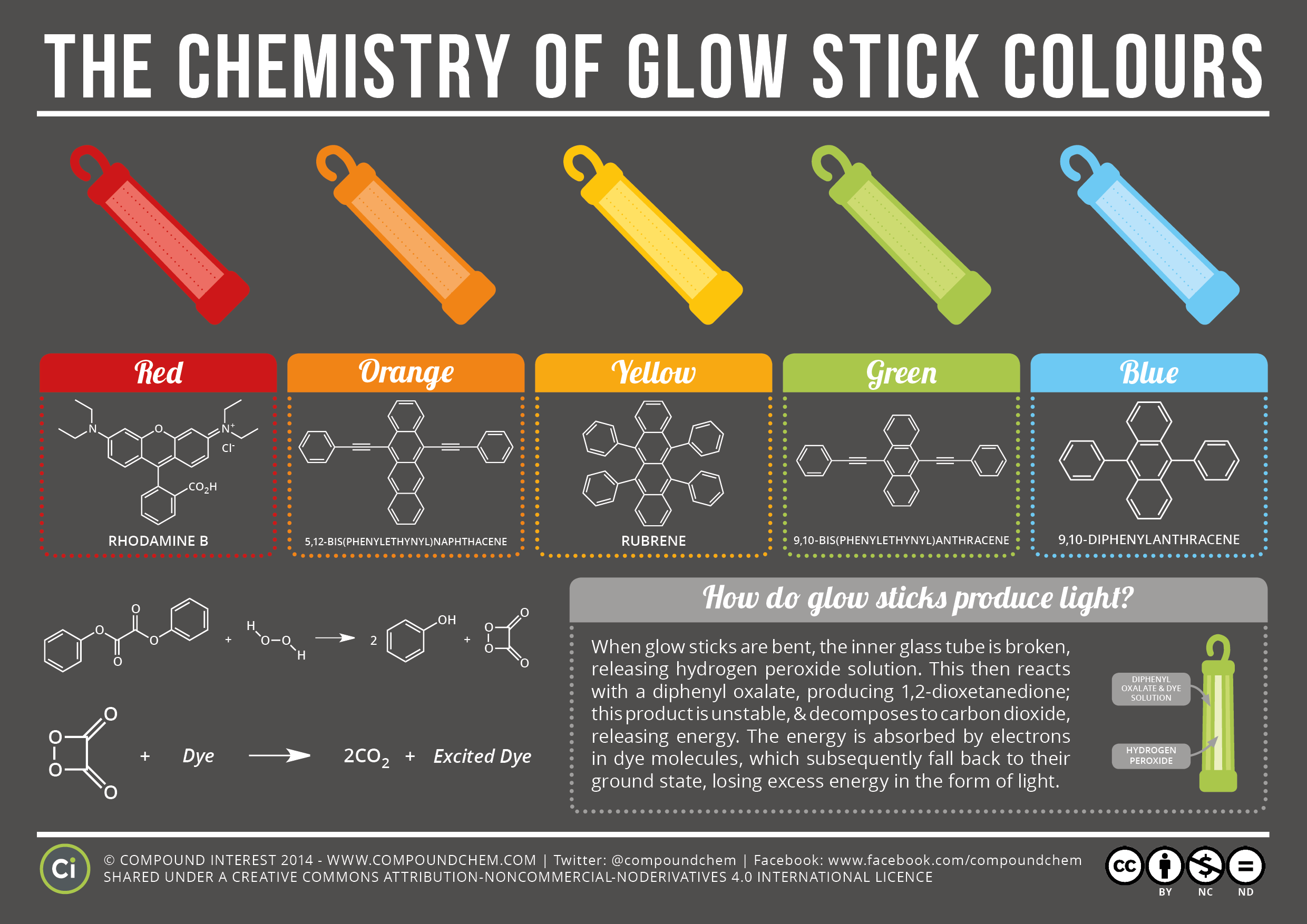
A glow stick contains two chemicals and a suitable dye. The chemicals inside the plastic tube are a mixture of the dye and diphenyl oxalate. The chemical in the glass vial is hydrogen peroxide. By mixing the peroxide with the phenyl oxalate ester, a chemical reaction takes place, yielding two molecules of phenol and one molecule of peroxyacid ester (1,2-dioxetanedione). The peroxyacid decomposes spontaneously to carbon dioxide, releasing energy that excites the dye, which then relaxes by releasing a photon. The wavelength of the photon—the color of the emitted light—depends on the structure of the dye.

As stated by the excellent article by Compound Interest, a range of different chemicals can be used, including those shown above, as well as one or two additional dyes. Whilst the molecules of the dye are always present in the solution, the hydrogen peroxide and the diphenyl oxalate are slowly used up by the reaction, until one runs out and the reaction ceases – and it’s at this point that the glow stick will stop emitting its glow.

Friday, 14 November 2014

Platinum

Platinum has the chemical symbol Pt and atomic number 78. It’s a dense, malleable, ductile, highly unreactive, precious, grey-white transition metal. Its name is derived from the Spanish term platina, which is literally translated into "little silver”.


Platinum occurs in the wild as the pure element as well as alloyed with iridium, known as platiniridium.  It is one of the rarest elements in the Earth's crust with an average abundance of approximately 5 μg/kg.

In addition to its high density, resistance to oxidation and other desirable qualities, platinum is remarkably chemically unreactive. For these reasons, a 90-10% alloy of platinum-iridium is still used as the International Prototype Kilogram. Originally, this prototype kilogram was made of pure platinum, but iridium was added to increase its hardness while retaining platinum's many desirable qualities.

Platinum Nuggets


Platinum is used in catalytic converters, laboratory equipment, electrical contacts and electrodes, platinum resistance thermometers, dentistry equipment, and jewellery. Being a heavy metal, it leads to health issues upon exposure to its salts, but due to its corrosion resistance, it is not as toxic as some metals. Some compounds containing platinum are applied in chemotherapy against certain types of cancer.

Platinum;s resistance to wear and tarnish is well suited to its use in fine jewellery.


Platinum is obtained commercially as a by-product from nickel and copper mining and processing.  As an example, of the 245 tonnes of platinum sold in 2010, 113 tonnes were used for vehicle emissions control devices (46%), 76 tonnes for jewellery (31%). The remaining 35.5 tonnes went to various other minor applications, such as investment, electrodes, anticancer drugs, oxygen sensors, spark plugs and turbine engines.

For more information visit:-
http://www.theguardian.com/science/grrlscientist/2013/jan/11/1?guni=Article:in%20body%20link
http://en.wikipedia.org/wiki/Platinum