Total Lab Supplies - Everything for your laboratory

Total Lab Supplies - Everything for your laboratory
Our Head Office in St Helens
Showing posts with label virus. Show all posts

Tuesday, 26 January 2016

Breast milk protein could be used in fight against antibiotic resistance

An antibiotic developed from human breast milk could combat certain drug-resistant bacteria, British scientists have found.

Tackling antibiotic-resistant bacteria, known as superbugs, is a priority for the government. A panel set up by David Cameron forecast that they would cost 10 million lives and £700bn a year worldwide by 2050 if the problem went unchecked.

The breakthrough, by the National Physical Laboratory (NPL) and University College London, found that the minuscule fragment, less than a nanometre in width, is responsible for giving the protein its anti-microbial properties.

This is what makes breast milk so important in protecting infants from disease in their first months of life. The protein, called lactoferrin, effectively kills bacteria, fungi and even viruses on contact.

After identifying the fragment, scientists re-engineered it into a virus-like capsule that can recognise and target specific bacteria and damage them on contact, but without affecting any surrounding human cells.

The team suggested this could help the fight against antibiotic resistance by serving as “delivery vehicles” for cures. The capsules could even pave the way for treatments for previously incurable conditions such as sickle-cell disease, cystic fibrosis and Duchenne muscular dystrophy.

The Lactating Breast
When the baby sucks, a hormone called oxytoxin starts the milk flowing from the alveoli, through the ducts (milk canals) into the sacs (milk pools) behind the areola and finally into the baby's mouth.
In an interview with the Times, Dame Sally Davies, the chief medical officer for England, said governments and experts needed to do more to tackle the antibiotics issue. “We need on average 10 new antibiotics every decade. If others do not work with us, it’s not something we can sort on our own,” she said. “This is a global problem. I am optimistic about this. The science is crackable. It’s doable.”

Colin Garner, honorary professor of pharmacology at the University of York and head of the charity Antibiotic Research UK, said the situation was too urgent to wait for international consensus. “The pipeline of new drugs had dried up and the problem was on the brink of becoming intractable, he told the Times.

“My heart sinks when I hear the term ‘global initiative’. How long has it taken the world to come to a sort of consensus about climate change?” he said.

“The problem of antibiotic resistance will be at least as intractable, because each nation takes a different view of what is required.”

The NPL findings are reported in the Royal Society of Chemistry journal Chemical Science.

For more information visit:


Friday, 13 March 2015

Vaccines


A vaccine is a biological preparation that provides active acquired immunity to a particular disease. A vaccine typically contains an agent that resembles a disease-causing microorganism and is often made from weakened or killed forms of the microbe, its toxins or one of its surface proteins. The agent stimulates the body's immune system to recognize the agent as a threat, destroy it, and keep a record of it, so that the immune system can more easily recognize and destroy any of these microorganisms that it later encounters

Vaccines have historically been the most effective means to fight and eradicate infectious diseases. Limitations to their effectiveness do exist.  Sometimes, protection fails because the host's immune system doesn’t respond adequately or at all. Lack of response commonly results from clinical factors such as diabetes, steroid use, HIV infection or age. However it also might fail for genetic reasons.

Adjuvants commonly are used to boost immune response, particularly for older people (50–75 years and up), whose immune response to a simple vaccine may have weakened.

Vaccines are dead or inactivated organisms or purified products derived from them.

There are several types of vaccines in use.  These represent different strategies used to try to reduce risk of illness, while retaining the ability to induce a beneficial immune response.
Some vaccines contain inactivated, but previously virulent, micro-organisms that have been destroyed with chemicals, heat, radioactivity, or antibiotics. Examples are influenza, cholera, bubonic plague, polio, hepatitis A, and rabies.
Some vaccines contain live, attenuated microorganisms. Many of these are active viruses that have been cultivated under conditions that disable their virulent properties, or that use closely related but less dangerous organisms to produce a broad immune response. Although most attenuated vaccines are viral, some are bacterial in nature. Examples include the viral diseases yellow fever, measles, rubella, and mumps, and the bacterial disease typhoid.
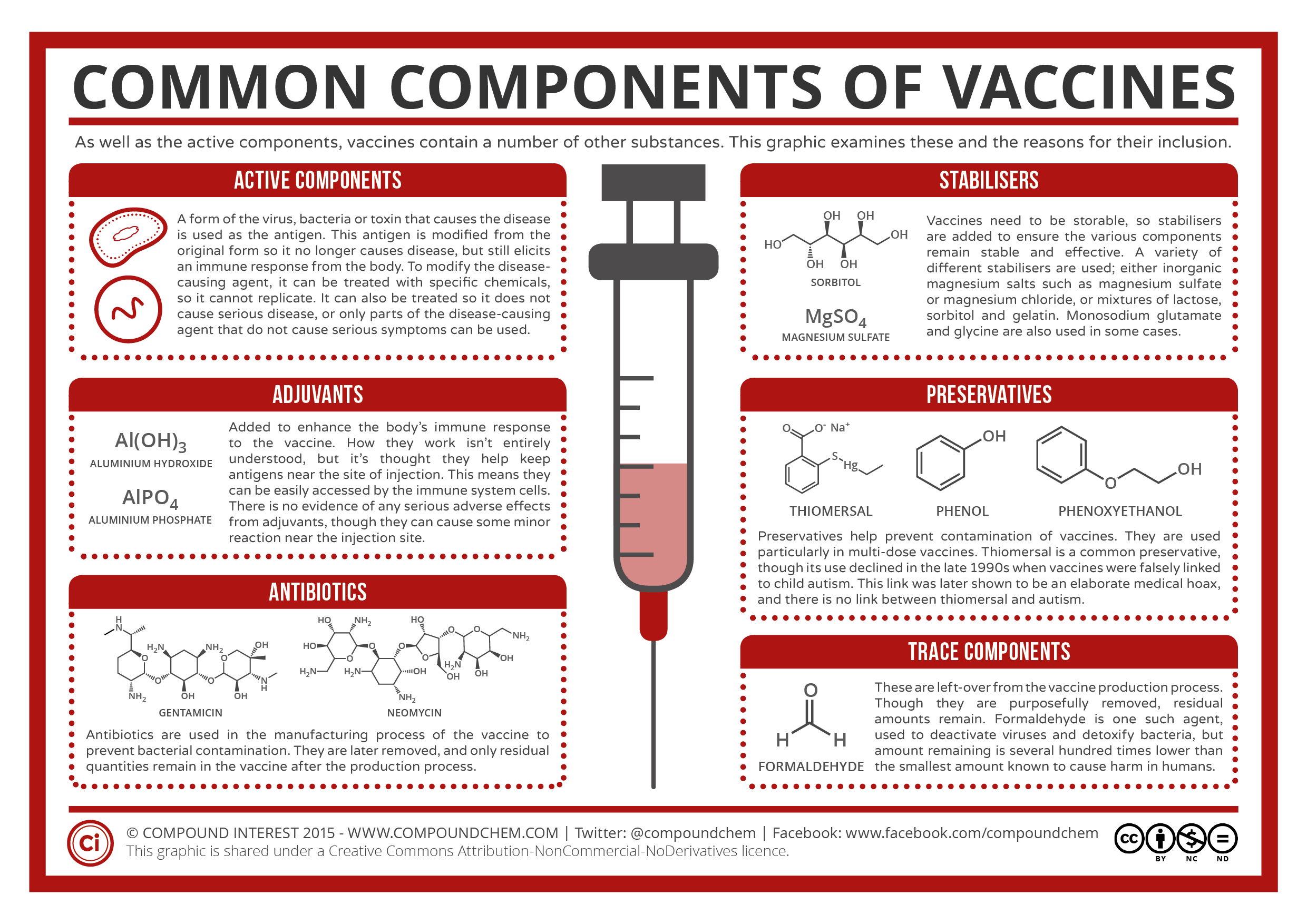
The infographic above from Compound Interest shows the common components of vaccines. 
When making vaccines, antibiotics can be used to prevent bacterial contamination. Although these are removed after manufacture, trace amounts can still remain in the final vaccine. Antibiotics that often cause adverse allergic reactions, such as penicillins, are avoided, in favour of antibiotics such as gentamycin and neomycin.
For more information visit:-