Total Lab Supplies - Everything for your laboratory

Total Lab Supplies - Everything for your laboratory
Our Head Office in St Helens
Showing posts with label biology. Show all posts

Tuesday, 17 January 2017

Simple fats, amino acids to explain how life began

Life is a process that originated 3.5 billion years ago. It emerged when the basic components of the cells that we know today, in other words, inanimate chemical molecules, gradually joined, merged, assembled themselves and interacted. At a given moment they became alive, or what amounts to the same thing, they turned into autonomous systems. As the years passed they gradually evolved until achieving their current complexity and diversity. A piece of research by the UPV/EHU is working on the start of this trajectory by studying how the chemical molecules assembled themselves so that life could begin.

A section of DNA. Zephyris at the English language Wikipedia [GFDL (http://www.gnu.org/copyleft/fdl.html) or CC-BY-SA-3.0 (http://creativecommons.org/licenses/by-sa/3.0/)], via Wikimedia Commons
DNA, RNA, proteins, membranes, sugars, …cells are made up of all kinds of components. In biology, and in the studies dealing with the origin of life specifically, it is very common to focus on one of these molecules and put forward hypotheses on how life originated by analysing the specific mechanisms related to it. "Basically, these studies are looking for the 'molecule of life', in other words, they set out to establish which was the most important molecule in making this milestone happen," said Kepa Ruiz-Mirazo, researcher in the Biophysics Unit and of the UPV/EHU's Department of Logic and Philosophy of Science. However, bearing in mind that "life involves activity among a huge variety of molecules and components, a change of approach has been taking place in recent years and research that takes into account various molecules at the same time is gaining strength," he added.

Besides emerging in favour of this fresh approach, Ruiz-Mirazo's group, in collaboration with the University of Montpellier, through an internship of the UPV/EHU PhD student Sara Murillo-Sánchez, has been able to show that interaction exists between some molecules and others. "Our group has expertise in research into membranes that are created in prebiotic environments, in other words, in the study of the dynamics that fatty acids, the precursors of current lipids, may have had. 

The Montpellier group for its part specialises in the synthesis of the first peptides. So when the knowledge of each group is put together, and when we experimentally blended the fatty acids and the amino acids, we could see that there was a strong synergy between them."

As they were able to see, the catalysis of the reaction took place when the fatty acids formed compartments. As they are in an aqueous medium, and due to the hydrophobic nature of lipids, they tend to join with each other and form closed compartments; in other words, they take on the function of a membrane; "at that time the membranes obviously weren't biological but chemical ones," explained Ruiz-Mirazo. In their experiments they were able to see that the conditions offered by these membranes are favourable for amino acids. "The Montpellier group had the prebiotic reactions of the formation of dipeptides very well characterised, so they were able to see that this reaction took place more efficiently in the presence of fatty acids," he added.

Besides demonstrating the synergy between fatty acids and amino acids, Ruiz-Mirazo believes it is very important to have conducted the study using basic chemical components, in other words, molecular precursors. "Life emerged out of these basic molecules; therefore, to study its origin we cannot start from the complex phospholipids that are found in today's membranes. We have demonstrated the formation of the first coming together and formation of chains on the basis of molecular precursors. Or to put it another way, we have demonstrated that it is possible to achieve diversity and complexity in biology by starting from chemistry."

In his studies, in addition to the experimental work, Ruiz-Mirazo is working in another two spheres so in the end he is studying the origin of life from three pillars or perspectives: "firstly, we have the experimental field; another is based on theoretical models and computational simulations, which we use to analyse the results obtained in the experiments, and the third is a little broader, because we are studying from the philosophical viewpoint what life is, the influence that the conception held about life exerts on the experimental field, since each conception leads you to carry out a specific type of experiment," he explained. "These three methodologies mutually feed each other: an idea that may emerge in the philosophical analysis leads you to carry out a new simulation, and the results of the simulations mark out the path for designing the experiments. Or the other way round. Most likely we will never manage to find the answer to how life began, but we are working on it: all of us living beings on Earth have the same origin and we want to know how it happened."

For more information visit:-


Tuesday, 4 October 2016

The chemistry behind the aroma of coffee

The Aroma of Coffee (Compound Interest
What is it about that delicious smell of coffee? Or, more specifically, what lies behind it? The graphic above takes a look at a selection of the chemical compounds behind this aroma. 

So that's the chemistry, but what about the biology of coffee?

Several species of shrub of the genus Coffea produce the berries from which coffee is extracted. The two main species commercially cultivated are Coffea canephora (predominantly a form known as 'robusta') and C. arabica. C. arabica, the most highly regarded species, is native to the southwestern highlands of Ethiopia and the Boma Plateau in southeastern Sudan and possibly Mount Marsabit in northern Kenya. C. canephora is native to western and central Subsaharan Africa, from Guinea to Uganda and southern Sudan. Less popular species are C. liberica, C. stenophylla, C. mauritiana, and C. racemosa.

All coffee plants are classified in the large family Rubiaceae. They are evergreen shrubs or trees that may grow 5 m (15 ft) tall when unpruned. The leaves are dark green and glossy, usually 10–15 cm (4–6 in) long and 6 cm (2.4 in) wide, simple, entire, and opposite. Petioles of opposite leaves fuse at base to form interpetiolar stipules, characteristic of Rubiaceae. The flowers are axillary, and clusters of fragrant white flowers bloom simultaneously. Gynoecium consists of inferior ovary, also characteristic of Rubiaceae. The flowers are followed by oval berries of about 1.5 cm (0.6 in). When immature they are green, and they ripen to yellow, then crimson, before turning black on drying. Each berry usually contains two seeds, but 5–10% of the berries have only one; these are called peaberries. 

Arabica berries ripen in six to eight months, while robusta take nine to eleven months.

Coffea arabica is predominantly self-pollinating, and as a result the seedlings are generally uniform and vary little from their parents. In contrast, Coffea canephora, and C. liberica are self-incompatible and require outcrossing. This means that useful forms and hybrids must be propagated vegetatively. Cuttings, grafting, and budding are the usual methods of vegetative propagation. On the other hand, there is great scope for experimentation in search of potential new strains.

In 2016, Oregon State University entomologist George Poinar, Jr. announced the discovery of a new plant species that's a 45-million-year-old relative of coffee found in amber. Named Strychnos electri, after the Greek word for amber (electron), the flowers represent the first-ever fossils of an asterid, which is a family of flowering plants that not only later gave us coffee, but also sunflowers, peppers, potatoes, mint — and deadly poisons.

For more information visit:-


Friday, 13 March 2015

Vaccines


A vaccine is a biological preparation that provides active acquired immunity to a particular disease. A vaccine typically contains an agent that resembles a disease-causing microorganism and is often made from weakened or killed forms of the microbe, its toxins or one of its surface proteins. The agent stimulates the body's immune system to recognize the agent as a threat, destroy it, and keep a record of it, so that the immune system can more easily recognize and destroy any of these microorganisms that it later encounters

Vaccines have historically been the most effective means to fight and eradicate infectious diseases. Limitations to their effectiveness do exist.  Sometimes, protection fails because the host's immune system doesn’t respond adequately or at all. Lack of response commonly results from clinical factors such as diabetes, steroid use, HIV infection or age. However it also might fail for genetic reasons.

Adjuvants commonly are used to boost immune response, particularly for older people (50–75 years and up), whose immune response to a simple vaccine may have weakened.

Vaccines are dead or inactivated organisms or purified products derived from them.

There are several types of vaccines in use.  These represent different strategies used to try to reduce risk of illness, while retaining the ability to induce a beneficial immune response.
Some vaccines contain inactivated, but previously virulent, micro-organisms that have been destroyed with chemicals, heat, radioactivity, or antibiotics. Examples are influenza, cholera, bubonic plague, polio, hepatitis A, and rabies.
Some vaccines contain live, attenuated microorganisms. Many of these are active viruses that have been cultivated under conditions that disable their virulent properties, or that use closely related but less dangerous organisms to produce a broad immune response. Although most attenuated vaccines are viral, some are bacterial in nature. Examples include the viral diseases yellow fever, measles, rubella, and mumps, and the bacterial disease typhoid.
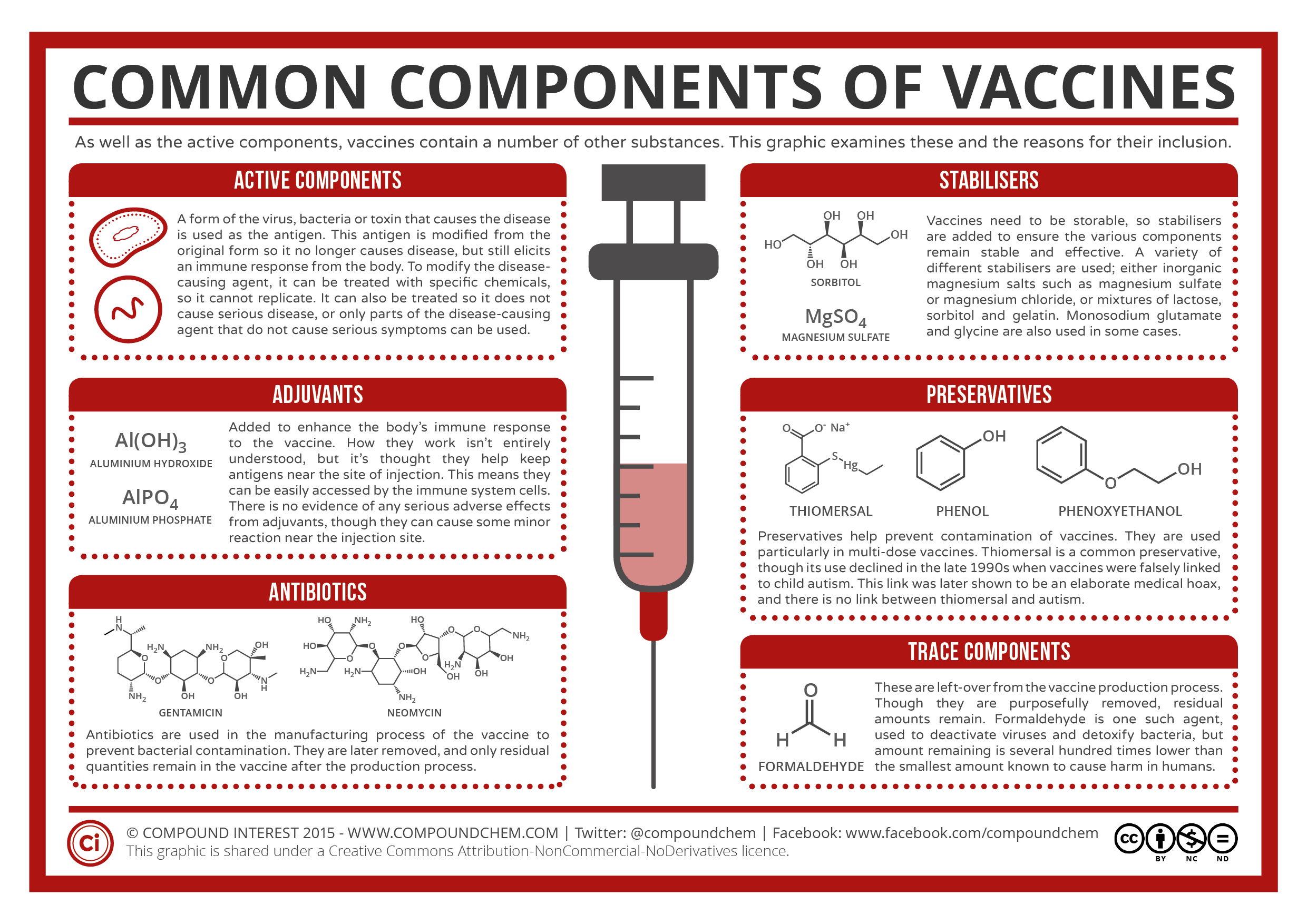
The infographic above from Compound Interest shows the common components of vaccines. 
When making vaccines, antibiotics can be used to prevent bacterial contamination. Although these are removed after manufacture, trace amounts can still remain in the final vaccine. Antibiotics that often cause adverse allergic reactions, such as penicillins, are avoided, in favour of antibiotics such as gentamycin and neomycin.
For more information visit:-


Friday, 27 February 2015

On this day

Charles Herbert Best was born on 27th February 1899.  He was a scientist and co-discoverer of Insulin.

(February 27, 1899 – March 31, 1978)

Best was born in West Pembroke, Washington County, Maine and was the son of Luella Fisher and Herbert Huestis Best, Canadians from Nova Scotia.
Best married Margaret Hooper Mahon in Toronto in 1924 and they had two sons. One son, Dr. Henry Best was a well-regarded historian who later became president of Laurentian University in Sudbury, Ontario. Best's other son was Charles Alexander Best, a Canadian politician and geneticist.
 
As a 22-year-old medical student at the University of Toronto he worked as an assistant to Dr. Frederick Banting and played a major role in the discovery of the pancreatic hormone insulin—one of the more significant medical advances, enabling an effective treatment for diabetes.
 
Insulin is a peptide hormone produced by beta cells in the pancreas. It regulates the metabolism of carbohydrates and fats by promoting the absorption of glucose from the blood to skeletal muscles and fat tissue and by causing fat to be stored rather than used for energy.
 
When control of insulin levels fails, diabetes can result.  Insulin is used medically to treat some forms of diabetes. Patients with type 1 diabetes depend on external insulin (most commonly injected) for their survival because the hormone is no longer produced internally. Patients with type 2 diabetes are often insulin resistant and may suffer from a "relative" insulin deficiency. Some patients with type 2 diabetes may eventually require insulin if dietary modifications or other medications fail to control blood glucose levels adequately. Over 40% of those with Type 2 diabetes require insulin as part of their diabetes management plan.
 
Best received 18 Honorary Degrees from universities around the world.
 
For more information visit:-
 

Friday, 1 November 2013

Hangnails!!


A hangnail or agnail (also known as a stepmother's blessing particularly in the Lancashire region) is a corruption of agnail which literally means painful (anguished) nail.

Hangnails can seem rather insignificant in the grand scheme of health problems but they can become infected and lead to a handful of other issues. Fortunately, there are many ways to avoid hangnail hazards.


Hangnails don't have anything to do with your fingernails. Many people confuse hangnails with ingrown nails, a condition in which the corner of your nail grows into the soft skin of your nail bed.  In fact, hangnails are the dry, sometimes brittle triangular-shaped tags of skin around your fingernails that can tear off.  Because there are many different causes of hangnails, everyone gets them occasionally. But chronic, consistent hangnails can lead to bigger problems.

When the skin around your fingernails tears off, it opens the door to infection, especially when you consider all the bacteria your hands are exposed to every day, not to mention dishwater, cold weather and all the other things that dry out your hands in the first place. Fortunately, there are quick and easy ways to prevent hangnails that range from moisturising often to pampering your hands with cuticle soaks and manicures.

If you just can't beat hangnails, there are also easy ways to treat them. Antibacterial lotions can often do the trick, and in more serious cases, a prescription antibiotic might be in order.


Of course, before you can avoid hangnails, you need to know what causes them.

Hangnails are more common during the cold winter months. During the winter, skin dries out really fast which is one of the main causes of hangnails. Anything that can dry out your skin, such as cold winter weather, harsh chemicals or frequent immersion in water can cause hangnails to develop.

If you are a nail biter it can damage your nail bed, which is the skin underneath the actual fingernail and a weak nail bed can result in more hangnails.

Hangnails that aren't properly cared for can result in an infection called paronychia. There are three types of paronychia infection: bacterial, Candidal -- which is a type of yeast -- and fungal

Now that you know how hangnails happen, you're probably wondering how you can stop them before they start.
  • Moisturise your hands and your nail beds.  Moisturising your nail beds helps your nails and your cuticles as well which can have a big impact on your overall nail health
  • Stop biting your nails.
  • Manicure.
  • Wear gloves if you are exposed to harsh chemicals or even just soapy water from washing the dishes.
Working in a laboratory can cause a number of hand problems including latex glove allergies.  Make sure you choose the right gloves for your skin and for the job in hand.  Remember to wash your hands properly and moisturise afterwards.

Remember P&R Labpak offers a range of soaps and moisturisers for laboratories so you don’t need to suffer from hangnails!  The new VWR Safety catalogue is also available covering everything you need relating to personal protection, workplace safety, first aid and housekeeping.  Ask for your copy now!

For more information visit:-


Friday, 12 July 2013

What Is the Fastest Articulated Motion a Human Can Execute?

Humans are amazing throwers. We are unique among all animals, including our closest living relative, the chimpanzee, in our ability to throw projectiles at high speeds and with incredible accuracy.
 
This trait was critical to the survival and success of our ancestors, aiding their hunting and protective skills, according to National Science Foundation- (NSF) funded research featured on the cover of this week’s journal Nature.

Harvard University researchers supported by NSF’s Biological Anthropology Program discovered that humans are able to throw projectiles at incredible speeds by storing and releasing energy in the tendons and ligaments crossing the shoulder. This energy is used to catapult the arm forward, creating the fastest motion the human body can produce and resulting in very rapid throws.

"Our research demonstrates that the ability to store energy in the shoulder is made possible by three critical changes in our upper bodies that occurred during human evolution," said Neil Roach, lead researcher currently at the Centre for the Advanced Study of Hominid Paleobiology at The George Washington University. "The expansion of the waist, a lower positioning of the shoulders on the torso, and the twisting of the humerus (the bone in the upper arm) are the key morphological changes that first appeared together nearly two million years ago in the species Homo erectus."

Two million years ago is also the time at which the archaeological record suggests that our hominin ancestors began to hunt more intensely. "We think that throwing was probably most important early on in terms of hunting behaviour, enabling our ancestors to effectively and safely kill big game," said Roach. "Eating more calorie-rich meat and fat would have allowed our ancestors to grow larger brains and bodies and expand into new regions of the world---all of which helped make us who we are today."

To discover how and why humans throw so well, Roach and his team used a 3-D motion-capture camera system--similar to those used to make video games and animate movie characters--to record the throws of collegiate baseball players. They analysed these data using simple physics that breaks down complex movements into the individual motions occurring at each joint and determined velocity and estimated the forces needed to create each motion.

The authors found that humans are able to throw with such velocity by storing elastic energy in their shoulders. This energy storage occurs in the "cocking" phase of the throw, when the arm is pulled backward away from the target.
"The cocking of the arm stretches the tendons, ligaments and muscles crossing the shoulder and stores elastic energy, like a slingshot," said Roach. "When this energy is then released, it powers the very rapid rotation of the upper arm, which is the fastest motion the human body produces. This rapid rotation also causes the elbow to quickly straighten and the projectile to be released at very high speeds."

The team also used therapeutic braces to limit the throwers' movements. "The braces allowed us to mimic our ancestral anatomy in modern throwers, giving us the opportunity to see how anatomical changes that occurred during our evolutionary past would have affected our ability to throw," said Roach.

Roach's study is the first to suggest a link between human's incredible throwing ability and the critical evolutionary shifts made possible by our ancestors' increased hunting. It is also the first to demonstrate the use of elastic energy in the human arm. Next, Roach and his colleagues plan to build on their work by determining what type of objects our ancestors actually threw.

For more information:-
http://www.nsf.gov/news/news_summ.jsp?cntn_id=128399

Friday, 26 April 2013

Want to extract your own DNA?


As shown recently by Professor Brian Cox on the BBC TV Series Wonders of Life it is possible using a few household ingredients to extract your own DNA.
 
DNA, or Deoxyribonucleic Acid, is the genetic material of nearly all living organisms on the planet Earth and, as such, can be called the basic building block of life. In 1953, James Watson and Francis Crick unveiled their discoveries about DNA and the double helix model, which formed the basis of genetic coding.

DNA - A Brief Description
DNA is located in the cell nucleus as the basic structure of the genes, and is composed of two strands of nucleic acid made up of units called nucleotides, wound around each other to form a double helix shape.

Nucleic acids, called that because they were discovered in cell nuclei, are long organic polymers that contain carbon, hydrogen, oxygen, nitrogen and phosphorus, forming the inherited genetic material inside each cell. In humans, each gene is a segment of DNA and controls protein synthesis, regulating most of the activities that take place in the cells.

The DNA molecule can make exact copies of itself by the process of replication, thereby passing on hereditary information - so determining all physical (and some would argue, personality) traits. This enables DNA to be used to identify gender, hair and eye colour, and other genetic markers.


To extract DNA at home you will need the following:
•saline solution (a glass of salty water)
•a clean glass
•1 tsp (5ml) washing-up liquid/detergent
•3 tsp (15ml) tap water
•a clean teaspoon
•a bottle of ice-cold alcohol (gin or vodka are excellent, as many people keep these in the freezer2. If you don't have strong booze available, any alcohol will do, such as rubbing alcohol.)
•a mouthful of spit


Method
  1. Swill out your mouth with the saline solution for about 30 seconds. This is to collect the DNA contained in your saliva, and around the walls of your cheeks.
  2. Spit the contents of your mouth into a glass containing a mix of three teaspoons of water and one teaspoon of washing-up liquid/detergent. You are thus (hopefully) transferring the DNA from your cheek cells into the solution.
  3. Stir this mix slowly and gentlyfor a couple of minutes. During this process it is necessary to break up tissue (in this case, cheek cells) mechanically, and then to degrade both the cell membranes and those surrounding the nuclei - releasing the DNA contained within them
  4. Now pour (slowly!) some of the ice-cold alcohol carefully down the inside of the glass, allowing it to settle on top of the solution. DNA is insoluble in cold alcohol and while there will be a few bubbles, the other compounds in the mixture will dissolve, and the DNA will separate from the other ingredients. Leave it for about two to three minutes for this to happen
  5. If you are lucky you will see a spindly white substance, maybe clumps of it if you are really careful, forming on top of the salt/detergent mixture. Be patient - it will happen slowly. The resulting 'goo' is unique to you; it is your very own DNA!
For more information visit:


Or watch Professor Brian Cox in action below.

http://www.bbc.co.uk/programmes/p01466mm


Friday, 5 April 2013

The eyes have it!

Eye colour

Structure of the Iris

The iris is made up of four layers:

  • The anterior border layer (the front layer facing out)
  • The stroma
  • Two layers of endothelium (at the back of the iris)

The double layer is responsible for dilating the pupil and absorbing any stray light that reaches the back of the iris. It is only the first two layers that determine iris colour.

The anterior border layer contains melanocytes. Everyone's body contains about the same number of melanocytes, but the amount of melanin in these cells is genetically determined. Melanin absorbs light and is the principle pigment in hair and skin. Differing levels of melanin account for the differences in skin and hair colour between races and individuals. People with dark skin and hair have a generally higher level of melanin than pale, blond people. As a result, people with darker skin and/or hair are more likely to have brown eyes. In the eye, low levels of melanin absorb less light and have a yellow appearance, while high levels look brown.

The stroma is a connective tissue layer which contains collagen, blood vessels and the iris sphincter. The iris sphincter is the muscle which constricts the pupil. White light entering the stroma is scattered by the collagen. The collagen absorbs most of the colours apart from blue or grey, these are reflected back by the collagen. The blood vessels and sphincter scatter the light in different ways giving different patterns of flecks. The ring that can sometimes be seen in the iris is the minor iridic circle, which is the artery ring supplying the iris with blood. Freckles and darker patches on the iris are caused by round groups of pigment and are called clump cells.

Whether the eye is blue or grey depends on the arrangement of the collagen fibres: fine arrangement causes blue eyes while a coarser arrangement causes grey ones.

Different Eye Colours


In a brown eye there is a lot of melanin in the anterior border layer. This absorbs the light and gives a brown velvety appearance.

In a blue eye there is not much melanin in the anterior border layer. The light passes into the stroma where the collagen fibres scatter the light back as blue.

In a green eye (or a hazel one) there is a variable level of melanin, so that some of the light is absorbed by the melanin and some is scattered by the collagen. The brown layer looks yellow as it is thinner, and so the yellow and blue mix to make green.

Red irides1 are a result of albinism. Albinism is where there is no melanin in the melanocytes at all. Therefore all of the blood vessels (in the iris and retina) are seen and a redder appearance is given. In practice only very few albinos have red eyes, the blue reflections of the collagen show up stronger and so most have blue/grey or even brown. The mixing of red and blue reflections can also give rise to violet eyes.

Why the Pupil Usually Looks Black

The retina of a human eye looks red because it has lots of blood vessels supplying the cells with metabolites. One reason you don't see the red colour is because the retina absorbs nearly all of the light which enters the pupil. In normal circumstances very little light is reflected and so the pupil looks dark. When a very strong light is shone on the pupil, some of the light is reflected back and the pupil looks red (so you sometimes get red-eye in photographs).

For more information:-
http://en.wikipedia.org/wiki/Eye_color
http://www.h2g2.com/approved_entry/A734933