Total Lab Supplies - Everything for your laboratory

Total Lab Supplies - Everything for your laboratory
Our Head Office in St Helens
Showing posts with label detergent. Show all posts

Friday, 26 January 2018

The chemistry behind why you shouldn’t eat laundry pods

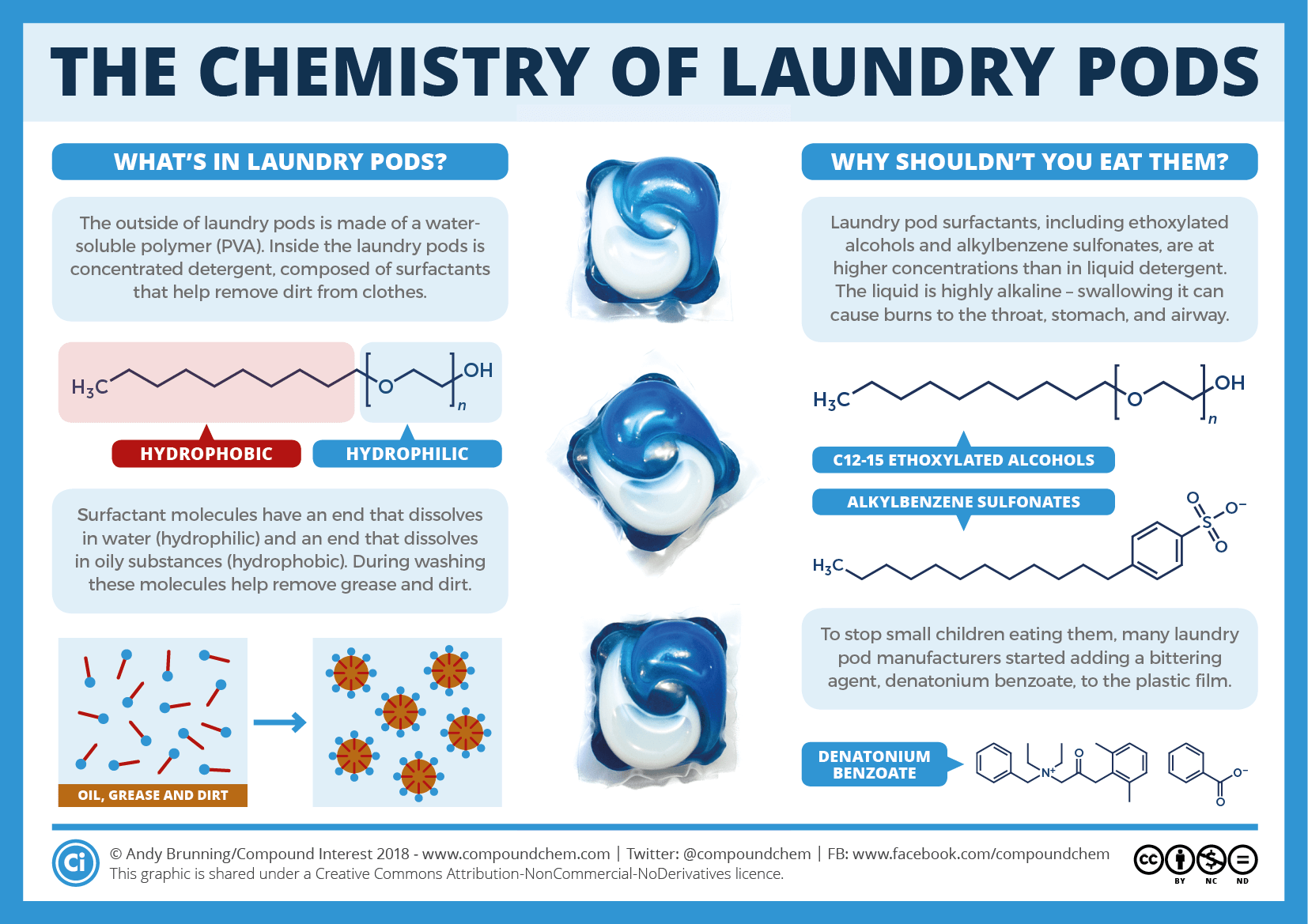
Laundry pods have featured in the news this week after cases of people eating them in what's being referred to as the 'Tide Pod Challenge'. In case you didn't already realise that this is a pretty terrible idea, this graphic looks at the chemical reasons why you really don't want them anywhere near your mouth
The Chemistry of Laundry pods

Eating laundry pods is particularly risky since the detergents are at a higher concentration than in liquid detergents. They are highly alkaline; just as highly acidic substances can cause burns, so too can very alkaline ones. If you eat a laundry pod, you run the risk of burns to your throat and stomach from the high concentration detergent they contain. As they pop in your mouth, they can also be accidentally inhaled – definitely not good for your airway and lungs either.


In addition, eating them can also cause breathing problems. Why exactly this is is currently unclear. It seems that in some laundry pod formulations, a sedative effect is seen when they are ingested. This can lead to drowsiness and breathing difficulties. It’s been speculated that a solvent used in the pods, propylene glycol, might contribute. Alternatively, it might be an unknown effect of certain ethoxylated alcohols.

Laundry pods like this also contain a bitter substance to deter children from putting them in their mouths.  For more information visit the full article at the excellent Compound Interest

http://www.compoundchem.com/2018/01/25/laundry-pods/

For all your chemical needs contact us on 01744 455000

TOTAL LAB SUPPLIES

Friday, 1 November 2013

Hangnails!!


A hangnail or agnail (also known as a stepmother's blessing particularly in the Lancashire region) is a corruption of agnail which literally means painful (anguished) nail.

Hangnails can seem rather insignificant in the grand scheme of health problems but they can become infected and lead to a handful of other issues. Fortunately, there are many ways to avoid hangnail hazards.


Hangnails don't have anything to do with your fingernails. Many people confuse hangnails with ingrown nails, a condition in which the corner of your nail grows into the soft skin of your nail bed.  In fact, hangnails are the dry, sometimes brittle triangular-shaped tags of skin around your fingernails that can tear off.  Because there are many different causes of hangnails, everyone gets them occasionally. But chronic, consistent hangnails can lead to bigger problems.

When the skin around your fingernails tears off, it opens the door to infection, especially when you consider all the bacteria your hands are exposed to every day, not to mention dishwater, cold weather and all the other things that dry out your hands in the first place. Fortunately, there are quick and easy ways to prevent hangnails that range from moisturising often to pampering your hands with cuticle soaks and manicures.

If you just can't beat hangnails, there are also easy ways to treat them. Antibacterial lotions can often do the trick, and in more serious cases, a prescription antibiotic might be in order.


Of course, before you can avoid hangnails, you need to know what causes them.

Hangnails are more common during the cold winter months. During the winter, skin dries out really fast which is one of the main causes of hangnails. Anything that can dry out your skin, such as cold winter weather, harsh chemicals or frequent immersion in water can cause hangnails to develop.

If you are a nail biter it can damage your nail bed, which is the skin underneath the actual fingernail and a weak nail bed can result in more hangnails.

Hangnails that aren't properly cared for can result in an infection called paronychia. There are three types of paronychia infection: bacterial, Candidal -- which is a type of yeast -- and fungal

Now that you know how hangnails happen, you're probably wondering how you can stop them before they start.
  • Moisturise your hands and your nail beds.  Moisturising your nail beds helps your nails and your cuticles as well which can have a big impact on your overall nail health
  • Stop biting your nails.
  • Manicure.
  • Wear gloves if you are exposed to harsh chemicals or even just soapy water from washing the dishes.
Working in a laboratory can cause a number of hand problems including latex glove allergies.  Make sure you choose the right gloves for your skin and for the job in hand.  Remember to wash your hands properly and moisturise afterwards.

Remember P&R Labpak offers a range of soaps and moisturisers for laboratories so you don’t need to suffer from hangnails!  The new VWR Safety catalogue is also available covering everything you need relating to personal protection, workplace safety, first aid and housekeeping.  Ask for your copy now!

For more information visit:-


Friday, 14 June 2013

Laboratory Detergents

It's important to make sure you choose the right detergent for your laboratory tasks whether they are for manual washing or for use in a washing machine.
 
As the sensitivity of analytical techniques has increased, the importance of stringent sample preparation and the quality and purity of the reagents are integral to getting good results. Even the best technique can be compromised by contaminated glassware or other lab utensils.

In the past, cleanliness was assured with toxic and aggressive products such as sodium hydroxide or Sulfo-chromic acid solutions that were very unpleasant to use. Fortunately lab detergents have come a long way. Today most labs have washing machines minimising effort and exposure to cleaning chemicals.

The issue now is ensuring that glassware is not contaminated with the detergent itself in the form of residues after cleaning. The detergent must be effective against contamination but not become a contaminant itself! A tall order when you consider the breadth of different tasks in specialised laboratories involving multiple types of contamination with various physical and chemical properties.
That’s the reason why the Labwash® Premium detergents range was developed in collaboration with experts. The range is extensive and includes good all round performance plus specialist products for specific requirements in different applications in pharma, petrochemicals, food industries, clinical labs etc..
Reliable processes are only possible with thorough, residue free cleaning and Labwash® delivers.
Excellent cleaning with no residues: Wide range of detergents suited to different cleaning tasks
High purity biodegradable ingredients: All raw materials fulfil the requirements of environmental protection.  Ecologically inert
High activity but low consumption: Labwash® Premium is concentrated but really efficient at low concentrations
Compatible with most materials: Labwash® Premium acts against contamination not the material being cleaned
1, 5, 10 and 20 l plastic packs: A wide range of packaging, easy to handle, adapted to your consumption
 
P&R Labpak are proud to offer this range of detergents to its customers.  We have a cross reference list to help customers choose which detergent is best suited for their needs if they want to swap from their existing brand so as to save money.
 
Why not visit our news page below and download the flyer detailing all the types available.