Total Lab Supplies - Everything for your laboratory

Total Lab Supplies - Everything for your laboratory
Our Head Office in St Helens
Showing posts with label colour. Show all posts

Friday, 3 April 2015

Stained and Coloured Glass

Stained glass can refer to coloured glass as a material or to works created from it - most commonly seen in the stained glass windows of churches and other buildings.  Coloured glass is also found in everyday life such as green wine bottles.


As a material stained glass is glass that has been coloured by adding metallic salts during its manufacture.

There are two main types of glass - soda lime glass - commonly used in beverage bottles and the like and borosilicate glass - used in laboratory glassware and also some domestic glassware such as oven proof dishes.

Coloured glass is made in a number of ways.  There are three main ways.

The first involves introducing metallic or rare earth metal oxides to the glass as mentioned above.

Silver compounds for example such as silver nitrate are used as stain applied to the surface of glass and fired on. They can produce a range of colours from orange-red to yellow. The way the glass is heated and cooled can significantly affect the colours produced by these compounds.

Another way is by formation of colloidal particles. This means particles of a substance are suspended throughout the glass. The particles scatter light of particular frequencies as it passes through the glass, causing colouration.

Gold gives a ruby red colour, and selenium gives a pink to intense red.

The final main way in which colour can be introduced is through the addition of already coloured particles to the glass. Examples of this type of colouration include milk glass and smoked glass; milk glass is achieved by adding tin oxide.

The infographic below from Compound Interest shows what chemicals are involved in the colour process.  Click for a larger image.
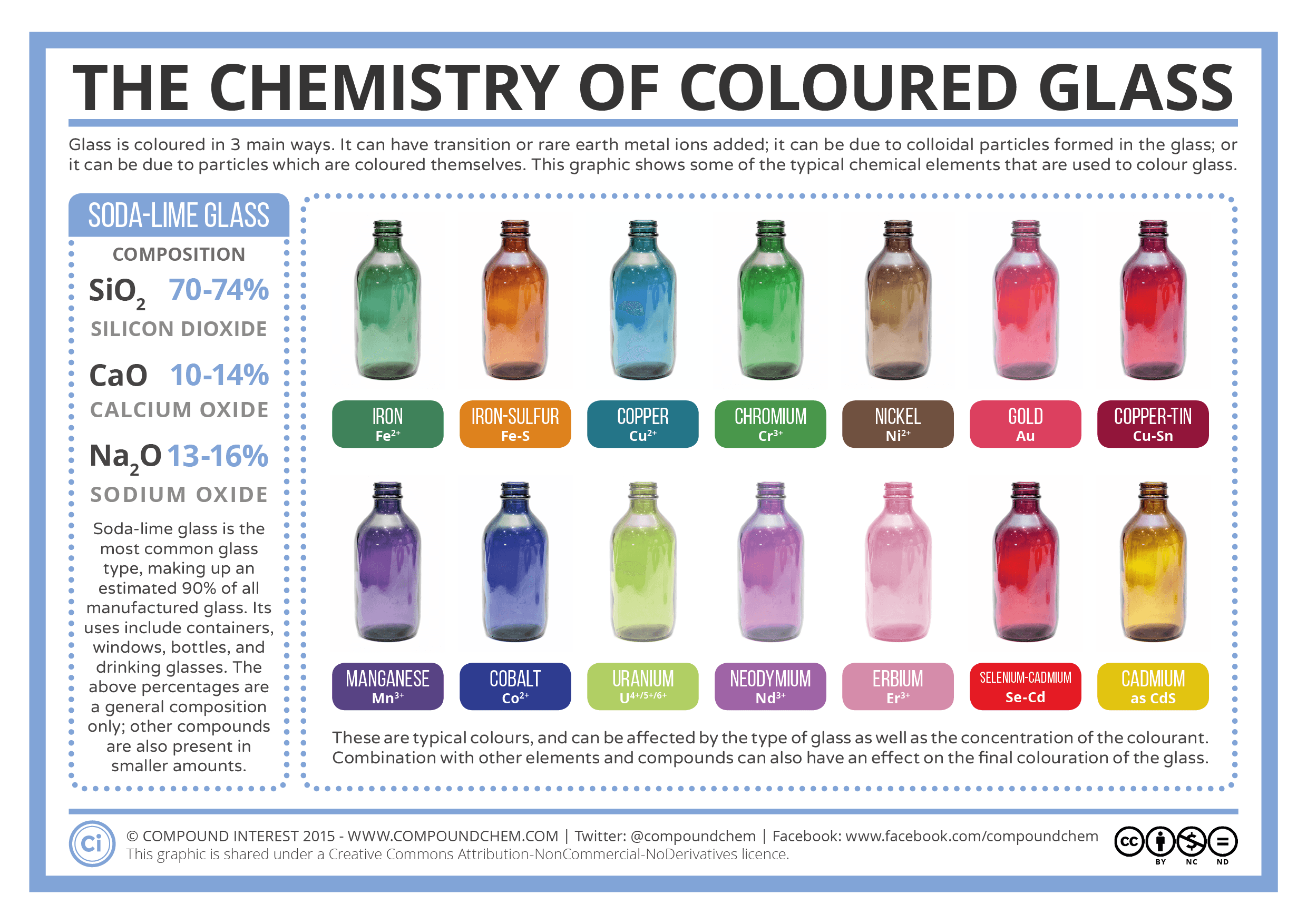

Click to enlarge
For more information visit:-
http://en.wikipedia.org/wiki/Stained_glass
http://www.compoundchem.com/2015/03/03/coloured-glass/

Friday, 31 October 2014

Autumn leaves - the chemistry behind the colour

As Autumn pushes onwards the leaves on the trees have lost their green colour and have allowed the vibrant hues of autumn to show through. Although this change may initially seem a simple one, the vivid colours are a result of a range of chemical compounds.


A green leaf is green because of the presence of a pigment known as chlorophyll, which is inside an organelle called a chloroplast. When they are abundant in the leaf's cells, as they are during the growing season, the chlorophylls' green colour dominates and masks out the colours of any other pigments that may be present in the leaf. Thus the leaves of summer are characteristically green.

As summer fades, so too does the amount of light, and thus chlorophyll production slows  The existing chlorophyll decomposes. As a result of this, other compounds present in the leaves can come to the fore, and affect the perceived colouration as shown in the infographic below featured on the CompoundInterest website.  Click on the link below for a larger picture.


Autumn Leaves-click to enlarge
Carotenoids
Carotenoids are present in leaves the whole year round, but their orange-yellow colours are usually masked by green chlorophyll.  Carotenoids provide colourations of yellow, brown, orange, and the many hues in between.

Anthocyanins
The reds, the purples, and their blended combinations that decorate autumn foliage come from another group of pigments in the cells called anthocyanins. Unlike the carotenoids, these pigments are not present in the leaf throughout the growing season, but are actively produced towards the end of summer.   They develop in late summer in the sap of the cells of the leaf, and this development is the result of complex interactions of many influences — both inside and outside the plant. Their formation depends on the breakdown of sugars in the presence of bright light as the level of phosphate in the leaf is reduced.

The brown colour of leaves is not the result of a pigment, but rather cell walls, which may be evident when no colouring pigment is visible.

For more information visit:-
http://www.compoundchem.com/2014/09/11/autumnleaves/
http://en.wikipedia.org/wiki/Autumn_leaf_color

Friday, 26 September 2014

Flamin' hot colours!

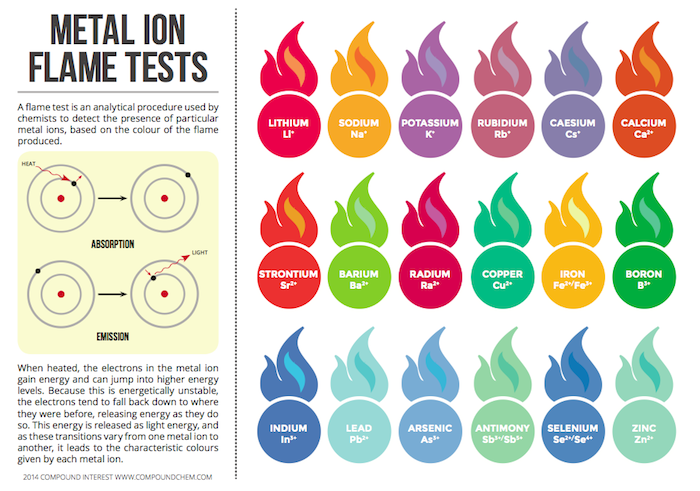
Back in your school days there was probably an experiment where you placed a small amount of a compound into a flame and observed it's colour.  This is the flame test and depending on the colour observed it can tell you what elements are present.


Scientifically put, A flame test is an analytic procedure used in chemistry to detect the presence of certain elements, primarily metal ions, based on each element's characteristic emission spectrum. The colour of flames in general also depends on temperature.

The test involves introducing a sample of the element or compound to a hot, non-luminous flame, and observing the colour of the flame that results. The idea of the test is that sample atoms evaporate and since they are hot, they emit light when being in flame.

The flame test is relatively quick and simple to perform, and can be carried out with the basic equipment found in most chemistry laboratories. However, the range of elements positively detectable under these conditions is small, as the test relies on the subjective experience of the experimenter rather than any objective measurements. The test has difficulty detecting small concentrations of some elements, while too strong a result may be produced for certain others, which tends to cause fainter colours to not appear.


Metal Ion Flame Tests-Click to enlarge
The table above from www.compoundchem.com shows the range of colours chemicals produce.  These tests work better for some metal ions than other; in particular, those ions shown on the bottom row of the infographic are generally quite faint and hard to distinguish. Sodium’s flame colour is also very strong, and can easily mask the colours of other metal ions.

For more information and more pictures visit:-
http://www.compoundchem.com/2014/02/06/metal-ion-flame-test-colours-chart/
http://en.wikipedia.org/wiki/Flame_test