Total Lab Supplies - Everything for your laboratory

Total Lab Supplies - Everything for your laboratory
Our Head Office in St Helens
Showing posts with label borosilicate. Show all posts

Friday, 3 April 2015

Stained and Coloured Glass

Stained glass can refer to coloured glass as a material or to works created from it - most commonly seen in the stained glass windows of churches and other buildings.  Coloured glass is also found in everyday life such as green wine bottles.


As a material stained glass is glass that has been coloured by adding metallic salts during its manufacture.

There are two main types of glass - soda lime glass - commonly used in beverage bottles and the like and borosilicate glass - used in laboratory glassware and also some domestic glassware such as oven proof dishes.

Coloured glass is made in a number of ways.  There are three main ways.

The first involves introducing metallic or rare earth metal oxides to the glass as mentioned above.

Silver compounds for example such as silver nitrate are used as stain applied to the surface of glass and fired on. They can produce a range of colours from orange-red to yellow. The way the glass is heated and cooled can significantly affect the colours produced by these compounds.

Another way is by formation of colloidal particles. This means particles of a substance are suspended throughout the glass. The particles scatter light of particular frequencies as it passes through the glass, causing colouration.

Gold gives a ruby red colour, and selenium gives a pink to intense red.

The final main way in which colour can be introduced is through the addition of already coloured particles to the glass. Examples of this type of colouration include milk glass and smoked glass; milk glass is achieved by adding tin oxide.

The infographic below from Compound Interest shows what chemicals are involved in the colour process.  Click for a larger image.
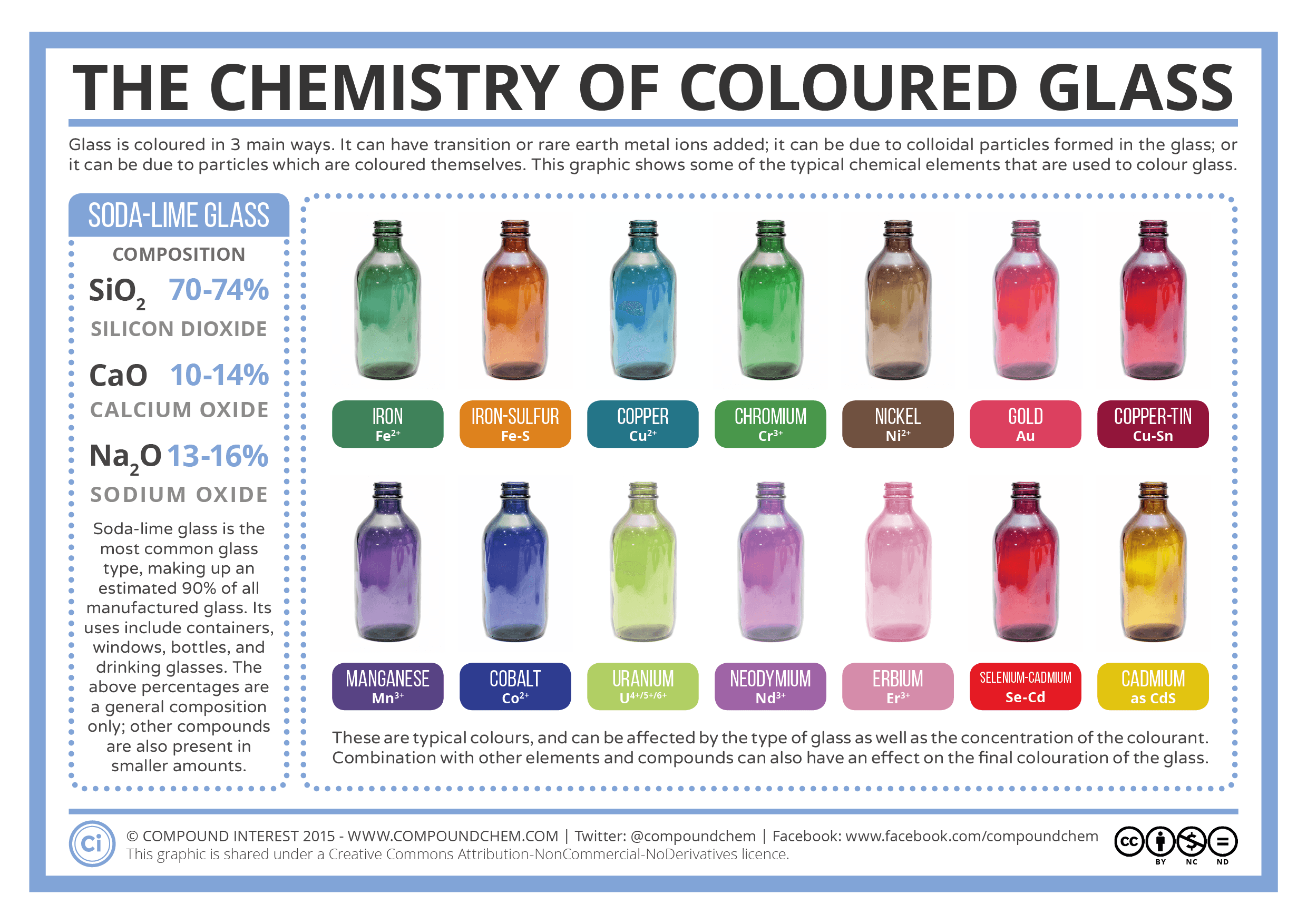

Click to enlarge
For more information visit:-
http://en.wikipedia.org/wiki/Stained_glass
http://www.compoundchem.com/2015/03/03/coloured-glass/

Friday, 17 May 2013

The amazing properties of Borosilicate Glass

Borosilicate glass is a type of glass with the main glass-forming constituents silica and boron oxide. Borosilicate glasses are known for having very low coefficients of thermal expansion (~3 × 10−6 /°C at 20°C), making them resistant to thermal shock, more so than any other common glass. Such glass is less subject to thermal stress and is commonly used for the construction of reagent bottles, flasks, beakers and many other laboratory glassware items. Borosilicate glass is sold under such trade names as Pyrex, Schott & Simax.

 
Borosilicate glass was first developed by German glassmaker Otto Schott in the late 19th century and sold under the brand name "Duran" in 1893. After Corning Glass Works introduced Pyrex in 1915, the name became a synonym for borosilicate glass in the English-speaking world.

Chemical Properties
Borosilicate glass has a very high resistance to attack from water, acids, salt solutions, halogens and organic solvents. Only hydrofluoric acid, hot concentrated phosphoric acid and strong alkaline solutions cause appreciable corrosion of the glass.

Hydrolytic resistance For many applications, it is important that laboratory glassware has excellent hydrolytic resistance; e.g. during steam sterilisation procedures, where repeated exposure to water vapour at high temperature can leach out alkali (Na+) ions. Pyrex borosilicate glass for example has a relatively low alkali metal oxide content and consequently a high resistance to attack from water. Pyrex fits into Class 1 of glasses for hydrolytic resistance according to ISO 719 (98°C) and ISO 720 (121°C).


Acid resistance
Glasses with a high percentage weight of silica (SiO2) are less likely to be attacked by acids.
Pyrex borosilicate glass is over 80% silica and therefore remarkably resistant to acids (with the exception of hot concentrated phosphoric acid and hydrofluoric acid). Glass is separated into 4 acid resistance classes and Pyrex corresponds to Class 1 in accordance with DIN 12116 and meets the requirements of ISO 1776.

Alkali resistance
Alkaline solutions attack all glasses and
Pyrex can be classified as moderately resistant. The alkali resistance of Pyrex borosilicate glass meets Class 2 requirements as defined by ISO 695 and DIN 52322.

High usage temperature

           
The maximum permissible operating temperature for DURAN® borosilicate glass is 500 °C. Above a temperature of 525 °C the glass begins to soften and above a temperature of 860 °C it changes to the liquid state.

DURAN® can be cooled down to the maximum possible negative temperature and is therefore suitable for use with liquid nitrogen (approx. – 196 °C). During such use/ freezing. In general DURAN® products are recommended for use down to – 70 °C. During thawing ensure that the temperature difference does not exceed 100 K.
 

The link below shows how Duran glass is made
http://www.duran-group.com/en/about-duran/how-duran-is-made.html

For more information visit
http://www.scilabware.com/Glass_technical/
http://www.duran-group.com/en/about-duran/duran-properties.html
http://en.wikipedia.org/wiki/Borosilicate_glass