Total Lab Supplies - Everything for your laboratory

Total Lab Supplies - Everything for your laboratory
Our Head Office in St Helens
Showing posts with label gold. Show all posts

Monday, 27 February 2017

The chemistry behind the 'Oscar'

A BIT of a mix up might have dinted the magical chemistry of the Oscars this year, but it didn’t damage the sheen on those golden statuettes! 

So, what exactly IS the chemistry behind the world’s most famous prize? Check out the graphic below to learn exactly WHAT goes into an Oscar statuette. 

Source: Compound Interest


So, who knew the statuette wasn’t made from REAL gold? And what is the history of Britannium? First produced in 1769 or 1770, Britannium metal was created by James Vickers after purchasing the formula from a dying friend. It was originally known as "Vickers White Metal" when made under contract by the Sheffield manufacturers Ebenezer Hancock and Richard Jessop. In 1776 James Vickers took over the manufacturing himself and remained as owner until his death in 1809, when the company passed to his son, John, and Son-in-Law, Elijah West. In 1836 the company was sold to John Vickers's nephew Ebenezer Stacey (the son of Hannah Vickers and John Stacey).

After the development of electroplating with silver in 1846, Britannia metal was widely used as the base metal for silver-plated household goods and cutlery. The abbreviation EPBM on such items denotes "electroplated Britannia metal". Britannia metal was generally used as a cheaper alternative to electroplated nickel silver (EPNS) which is more durable.

In his essay, A Nice Cup of Tea, writer George Orwell asserts that "britanniaware" teapots "produce inferior tea" (when compared to Chinaware).

For more information visit:-

http://www.compoundchem.com/2017/02/25/oscars/
http://www.prlabs.co.uk/lab-supplies.php?N=copper-1000ppm-for-icp&Id=60111
https://en.wikipedia.org/wiki/Britannia_metal


Tuesday, 16 August 2016

What are Olympic medals made of?

So, the Olympic medals are made of gold, silver and bronze right? Wrong! Pure gold medals would cost an awful lot, so what are the medals really made from? 

The graphic below looks at the different metals used.

Graphic: Compound Interest

So, what of real gold? Let’s find out more:

Gold is a chemical element with the symbol Au (from Latin: aurum) and the atomic number 79. In its purest form, it is a bright, slightly reddish yellow, dense, soft, malleable and ductile metal. Chemically, gold is a transition metal and a group 11 element. It is one of the least reactive chemical elements, and is solid under standard conditions. The metal therefore occurs often in free elemental (native) form, as nuggets or grains, in rocks, in veins and in alluvial deposits. It occurs in a solid solution series with the native element silver (as electrum) and also naturally alloyed with copper and palladium. Less commonly, it occurs in minerals as gold compounds, often with tellurium (gold tellurides).

Gold's atomic number of 79 makes it one of the higher atomic number elements that occur naturally in the universe. It is thought to have been produced in supernova nucleosynthesis and from the collision of neutron stars and to have been present in the dust from which the Solar System formed. Because the Earth was molten when it was just formed, almost all of the gold present in the early Earth probably sank into the planetary core. Therefore, most of the gold that is present today in the Earth's crust and mantle is thought to have been delivered to Earth later, by asteroid impacts during the Late Heavy Bombardment, about 4 billion years ago.

Gold resists attack by individual acids, but aqua regia (literally "royal water", a mixture of nitric acid and hydrochloric acid) can dissolve it. The acid mixture causes the formation of a soluble tetrachloroaurate anion. It is insoluble in nitric acid, which dissolves silver and base metals, a property that has long been used to refine gold and to confirm the presence of gold in metallic objects, giving rise to the term acid test. Gold also dissolves in alkaline solutions of cyanide, which are used in mining and electroplating. Gold dissolves in mercury, forming amalgam alloys, but this is not a chemical reaction.

Gold is a precious metal used for coinage, jewellery, and other arts throughout recorded history. In the past, a gold standard was often implemented as a monetary policy within and between nations, but gold coins ceased to be minted as a circulating currency in the 1930s, and the world gold standard was abandoned for a fiat currency system after 1976. The historical value of gold was rooted in its relative rarity, easy handling and minting, easy smelting and fabrication, resistance to corrosion and other chemical reactions (nobility), and distinctive colour.

The world consumption of new gold produced is about 50% in jewellery, 40% in investments, and 10% in industry. Gold's high malleability, ductility, resistance to corrosion and most other chemical reactions, and conductivity of electricity have led to its continued use in corrosion resistant electrical connectors in all types of computerized devices (its chief industrial use). Gold is also used in infrared shielding, coloured glass production, gold leafing, and tooth restoration. Certain gold salts are still used as anti-inflammatories in medicine.

For more information visit:-


Monday, 8 August 2016

Researchers reduce climate-warming CO2 to building blocks for fuels

Turning carbon dioxide into stored energy sounds like science fiction: researchers have long tried to find simple ways to convert this greenhouse gas into fuels and other useful chemicals. Now, a group of researchers led by Professor Ted Sargent of the University of Toronto's Faculty of Applied Science & Engineering have found a more efficient way, through the wonders of nanoengineering.

Drs. Min Liu and Yuanjie Pang, along with a team of graduate students and post-doctoral fellows in University of Toronto Engineering, have developed a technique powered by renewable energies such as solar or wind. The catalyst takes climate-warming carbon-dioxide (CO2) and converts it to carbon-monoxide (CO), a useful building block for carbon-based chemical fuels, such as methanol, ethanol and diesel.

The frozen version of CO2, small pellets of dry ice sublimating in air. By Richard Wheeler (Zephyris) at en.wikipedia (Transferred from en.wikipedia) [GFDL (http://www.gnu.org/copyleft/fdl.html) or CC-BY-SA-3.0 (http://creativecommons.org/licenses/by-sa/3.0/)], via Wikimedia Commons
"CO2 reduction is an important challenge due to inertness of the molecule," says Liu. "We were looking for the best way to both address mounting global energy needs and help the environment," adds Pang. "If we take CO2 from industrial flue emissions or from the atmosphere, and use it as a reagent for fuels, which provide long-term storage for green energy, we're killing two birds with one stone."

The team's solution is sharp: they start by fabricating extremely small gold "nanoneedles" - the tip of each needle is 10,000 times smaller than a human hair. "The nanoneedles act like lightning rods for catalyzing the reaction," says Liu.

When they applied a small electrical bias to the array of nanoneedles, they produced a high electric field at the sharp tips of the needles. This helps attract CO2, speeding up the reduction to CO, with a rate faster than any catalyst previously reported. This represents a breakthrough in selectivity and efficiency which brings CO2 reduction closer to the realm of commercial electrolysers. The team is now working on the next step: skipping the CO and producing more conventional fuels directly.

Their work is published in the journal Nature.

"The field of water-splitting for energy storage has seen rapid advances, especially in the intensity with which these reactions can be performed on a heterogeneous catalyst at low overpotential - now, analogous breakthroughs in the rate of CO2 reduction using renewable electricity are urgently needed," says Michael Graetzel, a professor of physical chemistry at École Polytechnique Fédérale de Lausanne and a world leader in this field. "The University of Toronto team's breakthrough was achieved using a new concept of field-induced reagent concentration."

"Solving global energy challenges needs solutions that cut across many fields," says Sargent. "This work not only provides a new solution to a longstanding problem of CO2 reduction, but opens possibilities for storage of alternative energies such as solar and wind."

For more information visit:


Monday, 13 June 2016

Dagger in Tutankhamun's tomb was made with iron from a meteorite

A dagger entombed with King Tutankhamun was made with iron from a meteorite, a new analysis on the metal composition shows.

In 1925, archaeologist Howard Carter found two daggers, one iron and one with a blade of gold, within the wrapping of the teenage king, who was mummified more than 3,300 years ago. The iron blade, which had a gold handle, rock crystal pommel and lily and jackal-decorated sheath, has puzzled researchers in the decades since Carter’s discovery: ironwork was rare in ancient Egypt, and the dagger’s metal had not rusted.

Italian and Egyptian researchers analysed the metal with an x-ray fluorescence spectrometer to determine its chemical composition, and found its high nickel content, along with its levels of cobalt, “strongly suggests an extraterrestrial origin”. They compared the composition with known meteorites within 2,000km around the Red Sea coast of Egypt, and found similar levels in one meteorite.

That meteorite, named Kharga, was found 150 miles (240km) west of Alexandria, at the seaport city of Mersa Matruh, which in the age of Alexander the Great – the fourth century BC – was known as Amunia.

The researchers published their findings on Tuesday in the journal Meteoritics & Planetary Science.

Although people have worked with copper, bronze and gold since 4,000BC, ironwork came much later, and was rare in ancient Egypt. In 2013, nine blackened iron beads, excavated from a cemetery near the Nile in northern Egypt, were found to have been beaten out of meteorite fragments, and also a nickel-iron alloy. The beads are far older than the young pharaoh, dating to 3,200BC.

“As the only two valuable iron artifacts from ancient Egypt so far accurately analysed are of meteoritic origin,” the team that studied the knife wrote, “we suggest that ancient Egyptians attributed great value to meteoritic iron for the production of fine ornamental or ceremonial objects”.

The researchers also stood with a hypothesis that ancient Egyptians placed great importance on rocks falling from the sky. They suggested that the finding of a meteorite-made dagger adds meaning to the use of the term “iron” in ancient texts, and noted around the 13th century BC, a term “literally translated as ‘iron of the sky’ came into use … to describe all types of iron”.

“Finally, somebody has managed to confirm what we always reasonably assumed,” Thilo Rehren, an archaeologist with University College London, told the Guardian.

Rehren, who studied the nine meteoritic beads, said “there never has been a reason to doubt this outcome but we were never really able to put this hard data behind it”.

He added that other objects from Tutankhamun’s tomb, including jewelry and miniature daggers, are believed to made from meteorite iron.

“Yes, the Egyptians referred to this stuff as metal from the heaven, which is purely descriptive,” he said. “What I find impressive is that they were capable of creating such delicate and well manufactured objects in a metal of which they didn’t have much experience.”

An iron meteorite, by James St. John (Flickr: Murnpeowie Meteorite) [CC BY 2.0 (http://creativecommons.org/licenses/by/2.0)], via Wikimedia Commons
The researchers wrote in the new study: “The introduction of the new composite term suggests that the ancient Egyptians were aware that these rare chunks of iron fell from the sky already in the 13th [century] BCE, anticipating Western culture by more than two millennia.”

Egyptologist Joyce Tyldesley, of the University of Manchester, has similarly argued that ancient Egyptians would have revered celestial objects that had plunged to earth.

“The sky was very important to the ancient Egyptians,” she told Nature, apropos of her work on the meteoritic beads. “Something that falls from the sky is going to be considered as a gift from the gods.”

The high quality of the blade suggests that Tutankhamun, who lived during the latest stage of the Bronze Age, was supported by ironworkers who were skilled despite the relative rarity of the material.

The blade may not be the only item derived from falling rocks on Tut’s person.

In 2006, an Austrian astrochemist proposed that an unusual yellowish gem, shaped as a scarab in King Tut’s burial necklace, is actually glass formed in the heat of a meteorite crashing into sand.

“It would be very interesting to analyse more pre-Iron Age artifacts, such as other iron objects found in King Tut’s tomb,” Daniela Comelli, of the physics department at Milan Polytechnic, told Discovery News. “We could gain precious insights into metal working technologies in ancient Egypt and the Mediterranean.”

For more information visit:-


Tuesday, 9 February 2016

On this day in history – an atom of the element 112 was created

In 1996, only a little more than a year after they created element 111, a team of German scientists led by Peter Armbruster at the Gesellschaft für schwerionenforschung (GSI) facility at Darmstadt, Germany, claimed to have created an atom of the element 112. Its nucleus has 112 protons and 166 neutrons, giving it a mass number of 277. As a new element it was named ununbium, symbol Uub, according to an internationally adopted system for naming new elements. This was based on the presence of one atom of the element made by accelerating zinc atoms to high speed and bombarding them into lead. When an atom of each fused to make the new nucleus, it lasted a fraction of a thousandth of a second before decaying, emitting an alpha particle to become a nucleus of element 110.

What is an element?

A chemical element or element is a species of atoms having the same number of protons in their atomic nuclei (i.e. the same atomic number, Z). There are 118 elements that have been identified, of which the first 94 occur naturally on Earth with the remaining 24 being synthetic elements. There are 80 elements that have at least one stable isotope and 38 that have exclusively radioactive isotopes, which decay over time into other elements. Iron is the most abundant element (by mass) making up the Earth, while oxygen is the most common element in the crust of the earth.

The Periodic Table, by Sandbh (Own work) via Wikimedia Commons
Chemical elements constitute all of the ordinary matter of the universe. However astronomical observations suggest that ordinary observable matter is only approximately 15% of the matter in the universe: the remainder is dark matter, the composition of which is unknown, but it is not composed of chemical elements. The two lightest elements, hydrogen and helium were mostly formed in the Big Bang and are the most common elements in the universe. The next three elements (lithium, beryllium and boron) were formed mostly by cosmic ray spallation, and are thus more rare than those that follow. Formation of elements with from six to twenty six protons occurred and continues to occur in main sequence stars via stellar nucleosynthesis. The high abundance of oxygen, silicon, and iron on Earth reflects their common production in such stars. Elements with greater than twenty-six protons are formed by supernova nucleosynthesis in supernovae, which, when they explode, blast these elements far into space as planetary nebulae, where they may become incorporated into planets when they are formed.

The term "element" is used for a kind of atom with a given number of protons (regardless of whether they are or they are not ionized or chemically bonded, e.g. hydrogen in water) as well as for a pure chemical substance consisting of a single element (e.g. hydrogen gas).

When different elements are chemically combined, with the atoms held together by chemical bonds, they form chemical compounds. Only a minority of elements are found uncombined as relatively pure minerals. Among the more common of such "native elements" are copper, silver, gold, carbon (as coal, graphite, or diamonds), and sulphur. All but a few of the most inert elements, such as noble gases and noble metals, are usually found on Earth in chemically combined form, as chemical compounds. While about 32 of the chemical elements occur on Earth in native uncombined forms, most of these occur as mixtures. For example, atmospheric air is primarily a mixture of nitrogen, oxygen, and argon, and native solid elements occur in alloys, such as that of iron and nickel.

The history of the discovery and use of the elements began with primitive human societies that found native elements like carbon, sulphur, copper and gold. Later civilizations extracted elemental copper, tin, lead and iron from their ores by smelting, using charcoal. Alchemists and chemists subsequently identified many more, with almost all of the naturally-occurring elements becoming known by 1900.

The properties of the chemical elements are summarized on the periodic table, which organizes the elements by increasing atomic number into rows ("periods") in which the columns ("groups") share recurring ("periodic") physical and chemical properties. Save for unstable radioactive elements with short half-lives, all of the elements are available industrially, most of them in high degrees of purity.

For more information visit:-
Wednesday, 13 January 2016

On this day in history – Alchemy was forbidden

In 1404, English alchemists were forbidden to use their knowledge to create precious metals. Since the time of Roger Bacon, it had fascinated the imagination of many ardent men in England. During the reign of Henry IV, the Act of Multipliers was passed by the Parliament, declaring the use of transmutation to “multiply” gold and silver to be felony. Great alarm was felt at that time lest any alchemist should succeed in his projects, and perhaps bring ruin upon the state, by furnishing boundless wealth to some designing tyrant, who would make use of it to enslave his country. In 1689, Robert Boyle lobbied for repeal of the Act.

The world's largest gold bar, by PHGCOM (Own work by uploader, Toi Mine) [CC BY-SA 3.0 (http://creativecommons.org/licenses/by-sa/3.0) or GFDL (http://www.gnu.org/copyleft/fdl.html)], via Wikimedia Commons

What is Alchemy?

Alchemy is a philosophical and protoscientific tradition practiced throughout Egypt and Eurasia which aimed to purify, mature, and perfect certain objects. Common aims were chrysopoeia, the transmutation of "base metals" (e.g. lead) into "noble" ones (particularly gold); the creation of an elixir of immortality; the creation of panaceas able to cure any disease; and the development of an alkahest, a universal solvent. The perfection of the human body and soul was thought to permit or result from the alchemical magnum opus and, in the Hellenistic and western tradition, the achievement of gnosis.  In Europe, the creation of a philosopher's stone was variously connected with all of these projects.

In English, the term is often limited to descriptions of European alchemy, but similar practices existed in the Far East, the Indian subcontinent, and the Muslim world. In Europe, following the 12th-century Renaissance produced by the translation of Arabic works on science and the Recovery of Aristotle, alchemists played a significant role in early modern science (particularly chemistry and medicine). Islamic and European alchemists developed a structure of basic laboratory techniques, theory, terminology, and experimental method, some of which are still in use today. However, they continued antiquity's belief in four elements and guarded their work in secrecy including cyphers and cryptic symbolism. Their work was guided by Hermetic principles related to magic, mythology, and religion.


Modern discussions of alchemy are generally split into an examination of its exoteric practical applications and its esoteric spiritual aspects, despite the arguments of scholars like Homyard and von Franz that they should be understood as complementary. The former is pursued by historians of the physical sciences who examine the subject in terms of protochemistry, medicine, and charlatanism. The latter interests historians of esotericism, psychologists, and some philosophers and spiritualists. The subject has also made an ongoing impact on literature and the arts. Despite this split, which von Franz believes has existed since the Western traditions' origin in a mix of Greek philosophy was mixed with Egyptian and Mesopotamian technology, numerous sources have stressed an integration of esoteric and exoteric approaches to alchemy as far back as Bolus of Mendes's 3rd-century bc On Physical and Mystical Matters (Greek: Physika kai Mystika).

For more information visit: 

Monday, 20 April 2015

Silver

Silver is a chemical element with symbol Ag (Greek: άργυρος árguros, Latin: argentum, both from the Indo-European root *h₂erǵ- for "grey" or "shining") and atomic number 47. 
A soft, white, lustrous transition metal, it possesses the highest electrical conductivity of any element, the highest thermal conductivity and reflectivity of any metal. The metal occurs naturally in its pure, free form (native silver), as an alloy with gold and other metals, and in minerals such as argentite and chlorargyrite. Most silver is produced as a byproduct of copper, gold, lead, and zinc refining.

Silver has long been valued as a precious metal. More abundant than gold, silver metal has in many premodern monetary systems functioned as coinable specie, sometimes even alongside gold. In addition, silver has numerous applications beyond currency, such as in solar panels, water filtration, jewelry and ornaments, high-value tableware and utensils (hence the term silverware), and also as an investment in the forms ofcoins and bullion.

Silver is used industrially in electrical contacts and conductors, in specialized mirrors, window coatings and in catalysis of chemical reactions. Its compounds are used in photographic film and X-rays. Dilute silver nitrate solutions and other silver compounds are used as disinfectants and microbiocides (oligodynamic effect), added to bandages and wound-dressings, catheters and other medical instruments.

Electrolytically refined silver

Friday, 3 April 2015

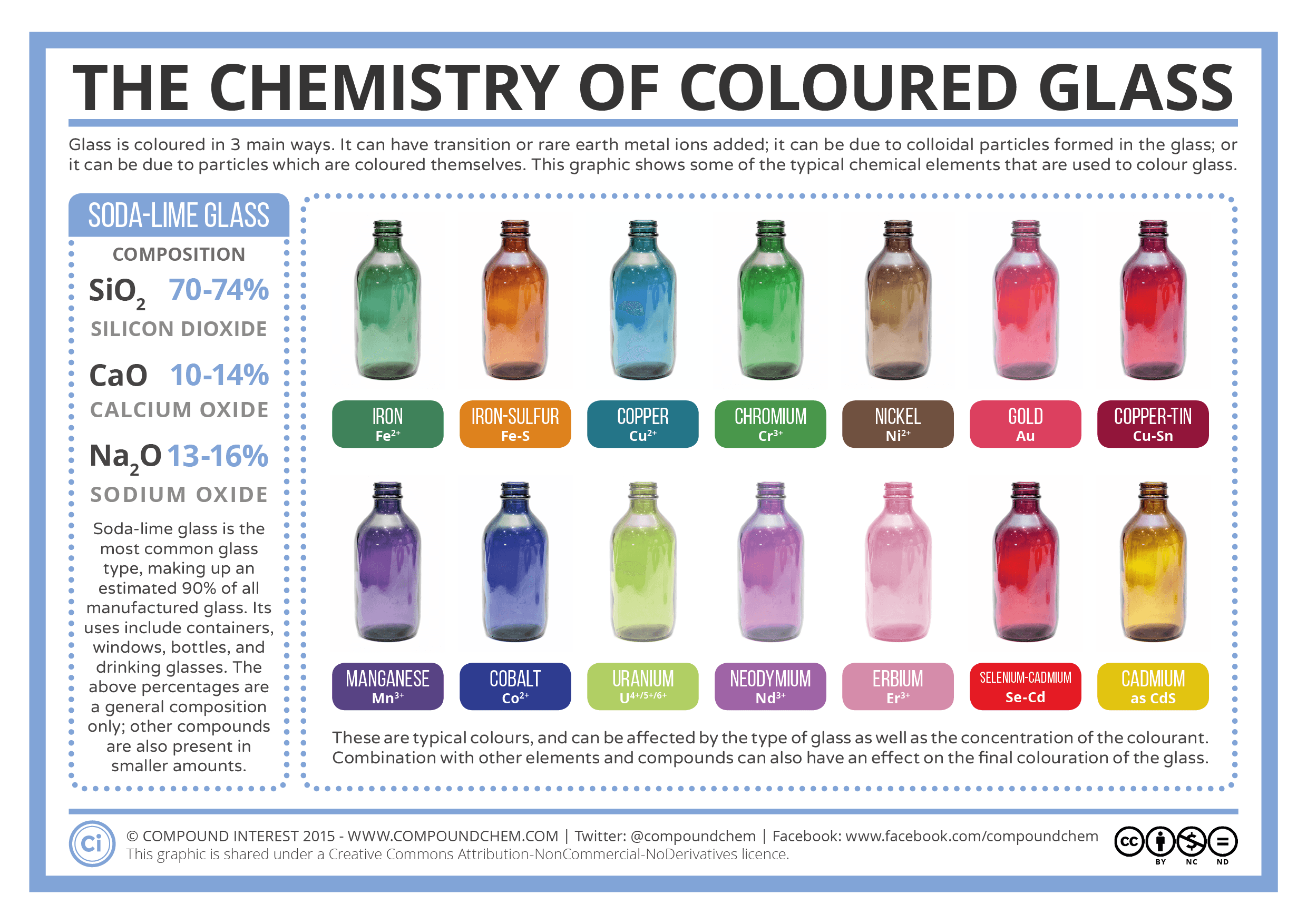
Stained and Coloured Glass

Stained glass can refer to coloured glass as a material or to works created from it - most commonly seen in the stained glass windows of churches and other buildings.  Coloured glass is also found in everyday life such as green wine bottles.


As a material stained glass is glass that has been coloured by adding metallic salts during its manufacture.

There are two main types of glass - soda lime glass - commonly used in beverage bottles and the like and borosilicate glass - used in laboratory glassware and also some domestic glassware such as oven proof dishes.

Coloured glass is made in a number of ways.  There are three main ways.

The first involves introducing metallic or rare earth metal oxides to the glass as mentioned above.

Silver compounds for example such as silver nitrate are used as stain applied to the surface of glass and fired on. They can produce a range of colours from orange-red to yellow. The way the glass is heated and cooled can significantly affect the colours produced by these compounds.

Another way is by formation of colloidal particles. This means particles of a substance are suspended throughout the glass. The particles scatter light of particular frequencies as it passes through the glass, causing colouration.

Gold gives a ruby red colour, and selenium gives a pink to intense red.

The final main way in which colour can be introduced is through the addition of already coloured particles to the glass. Examples of this type of colouration include milk glass and smoked glass; milk glass is achieved by adding tin oxide.

The infographic below from Compound Interest shows what chemicals are involved in the colour process.  Click for a larger image.


Click to enlarge
For more information visit:-
http://en.wikipedia.org/wiki/Stained_glass
http://www.compoundchem.com/2015/03/03/coloured-glass/