Total Lab Supplies - Everything for your laboratory

Total Lab Supplies - Everything for your laboratory
Our Head Office in St Helens
Showing posts with label glass. Show all posts

Wednesday, 26 July 2017

Moon has a water-rich interior

A new study of satellite data finds that numerous volcanic deposits distributed across the surface of the Moon contain unusually high amounts of trapped water compared with surrounding terrains. The finding of water in these ancient deposits, which are believed to consist of glass beads formed by the explosive eruption of magma coming from the deep lunar interior, bolsters the idea that the lunar mantle is surprisingly water-rich.

Scientists had assumed for years that the interior of the Moon had been largely depleted of water and other volatile compounds. That began to change in 2008, when a research team including Brown University geologist Alberto Saal detected trace amounts of water in some of the volcanic glass beads brought back to Earth from the Apollo 15 and 17 missions to the Moon. In 2011, further study of tiny crystalline formations within those beads revealed that they actually contain similar amounts of water as some basalts on Earth. That suggests that the Moon's mantle - parts of it, at least - contain as much water as Earth's.

"The key question is whether those Apollo samples represent the bulk conditions of the lunar interior or instead represent unusual or perhaps anomalous water-rich regions within an otherwise 'dry' mantle," said Ralph Milliken, lead author of the new research and an associate professor in Brown's Department of Earth, Environmental and Planetary Sciences. "By looking at the orbital data, we can examine the large pyroclastic deposits on the Moon that were never sampled by the Apollo or Luna missions. The fact that nearly all of them exhibit signatures of water suggests that the Apollo samples are not anomalous, so it may be that the bulk interior of the Moon is wet."

Full Moon photograph taken 10-22-2010 from Madison, Alabama, USA. By Gregory H. Revera (Own work) [CC BY-SA 3.0 (http://creativecommons.org/licenses/by-sa/3.0) or GFDL (http://www.gnu.org/copyleft/fdl.html)], via Wikimedia Commons
The research, which Milliken co-authored with Shuai Li, a postdoctoral researcher at the University of Hawaii and a recent Brown Ph.D. graduate, is published in Nature Geoscience.

Detecting the water content of lunar volcanic deposits using orbital instruments is no easy task. Scientists use orbital spectrometers to measure the light that bounces off a planetary surface. By looking at which wavelengths of light are absorbed or reflected by the surface, scientists can get an idea of which minerals and other compounds are present.

The problem is that the lunar surface heats up over the course of a day, especially at the latitudes where these pyroclastic deposits are located. That means that in addition to the light reflected from the surface, the spectrometer also ends up measuring heat.

"That thermally emitted radiation happens at the same wavelengths that we need to use to look for water," Milliken said. "So in order to say with any confidence that water is present, we first need to account for and remove the thermally emitted component."

To do that, Li and Milliken used laboratory-based measurements of samples returned from the Apollo missions, combined with a detailed temperature profile of the areas of interest on the Moon's surface. Using the new thermal correction, the researchers looked at data from the Moon Mineralogy Mapper, an imaging spectrometer that flew aboard India's Chandrayaan-1 lunar orbiter.

The researchers found evidence of water in nearly all of the large pyroclastic deposits that had been previously mapped across the Moon's surface, including deposits near the Apollo 15 and 17 landing sites where the water-bearing glass bead samples were collected.

"The distribution of these water-rich deposits is the key thing," Milliken said. "They're spread across the surface, which tells us that the water found in the Apollo samples isn't a one-off. Lunar pyroclastics seem to be universally water-rich, which suggests the same may be true of the mantle."

The idea that the interior of the Moon is water-rich raises interesting questions about the Moon's formation. Scientists think the Moon formed from debris left behind after an object about the size of Mars slammed into the Earth very early in solar system history. One of the reasons scientists had assumed the Moon's interior should be dry is that it seems unlikely that any of the hydrogen needed to form water could have survived the heat of that impact.

"The growing evidence for water inside the Moon suggest that water did somehow survive, or that it was brought in shortly after the impact by asteroids or comets before the Moon had completely solidified," Li said. "The exact origin of water in the lunar interior is still a big question."

In addition to shedding light on the water story in the early solar system, the research could also have implications for future lunar exploration. The volcanic beads don't contain a lot of water - about .05 percent by weight, the researchers say - but the deposits are large, and the water could potentially be extracted.

"Other studies have suggested the presence of water ice in shadowed regions at the lunar poles, but the pyroclastic deposits are at locations that may be easier to access," Li said. "Anything that helps save future lunar explorers from having to bring lots of water from home is a big step forward, and our results suggest a new alternative."

The research was funded by the NASA Lunar Advanced Science and Exploration Research Program (NNX12AO63G).

For more information visit:-

Tuesday, 20 September 2016

On this day in science history: wire glass was patented

In 1892, wire glass was patented by Frank Schulman. Wire glass, as the name suggests, is simply a wire mesh inserted during the plate glass manufacturing process to create a single monolithic glass with properties useful where fire safety requirements apply.

In recent years, new materials have become available that offer both fire-ratings and safety ratings so the continued use of wired glass is being debated worldwide. The US International Building Code effectively banned wired glass in 2006.

Canada’s building codes still permit the use of wired glass but the codes are being reviewed and traditional wired glass is expected to be greatly restricted in its use. Australia has no similar review taking place.

Broken tempered glass showing the shape of the granular chunks. By George Slickers (Own work) [CC BY-SA 2.5-2.0-1.0 (http://creativecommons.org/licenses/by-sa/2.5-2.0-1.0), GFDL (http://www.gnu.org/copyleft/fdl.html) or CC-BY-SA-3.0 (http://creativecommons.org/licenses/by-sa/3.0/)], via Wikimedia Commons
Wired glass is still utilized in the U.S. for its fire-resistant abilities, and is well-rated to withstand both heat and hose streams. This is why wired glass exclusively is used on service elevators to prevent fire ingress to the shaft, and also why it is commonly found in institutional settings which are often well-protected and partitioned against fire.  The wire prevents the glass from falling out of the frame even if it cracks under thermal stress, and is far more heat-resistant than a laminating material.

For more information visit:


Tuesday, 16 August 2016

What are Olympic medals made of?

So, the Olympic medals are made of gold, silver and bronze right? Wrong! Pure gold medals would cost an awful lot, so what are the medals really made from? 

The graphic below looks at the different metals used.

Graphic: Compound Interest

So, what of real gold? Let’s find out more:

Gold is a chemical element with the symbol Au (from Latin: aurum) and the atomic number 79. In its purest form, it is a bright, slightly reddish yellow, dense, soft, malleable and ductile metal. Chemically, gold is a transition metal and a group 11 element. It is one of the least reactive chemical elements, and is solid under standard conditions. The metal therefore occurs often in free elemental (native) form, as nuggets or grains, in rocks, in veins and in alluvial deposits. It occurs in a solid solution series with the native element silver (as electrum) and also naturally alloyed with copper and palladium. Less commonly, it occurs in minerals as gold compounds, often with tellurium (gold tellurides).

Gold's atomic number of 79 makes it one of the higher atomic number elements that occur naturally in the universe. It is thought to have been produced in supernova nucleosynthesis and from the collision of neutron stars and to have been present in the dust from which the Solar System formed. Because the Earth was molten when it was just formed, almost all of the gold present in the early Earth probably sank into the planetary core. Therefore, most of the gold that is present today in the Earth's crust and mantle is thought to have been delivered to Earth later, by asteroid impacts during the Late Heavy Bombardment, about 4 billion years ago.

Gold resists attack by individual acids, but aqua regia (literally "royal water", a mixture of nitric acid and hydrochloric acid) can dissolve it. The acid mixture causes the formation of a soluble tetrachloroaurate anion. It is insoluble in nitric acid, which dissolves silver and base metals, a property that has long been used to refine gold and to confirm the presence of gold in metallic objects, giving rise to the term acid test. Gold also dissolves in alkaline solutions of cyanide, which are used in mining and electroplating. Gold dissolves in mercury, forming amalgam alloys, but this is not a chemical reaction.

Gold is a precious metal used for coinage, jewellery, and other arts throughout recorded history. In the past, a gold standard was often implemented as a monetary policy within and between nations, but gold coins ceased to be minted as a circulating currency in the 1930s, and the world gold standard was abandoned for a fiat currency system after 1976. The historical value of gold was rooted in its relative rarity, easy handling and minting, easy smelting and fabrication, resistance to corrosion and other chemical reactions (nobility), and distinctive colour.

The world consumption of new gold produced is about 50% in jewellery, 40% in investments, and 10% in industry. Gold's high malleability, ductility, resistance to corrosion and most other chemical reactions, and conductivity of electricity have led to its continued use in corrosion resistant electrical connectors in all types of computerized devices (its chief industrial use). Gold is also used in infrared shielding, coloured glass production, gold leafing, and tooth restoration. Certain gold salts are still used as anti-inflammatories in medicine.

For more information visit:-


Friday, 3 April 2015

Stained and Coloured Glass

Stained glass can refer to coloured glass as a material or to works created from it - most commonly seen in the stained glass windows of churches and other buildings.  Coloured glass is also found in everyday life such as green wine bottles.


As a material stained glass is glass that has been coloured by adding metallic salts during its manufacture.

There are two main types of glass - soda lime glass - commonly used in beverage bottles and the like and borosilicate glass - used in laboratory glassware and also some domestic glassware such as oven proof dishes.

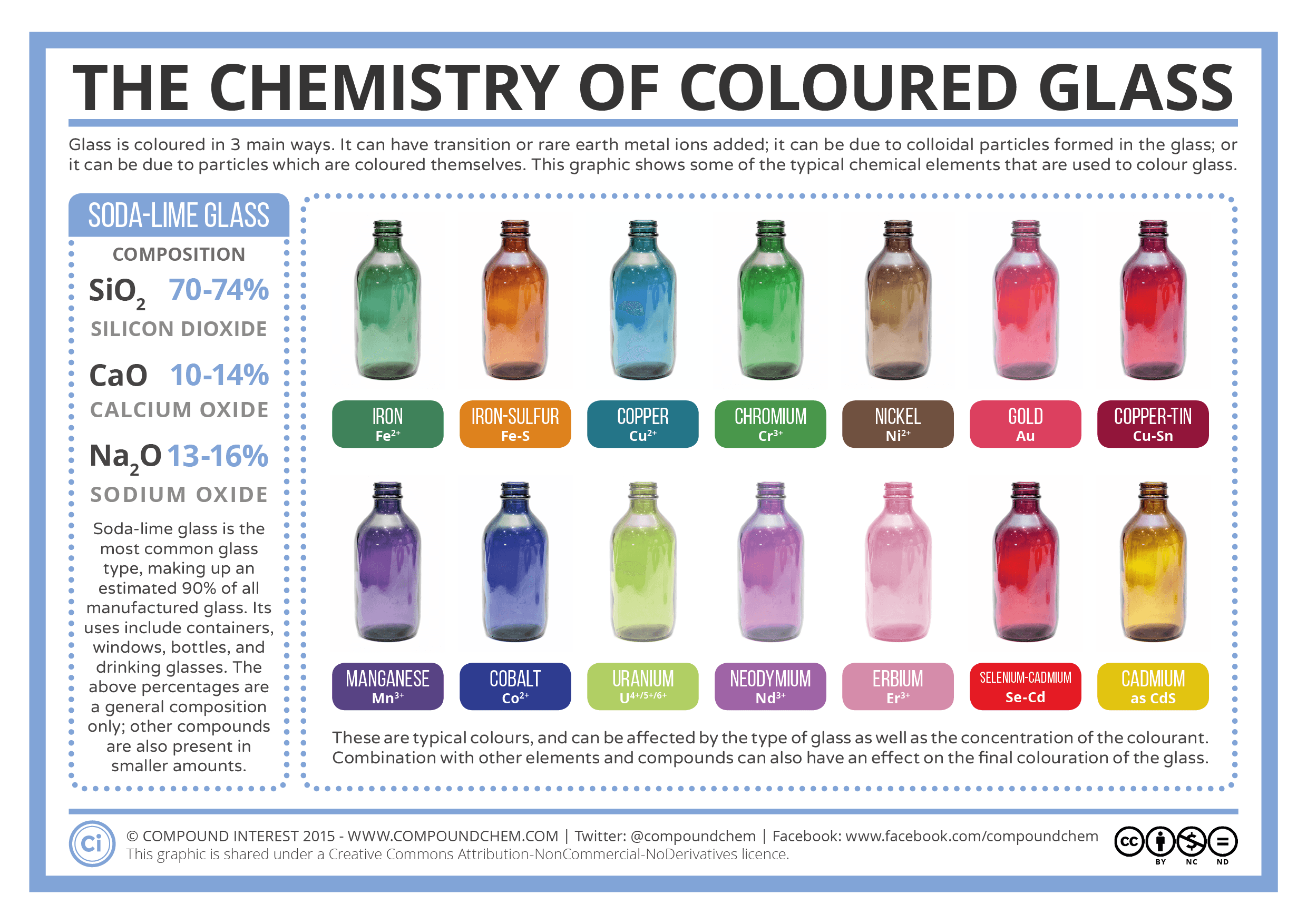
Coloured glass is made in a number of ways.  There are three main ways.

The first involves introducing metallic or rare earth metal oxides to the glass as mentioned above.

Silver compounds for example such as silver nitrate are used as stain applied to the surface of glass and fired on. They can produce a range of colours from orange-red to yellow. The way the glass is heated and cooled can significantly affect the colours produced by these compounds.

Another way is by formation of colloidal particles. This means particles of a substance are suspended throughout the glass. The particles scatter light of particular frequencies as it passes through the glass, causing colouration.

Gold gives a ruby red colour, and selenium gives a pink to intense red.

The final main way in which colour can be introduced is through the addition of already coloured particles to the glass. Examples of this type of colouration include milk glass and smoked glass; milk glass is achieved by adding tin oxide.

The infographic below from Compound Interest shows what chemicals are involved in the colour process.  Click for a larger image.


Click to enlarge
For more information visit:-
http://en.wikipedia.org/wiki/Stained_glass
http://www.compoundchem.com/2015/03/03/coloured-glass/

Friday, 17 May 2013

The amazing properties of Borosilicate Glass

Borosilicate glass is a type of glass with the main glass-forming constituents silica and boron oxide. Borosilicate glasses are known for having very low coefficients of thermal expansion (~3 × 10−6 /°C at 20°C), making them resistant to thermal shock, more so than any other common glass. Such glass is less subject to thermal stress and is commonly used for the construction of reagent bottles, flasks, beakers and many other laboratory glassware items. Borosilicate glass is sold under such trade names as Pyrex, Schott & Simax.

 
Borosilicate glass was first developed by German glassmaker Otto Schott in the late 19th century and sold under the brand name "Duran" in 1893. After Corning Glass Works introduced Pyrex in 1915, the name became a synonym for borosilicate glass in the English-speaking world.

Chemical Properties
Borosilicate glass has a very high resistance to attack from water, acids, salt solutions, halogens and organic solvents. Only hydrofluoric acid, hot concentrated phosphoric acid and strong alkaline solutions cause appreciable corrosion of the glass.

Hydrolytic resistance For many applications, it is important that laboratory glassware has excellent hydrolytic resistance; e.g. during steam sterilisation procedures, where repeated exposure to water vapour at high temperature can leach out alkali (Na+) ions. Pyrex borosilicate glass for example has a relatively low alkali metal oxide content and consequently a high resistance to attack from water. Pyrex fits into Class 1 of glasses for hydrolytic resistance according to ISO 719 (98°C) and ISO 720 (121°C).


Acid resistance
Glasses with a high percentage weight of silica (SiO2) are less likely to be attacked by acids.
Pyrex borosilicate glass is over 80% silica and therefore remarkably resistant to acids (with the exception of hot concentrated phosphoric acid and hydrofluoric acid). Glass is separated into 4 acid resistance classes and Pyrex corresponds to Class 1 in accordance with DIN 12116 and meets the requirements of ISO 1776.

Alkali resistance
Alkaline solutions attack all glasses and
Pyrex can be classified as moderately resistant. The alkali resistance of Pyrex borosilicate glass meets Class 2 requirements as defined by ISO 695 and DIN 52322.

High usage temperature

           
The maximum permissible operating temperature for DURAN® borosilicate glass is 500 °C. Above a temperature of 525 °C the glass begins to soften and above a temperature of 860 °C it changes to the liquid state.

DURAN® can be cooled down to the maximum possible negative temperature and is therefore suitable for use with liquid nitrogen (approx. – 196 °C). During such use/ freezing. In general DURAN® products are recommended for use down to – 70 °C. During thawing ensure that the temperature difference does not exceed 100 K.
 

The link below shows how Duran glass is made
http://www.duran-group.com/en/about-duran/how-duran-is-made.html

For more information visit
http://www.scilabware.com/Glass_technical/
http://www.duran-group.com/en/about-duran/duran-properties.html
http://en.wikipedia.org/wiki/Borosilicate_glass