Total Lab Supplies - Everything for your laboratory

Total Lab Supplies - Everything for your laboratory
Our Head Office in St Helens
Showing posts with label caesium. Show all posts

Friday, 20 July 2018

Caesium

Cæsium is a soft, silvery-gold alkali metal with the symbol Cs and atomic number 55.


It has a melting point of 28°C (82°F), which means it will be liquid on a warm summer day, and revert to a solid later that night after the ambient temperature cools. Cæsium is just one of five elemental metals that are liquids at or near room temperature.


Its name comes from the Latin word for sky-blue because when burned, cæsium turns the flame a lovely blue colour.

Since the 1990s, the largest application of the element has been as caesium formate for drilling fluids, but it has a range of applications in the production of electricity, in electronics, and in chemistry. The radioactive isotope caesium-137 has a half-life of about 30 years and is used in medical applications, industrial gauges, and hydrology. Nonradioactive caesium compounds are only mildly toxic, but the pure metal's tendency to react explosively with water means that caesium is considered a hazardous material, and the radioisotopes present a significant health and ecological hazard in the environment.

Caesium is also know for its use in atomic clocks and use the electromagnetic transitions in the hyperfine structure of caesium-133 atoms as a reference point. The first accurate caesium clock was built by Louis Essen in 1955 at the National Physical Laboratory in the UK. 

These clocks measure frequency with an error of 2 to 3 parts in 1014, which corresponding to an accuracy of 2 nanoseconds per day, or one second in 1.4 million years. The latest versions are more accurate than 1 part in 1015, about 1 second in 20 million years.  The Caesium standard is the primary standard for standards-compliant time and frequency measurements. Caesium clocks regulate the timing of cell phone networks and the Internet.

For more information visit
https://en.wikipedia.org/wiki/Caesium
https://www.theguardian.com/science/grrlscientist/2012/mar/23/1

Friday, 26 September 2014

Flamin' hot colours!

Back in your school days there was probably an experiment where you placed a small amount of a compound into a flame and observed it's colour.  This is the flame test and depending on the colour observed it can tell you what elements are present.


Scientifically put, A flame test is an analytic procedure used in chemistry to detect the presence of certain elements, primarily metal ions, based on each element's characteristic emission spectrum. The colour of flames in general also depends on temperature.

The test involves introducing a sample of the element or compound to a hot, non-luminous flame, and observing the colour of the flame that results. The idea of the test is that sample atoms evaporate and since they are hot, they emit light when being in flame.

The flame test is relatively quick and simple to perform, and can be carried out with the basic equipment found in most chemistry laboratories. However, the range of elements positively detectable under these conditions is small, as the test relies on the subjective experience of the experimenter rather than any objective measurements. The test has difficulty detecting small concentrations of some elements, while too strong a result may be produced for certain others, which tends to cause fainter colours to not appear.


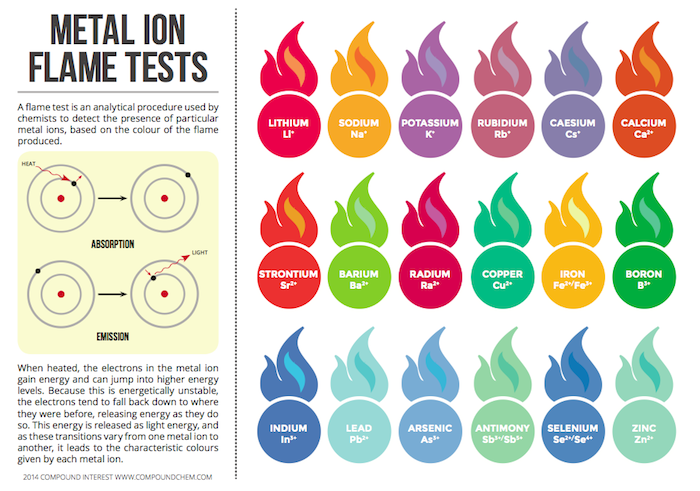
Metal Ion Flame Tests-Click to enlarge
The table above from www.compoundchem.com shows the range of colours chemicals produce.  These tests work better for some metal ions than other; in particular, those ions shown on the bottom row of the infographic are generally quite faint and hard to distinguish. Sodium’s flame colour is also very strong, and can easily mask the colours of other metal ions.

For more information and more pictures visit:-
http://www.compoundchem.com/2014/02/06/metal-ion-flame-test-colours-chart/
http://en.wikipedia.org/wiki/Flame_test