Total Lab Supplies - Everything for your laboratory

Total Lab Supplies - Everything for your laboratory
Our Head Office in St Helens
Showing posts with label potassium. Show all posts

Wednesday, 24 August 2016

On this day in science history: Mount Vesuvius erupted

In 79, the long-dormant Mount Vesuvius erupted in Italy, burying the Roman cities of Pompeii and Herculaneum in volcanic ash. An estimated 20,000 people died. When discovered, the sites became astonishing archaeological time capsules. Official excavations began on 6 Apr 1748 of behalf of the Italian king's interest in collecting antiquities.

Pompeii, with Vesuvius towering above. Qfl247 CC BY-SA 3.0 (http://creativecommons.org/licenses/by-sa/3.0) or GFDL (http://www.gnu.org/copyleft/fdl.html), via Wikimedia Commons
Scientific knowledge of the geologic history of Vesuvius comes from core samples taken from a 2,000 m (6,600 ft) plus bore hole on the flanks of the volcano, extending into Mesozoic rock. Cores were dated by potassium–argon and argon–argon dating. The mountain started forming 25,000 years ago. Although the area has been subject to volcanic activity for at least 400,000 years, the lowest layer of eruption material from the Somma mountain lies on top of the 40,000‑year‑old Campanian Ignimbrite produced by the Campi Flegrei complex, and was the product of the Codola Plinian eruption 25,000 years ago.

It was then built up by a series of lava flows, with some smaller explosive eruptions interspersed between them. However, the style of eruption changed around 19,000 years ago to a sequence of large explosive plinian eruptions, of which the 79 AD one was the most recent. The eruptions are named after the tephra deposits produced by them, which in turn are named after the location where the deposits were first identified:

  • The Basal Pumice (Pomici di Base) eruption, 18,300 years ago, VEI 6, saw the original formation of the Somma caldera. The eruption was followed by a period of much less violent, lava producing eruptions.
  • The Green Pumice (Pomici Verdoline) eruption, 16,000 years ago, VEI 5.
  • The Mercato eruption (Pomici di Mercato) – also known as Pomici Gemelle or Pomici Ottaviano – 8000 years ago, VEI 6, followed a smaller explosive eruption around 11,000 years ago (called the Lagno Amendolare eruption).
  • The Avellino eruption (Pomici di Avellino), 3800 years ago, VEI 5, followed two smaller explosive eruptions around 5,000 years ago. The Avellino eruption vent was apparently 2 km west of the current crater, and the eruption destroyed several Bronze Age settlements of the Apennine culture. Several carbon dates on wood and bone offer a range of possible dates of about 500 years in the mid-2nd millennium BC. In May 2001, near Nola, Italian archaeologists using the technique of filling every cavity with plaster or substitute compound recovered some remarkably well-preserved forms of perishable objects, such as fence rails, a bucket and especially in the vicinity thousands of human footprints pointing into the Apennines to the north. The settlement had huts, pots, and goats. The residents had hastily abandoned the village, leaving it to be buried under pumice and ash in much the same way that Pompeii was later preserved. Pyroclastic surge deposits were distributed to the northwest of the vent, travelling as far as 15 km (9.3 mi) from it, and lie up to 3 m (9.8 ft) deep in the area now occupied by Naples.

The volcano then entered a stage of more frequent, but less violent, eruptions until the most recent Plinian eruption, which destroyed Pompeii.

The last of these may have been in 217 BC. There were earthquakes in Italy during that year and the sun was reported as being dimmed by a haze or dry fog. Plutarch wrote of the sky being on fire near Naples and Silius Italicus mentioned in his epic poem Punica that Vesuvius had thundered and produced flames worthy of Mount Etna in that year, although both authors were writing around 250 years later. Greenland ice core samples of around that period show relatively high acidity, which is assumed to have been caused by atmospheric hydrogen sulfide.

The mountain was then quiet (for 295 years, if the 217 BC date for the last previous eruption is true) and was described by Roman writers as having been covered with gardens and vineyards, except at the top which was craggy. The mountain may have had only one summit at that time, judging by a wall painting, "Bacchus and Vesuvius", found in a Pompeiian house, the House of the Centenary (Casa del Centenario).

Several surviving works written over the 200 years preceding the 79 AD eruption describe the mountain as having had a volcanic nature, although Pliny the Elder did not depict the mountain in this way in his Naturalis Historia:

  • The Greek historian Strabo (ca 63 BC–AD 24) described the mountain in Book V, Chapter 4 of his Geographica as having a predominantly flat, barren summit covered with sooty, ash-coloured rocks and suggested that it might once have had "craters of fire". He also perceptively suggested that the fertility of the surrounding slopes may be due to volcanic activity, as at Mount Etna.
  • In Book II of De architectura, the architect Vitruvius reported that fires had once existed abundantly below the mountain and that it had spouted fire onto the surrounding fields. He went on to describe Pompeiian pumice as having been burnt from another species of stone.
  • Diodorus Siculus (ca 90 BC–ca 30 BC), another Greek writer, wrote in Book IV of his Bibliotheca Historica that the Campanian plain was called fiery (Phlegrean) because of the mountain, Vesuvius, which had spouted flame like Etna and showed signs of the fire that had burnt in ancient history.
For more information visit:-


Wednesday, 18 May 2016

Higher potato consumption associated with increased risk of high blood pressure

Higher intakes of boiled, baked, or mashed potatoes, and French fries is associated with an increased risk of developing high blood pressure (hypertension) in adult women and men, according to a study published by The BMJ today.

The US-based researchers suggest that replacing one serving a day of boiled, baked, or mashed potatoes with one serving of a non-starchy vegetable is associated with a lower risk of developing hypertension.

But a linked editorial argues that studying overall dietary patterns and risk of disease is more useful than a focus on individual foods or nutrients.

Various potato dishes by Scott Bauer (United States Department of Agriculture (link)) [Public domain], via Wikimedia Commons
Potatoes are one of the world's most commonly consumed foods - and have recently been included as vegetables in US government healthy meals programs, due to their high potassium content. But the association of potato intake with hypertension has not been studied.

So researchers based at Brigham and Women's Hospital and Harvard Medical School set out to determine whether higher long term intake of baked, boiled, or mashed potatoes, French fries, and potato chips (crisps) was associated with incident hypertension.

They followed over 187,000 men and women from three large US studies for more than 20 years. Dietary intake, including frequency of potato consumption, was assessed using a questionnaire. Hypertension was reported by participants based on diagnosis by a health professional.

After taking account of several other risk factors for hypertension, the researchers found that four or more servings a week of baked, boiled, or mashed potatoes was associated with an increased risk of hypertension compared with less than one serving a month in women, but not in men.

Higher consumption of French fries was also associated with an increased risk of hypertension in both women and men. However, consumption of potato chips (crisps) was associated with no increased risk.

After further analyses, the researchers suggest that replacing one serving a day of boiled, baked, or mashed potatoes with one serving of a non-starchy vegetable is associated with a decreased risk of hypertension.

The authors point out that potatoes have a high glycaemic index compared with other vegetables, so can trigger a sharp rise in blood sugar levels, and this could be one explanation for the findings.

They also acknowledge some study limitations and say that, as with any observational study, no firm conclusions can be drawn about cause and effect.

Nevertheless, they say their findings "have potentially important public health ramifications, as they do not support a potential benefit from the inclusion of potatoes as vegetables in government food programs but instead support a harmful effect that is consistent with adverse effects of high carbohydrate intakes seen in controlled feeding studies."

In a linked editorial, researchers at the University of New South Wales argue that, although diet has an important part to play in prevention and early management of hypertension, dietary behaviour and patterns of consumption are complex and difficult to measure.

"We will continue to rely on prospective cohort studies, but those that examine associations between various dietary patterns and risk of disease provide more useful insights for both policy makers and practitioners than does a focus on individual foods or nutrients," they conclude.

For more information visit:-


Friday, 26 September 2014

Flamin' hot colours!

Back in your school days there was probably an experiment where you placed a small amount of a compound into a flame and observed it's colour.  This is the flame test and depending on the colour observed it can tell you what elements are present.


Scientifically put, A flame test is an analytic procedure used in chemistry to detect the presence of certain elements, primarily metal ions, based on each element's characteristic emission spectrum. The colour of flames in general also depends on temperature.

The test involves introducing a sample of the element or compound to a hot, non-luminous flame, and observing the colour of the flame that results. The idea of the test is that sample atoms evaporate and since they are hot, they emit light when being in flame.

The flame test is relatively quick and simple to perform, and can be carried out with the basic equipment found in most chemistry laboratories. However, the range of elements positively detectable under these conditions is small, as the test relies on the subjective experience of the experimenter rather than any objective measurements. The test has difficulty detecting small concentrations of some elements, while too strong a result may be produced for certain others, which tends to cause fainter colours to not appear.


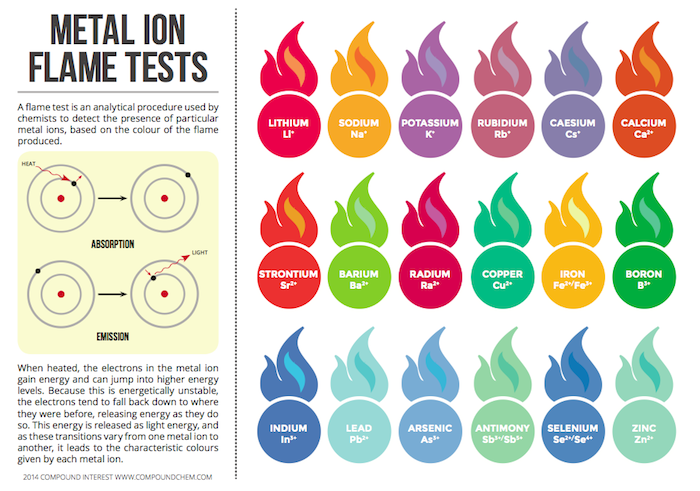
Metal Ion Flame Tests-Click to enlarge
The table above from www.compoundchem.com shows the range of colours chemicals produce.  These tests work better for some metal ions than other; in particular, those ions shown on the bottom row of the infographic are generally quite faint and hard to distinguish. Sodium’s flame colour is also very strong, and can easily mask the colours of other metal ions.

For more information and more pictures visit:-
http://www.compoundchem.com/2014/02/06/metal-ion-flame-test-colours-chart/
http://en.wikipedia.org/wiki/Flame_test