Total Lab Supplies - Everything for your laboratory

Total Lab Supplies - Everything for your laboratory
Our Head Office in St Helens
Showing posts with label cancer. Show all posts

Monday, 3 September 2018

Asbestos - The dangers!

Asbestos is a set of six naturally occurring silicate minerals which all have in common their eponymous asbestiform habit: i.e. long (roughly 1:20 aspect ratio), thin fibrous crystals, with each visible fibre composed of millions of microscopic "fibrils" that can be released by abrasion and other processes. They are commonly known by their colours, as blue asbestos, brown asbestos, white asbestos, and green asbestos.


Asbestos mining existed more than 4,000 years ago, but large-scale mining began at the end of the 19th century, when manufacturers and builders began using asbestos for its desirable physical properties. Some of those properties are sound absorption, average tensile strength, affordability, and resistance to fire, heat, and electricity. It was used in such applications as electrical insulation for hotplate wiring and in building insulation. When asbestos is used for its resistance to fire or heat, the fibers are often mixed with cement or woven into fabric or mats. These desirable properties made asbestos very widely used. Asbestos use continued to grow through most of the 20th century until public knowledge of the health hazards of asbestos dust led to its outlawing by courts and legislatures in mainstream construction and fireproofing in most countries.

Many countries have discontinued these uses since the health risks of asbestos became apparent. However, their legacy is that many buildings more than 20 years old contain asbestos. It’s estimated that 94% of hospitals in London contain asbestos, and it can also be found in older homes. It does not pose a danger unless disturbed, but can be costly to remove

For more information

Visit https://en.wikipedia.org/wiki/Asbestos
Visit http://www.compoundchem.com/2018/08/14/asbestos/

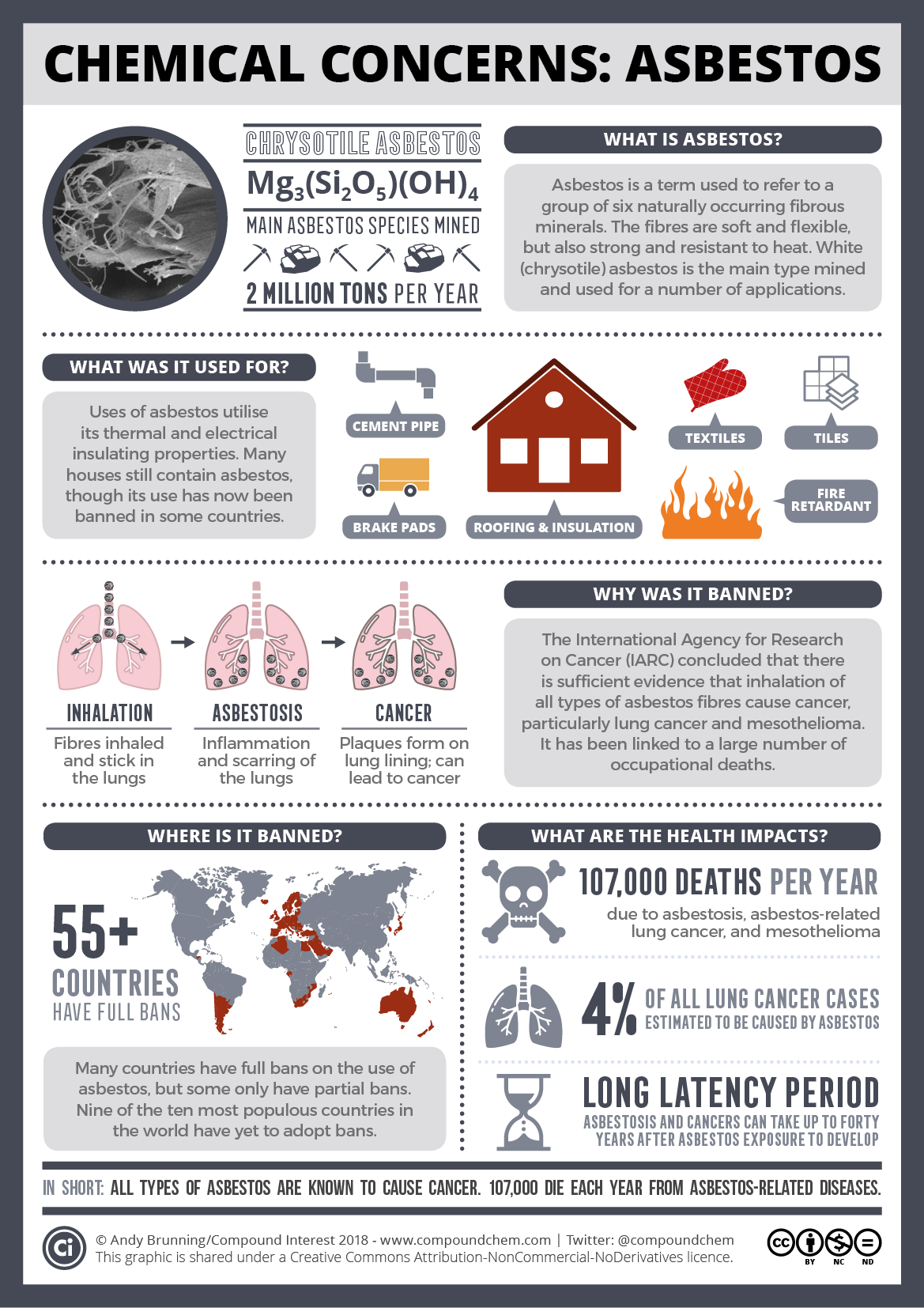
The excellent Compound Chem website has a graphic as below explaining the dangers of Asbestos in simple terms.  Click on it to enlarge.


Wednesday, 19 July 2017

Drinking coffee could lead to a longer life, scientist says

Here's another reason to start the day with a cup of joe: Scientists have found that people who drink coffee appear to live longer.

Drinking coffee was associated with a lower risk of death due to heart disease, cancer, stroke, diabetes, and respiratory and kidney disease for African-Americans, Japanese-Americans, Latinos and whites.

People who consumed a cup of coffee a day were 12 percent less likely to die compared to those who didn't drink coffee. This association was even stronger for those who drank two to three cups a day - 18 percent reduced chance of death.

Lower mortality was present regardless of whether people drank regular or decaffeinated coffee, suggesting the association is not tied to caffeine, said Veronica W. Setiawan, lead author of the study and an associate professor of preventive medicine at the Keck School of Medicine of USC.

A small cup of coffee. By Julius Schorzman (Own work) [CC BY-SA 2.0 (http://creativecommons.org/licenses/by-sa/2.0)], via Wikimedia Commons
"We cannot say drinking coffee will prolong your life, but we see an association," Setiawan said. "If you like to drink coffee, drink up! If you're not a coffee drinker, then you need to consider if you should start."

The study, which will be published in the July 11 issue of Annals of Internal Medicine, used data from the Multiethnic Cohort Study, a collaborative effort between the University of Hawaii Cancer Centre and the Keck School of Medicine.

The ongoing Multiethnic Cohort Study has more than 215,000 participants and bills itself as the most ethnically diverse study examining lifestyle risk factors that may lead to cancer.

"Until now, few data have been available on the association between coffee consumption and mortality in non-whites in the United States and elsewhere," the study stated. "Such investigations are important because lifestyle patterns and disease risks can vary substantially across racial and ethnic backgrounds, and findings in one group may not necessarily apply to others."

Since the association was seen in four different ethnicities, Setiawan said it is safe to say the results apply to other groups.

"This study is the largest of its kind and includes minorities who have very different lifestyles," Setiawan said. "Seeing a similar pattern across different populations gives stronger biological backing to the argument that coffee is good for you whether you are white, African-American, Latino or Asian."

Previous research by USC and others have indicated that drinking coffee is associated with reduced risk of several types of cancer, diabetes, liver disease, Parkinson's disease, Type 2 diabetes and other chronic diseases.

Setiawan, who drinks one to two cups of coffee daily, said any positive effects from drinking coffee are far-reaching because of the number of people who enjoy or rely on the beverage every day.

"Coffee contains a lot of antioxidants and phenolic compounds that play an important role in cancer prevention," Setiawan said. "Although this study does not show causation or point to what chemicals in coffee may have this 'elixir effect,' it is clear that coffee can be incorporated into a healthy diet and lifestyle."

About 62 percent of Americans drink coffee daily, a 5 percent increase from 2016 numbers, reported the National Coffee Association.

As a research institution, USC has scientists from across disciplines working to find a cure for cancer and better ways for people to manage the disease.

The Keck School of Medicine and USC Norris Comprehensive Cancer Center manage a state-mandated database called the Los Angeles Cancer Surveillance Program, which provides scientists with essential statistics on cancer for a diverse population.

Researchers from the USC Norris Comprehensive Cancer Center have found that drinking coffee lowers the risk of colorectal cancer.

But drinking piping hot coffee or beverages probably causes cancer in the esophagus, according to a World Health Organization panel of scientists that included Mariana Stern from the Keck School of Medicine.

In some respects, coffee is regaining its honor for wellness benefits. After 25 years of labelling coffee a carcinogen linked to bladder cancer, the World Health Organization last year announced that drinking coffee reduces the risk for liver and uterine cancer.

"Some people worry drinking coffee can be bad for you because it might increase the risk of heart disease, stunt growth or lead to stomach ulcers and heartburn," Setiawan said. "But research on coffee have mostly shown no harm to people's health."

Setiawan and her colleagues examined the data of 185,855 African-Americans (17 percent), Native Hawaiians (7 percent), Japanese-Americans (29 percent), Latinos (22 percent) and whites (25 percent) ages 45 to 75 at recruitment. Participants answered questionnaires about diet, lifestyle, and family and personal medical history.

They reported their coffee drinking habits when they entered the study and updated them about every five years, checking one of nine boxes that ranged from "never or hardly ever" to "4 or more cups daily." They also reported whether they drank caffeinated or decaffeinated coffee. The average follow-up period was 16 years.

Sixteen percent of participants reported that they did not drink coffee, 31 percent drank one cup per day, 25 percent drank two to three cups per day and 7 percent drank four or more cups per day. The remaining 21 percent had irregular coffee consumption habits.

Over the course of the study, 58,397 participants - about 31 percent - died. Cardiovascular disease (36 percent) and cancer (31 percent) were the leading killers.

The data was adjusted for age, sex, ethnicity, smoking habits, education, pre-existing disease, vigorous physical exercise and alcohol consumption.

Setiawan's previous research found that coffee reduces the risk of liver cancer and chronic liver disease. She is currently examining how coffee is associated with the risk of developing specific cancers.

Researchers from the University of Hawaii Cancer Centre and the National Cancer Institute contributed to this study. The study used data from the Multiethnic Cohort Study, which is supported by a $19,008,359 grant from the National Cancer Institute of the National Institutes of Health.

For more information, visit:-


Tuesday, 16 May 2017

Diesels pollute more than lab tests detect

Because of testing inefficiencies, maintenance inadequacies and other factors, cars, trucks and buses worldwide emit 4.6 million tons more harmful nitrogen oxide (NOx) than standards allow, according to a new study co-authored by University of Colorado Boulder researchers.

The study, published in Nature, shows these excess emissions alone lead to 38,000 premature deaths annually worldwide, including 1,100 deaths in the United States.

The findings reveal major inconsistencies between what vehicles emit during testing and what they emit in the real world - a problem that's far more severe, said the researchers, than the incident in 2015, when federal regulators discovered Volkswagen had been fitting millions of new diesel cars with "defeat devices."

Red Diesel Tank, by Meena Kadri [CC BY 2.0 (http://creativecommons.org/licenses/by/2.0)], via Wikimedia Commons
The devices sense when a vehicle is undergoing testing and reduce emissions to comply with government standards. Excess emissions from defeat devices have been linked to about 50 to 100 U.S. deaths per year, studies show.

"A lot of attention has been paid to defeat devices, but our work emphasizes the existence of a much larger problem," said Daven Henze, an associate professor of mechanical engineering at CU Boulder who, along with postdoctoral researcher Forrest Lacey, contributed to the study. "It shows that in addition to tightening emissions standards, we need to be attaining the standards that already exist in real-world driving conditions."

The research was conducted in partnership with the International Council on Clean Transportation, a Washington, D.C.-based nonprofit organization, and Environmental Health Analytics LLC.

For the paper, the researchers assessed 30 studies of vehicle emissions under real-world driving conditions in 11 major vehicle markets representing 80 percent of new diesel vehicle sales in 2015. Those markets include Australia, Brazil, Canada, China, the European Union, India, Japan, Mexico, Russia, South Korea and the United States.

They found that in 2015, diesel vehicles emitted 13.1 million tons of NOx, a chemical precursor to particulate matter and ozone. Exposure in humans can lead to heart disease, stroke, lung cancer and other health problems. Had the emissions met standards, the vehicles would have emitted closer to 8.6 million tons of NOx.

Heavy-duty vehicles, such as commercial trucks and buses, were by far the largest contributor worldwide, accounting for 76 percent of the total excess NOx emissions.

Henze used computer modeling and NASA satellite data to simulate how particulate matter and ozone levels are, and will be, impacted by excess NOx levels in specific locations. The team then computed the impacts on health, crops and climate.

"The consequences of excess diesel NOx emissions for public health are striking," said Susan Anenberg, co-lead author of the study and co-founder of Environmental Health Analytics LLC.

China suffers the greatest health impact with 31,400 deaths annually attributed to diesel NOx pollution, with 10,700 of those deaths linked to excess NOx emissions beyond certification limits. In Europe, where diesel-passenger cars are common, 28,500 deaths annually are attributed to diesel NOx pollution, with 11,500 of those deaths linked to excess emissions.

The study projects that by 2040, 183,600 people will die prematurely each year due to diesel vehicle NOx emissions unless governments act.

The authors say emission certification tests, both prior to sale and by vehicle owners, could be more accurate if they were to simulate a broader variety of speeds, driving styles and ambient temperatures. Some European countries now use portable testing devices that track emissions of a car in motion.

"Tighter vehicle emission standards coupled with measures to improve real-world compliance could prevent hundreds of thousands of early deaths from air pollution-related diseases each year," said Anenberg.

For more information, visit:-


Wednesday, 4 January 2017

Zinc eaten at levels found in biofortified crops reduces 'wear and tear' on DNA

A new study by researchers from the UCSF Benioff Children's Hospital Research Institute (CHORI) shows that a modest 4 milligrams of extra zinc a day in the diet can have a profound, positive impact on cellular health that helps fight infections and diseases. This amount of zinc is equivalent to what biofortified crops like zinc rice and zinc wheat can add to the diet of vulnerable, nutrient deficient populations.

The study, published in the American Journal of Clinical Nutrition, was led by CHORI Senior Scientist Janet King, PhD. King and her team are the first to show that a modest increase in dietary zinc reduces oxidative stress and damage to DNA.

Zinc Acetate. By Chemical interest (Own work (Original text: self-made)) [Public domain], via Wikimedia Commons
"We were pleasantly surprised to see that just a small increase in dietary zinc can have such a significant impact on how metabolism is carried out throughout the body," says King. "These results present a new strategy for measuring the impact of zinc on health and reinforce the evidence that food-based interventions can improve micronutrient deficiencies worldwide."

Zinc is ubiquitous in our body and facilitates many functions that are essential for preserving life. It plays a vital role in maintaining optimal childhood growth, and in ensuring a healthy immune system. Zinc also helps limit inflammation and oxidative stress in our body, which are associated with the onset of chronic cardiovascular diseases and cancers.

Around much of the world, many households eat polished white rice or highly refined wheat or maize flours, which provide energy but do not provide enough essential micronutrients such as zinc. Zinc is an essential part of nearly 3,000 different proteins, and it impacts how these proteins regulate every cell in our body. In the absence of sufficient zinc, our ability to repair everyday wear and tear on our DNA is compromised.

In the randomized, controlled, six-week study the scientists measured the impact of zinc on human metabolism by counting DNA strand breaks. They used the parameter of DNA damage to examine the influence of a moderate amount of zinc on healthy living. This was a novel approach, different from the commonly used method of looking at zinc in the blood or using stunting and morbidity for assessing zinc status.

According to King, these results are relevant to the planning and evaluation of food-based solutions for mitigating the impact of hidden hunger and malnutrition. King believes that biofortification can be a sustainable, long-term solution to zinc deficiency.

For more information please visit: -


Tuesday, 8 November 2016

On this day in science history: the first X-rays were observed

In 1895, Wilhelm Röntgen first observed X-rays during an experiment at WĂ¼rzburg University. After further investigation, on 1 Jan 1896, he notified other scientists of his discovery of this new radiation that would become known as X-rays. He sent copies of his manuscript and some of his X-ray photographs to several renowned physicists and friends, including Lord Kelvin in Glasgow and in Paris. On 5 Jan 1896, Die Presse published the news in a front-page article which described his investigations and suggested new methods of medical diagnoses might be made with this new kind of radiation.

Wilhelm Röntgen, by Nobel foundation [Public domain or Public domain], via Wikimedia Commons

So, what are the properties of X-Rays? 

X-ray photons carry enough energy to ionize atoms and disrupt molecular bonds. This makes it a type of ionizing radiation, and therefore harmful to living tissue. A very high radiation dose over a short period of time causes radiation sickness, while lower doses can give an increased risk of radiation-induced cancer. In medical imaging this increased cancer risk is generally greatly outweighed by the benefits of the examination. The ionizing capability of X-rays can be utilized in cancer treatment to kill malignant cells using radiation therapy. It is also used for material characterization using X-ray spectroscopy.

Hard X-rays can traverse relatively thick objects without being much absorbed or scattered. For this reason, X-rays are widely used to image the inside of visually opaque objects. The most often seen applications are in medical radiography and airport security scanners, but similar techniques are also important in industry (e.g. industrial radiography and industrial CT scanning) and research (e.g. small animal CT). The penetration depth varies with several orders of magnitude over the X-ray spectrum. This allows the photon energy to be adjusted for the application so as to give sufficient transmission through the object and at the same time good contrast in the image.

X-rays have much shorter wavelength than visible light, which makes it possible to probe structures much smaller than what can be seen using a normal microscope. This can be used in X-ray microscopy to acquire high resolution images, but also in X-ray crystallography to determine the positions of atoms in crystals.

For more information, visit:-


Tuesday, 26 April 2016

On this day in science history: Chernobyl nuclear plant explosion

In 1986, in Pripet, Russia, one of the four reactors at the Chernobyl nuclear plant exploded in the world's worst civil nuclear catastrophe. It sent a cloud of radioactive dust over Europe. 

The disaster began during a systems test on 26 April 1986 at reactor number four of the Chernobyl plant.  There was a sudden and unexpected power surge, and when an emergency shutdown was attempted, an exponentially larger spike in power output occurred, which led to a reactor vessel rupture and a series of steam explosions. These events exposed the graphite moderator of the reactor to air, causing it to ignite. The resulting fire sent a plume of highly radioactive fallout into the atmosphere and over an extensive geographical area, including Pripyat. The plume drifted over large parts of the western Soviet Union and Europe. From 1986 to 2000, 350,400 people were evacuated and resettled from the most severely contaminated areas of Belarus, Russia, and Ukraine. According to official post-Soviet data, about 60% of the fallout landed in Belarus.

The abandoned city of Pripyat with Chernobyl plant in the distance, by Jason Minshull [Public domain], via Wikimedia Commons
Russia, Ukraine, and Belarus have been burdened with the continuing and substantial decontamination and health care costs of the Chernobyl accident. A report by the International Atomic Energy Agency examines the environmental consequences of the accident. Another UN agency, UNSCEAR, has estimated a global collective dose of radiation exposure from the accident "equivalent on average to 21 additional days of world exposure to natural background radiation"; individual doses were far higher than the global mean among those most exposed, including 530,000 local recovery workers who averaged an effective dose equivalent to an extra 50 years of typical natural background radiation exposure each. Estimates of the number of deaths that will eventually result from the accident vary enormously; disparities reflect both the lack of solid scientific data and the different methodologies used to quantify mortality—whether the discussion is confined to specific geographical areas or extends worldwide, and whether the deaths are immediate, short term, or long term.

Thirty-one deaths are directly attributed to the accident, all among the reactor staff and emergency workers. An UNSCEAR report places the total confirmed deaths from radiation at 64 as of 2008. The Chernobyl Forum predicts the eventual death toll could reach 4,000 among those exposed to the highest levels of radiation (200,000 emergency workers, 116,000 evacuees and 270,000 residents of the most contaminated areas); this figure is a total causal death toll prediction, combining the deaths of approximately 50 emergency workers who died soon after the accident from acute radiation syndrome, nine children who have died of thyroid cancer and a future predicted total of 3940 deaths from radiation-induced cancer and leukemia.

In a peer-reviewed publication in the International Journal of Cancer in 2006, the authors (following a different conclusion methodology to the Chernobyl Forum study, which arrived at the total predicted death toll of 4,000 after cancer survival rates were factored in) stated, without entering into a discussion on deaths, that in terms of total excess cancers attributed to the accident:

The risk projections suggest that by now Chernobyl may have caused about 1000 cases of thyroid cancer and 4000 cases of other cancers in Europe, representing about 0.01% of all incident cancers since the accident. Models predict that by 2065 about 16,000 cases of thyroid cancer and 25,000 cases of other cancers may be expected due to radiation from the accident, whereas several hundred million cancer cases are expected from other causes.

Also based upon extrapolations from the linear no-threshold model of radiation induced damage, down to zero, the Union of Concerned Scientists estimates that, among the hundreds of millions of people living in broader geographical areas, there will be 50,000 excess cancer cases resulting in 25,000 excess cancer deaths.

For this broader group, the 2006 TORCH report, commissioned by the European Greens political party, predicts 30,000 to 60,000 excess cancer deaths. The environmental advocacy group Greenpeace reports the figure at 200,000 or more.

The Russian founder of that region's chapter of Greenpeace also authored a book titled Chernobyl: Consequences of the Catastrophe for People and the Environment, which concludes that among the billions of people worldwide who were exposed to radioactive contamination from the disaster, nearly a million premature cancer deaths occurred between 1986 and 2004. The book, however, has failed the peer review process. Of the five reviews published in the academic press, four considered the book severely flawed and contradictory, and one praised it while noting some shortcomings. The review by M. I. Balonov published by the New York Academy of Sciences concludes that the report is of negative value because it has very little scientific merit while being highly misleading to the lay reader. It characterized the estimate of nearly a million deaths as more in the realm of science fiction than science.

The accident raised concerns about nuclear power worldwide and slowed or reversed the expansion of nuclear power stations. The accident also raised concerns about the safety of the Soviet nuclear power industry, slowing its expansion for a number of years and forcing the Soviet government to become less secretive about its procedures. The government coverup of the Chernobyl disaster was a "catalyst" for glasnost, which "paved the way for reforms leading to the Soviet collapse".

The final shutdown of the undamaged last reactor on the site took place ceremoniously on 15 Dec 2000.

For more information visit:-


Tuesday, 27 October 2015

Meat and tobacco: the difference between risk and strength of evidence

Comparing smoking to bacon in terms of risk of cancer is extremely misleading, despite the strength of evidence being similar.

Vegetarians are probably breathing a sigh of relief today as headlines are warning us that processed and cured meats cause cancer. But the way this message has been framed in the media is extremely misleading.

Comparing meat to tobacco, as most news organisations who’ve chosen to report this have done, makes it seem like a bacon sandwich might be just as harmful as a cigarette. This is absolutely not the case.

A bacon sandwich

The headlines are referring to the news that the World Health Organisation has classified cured and processed meats (bacon, salami, sausages, ham) as group 1 carcinogens, because there is a causal link between consuming these meats and bowel cancer. This group also includes tobacco, alcohol, arsenic and asbestos, all known to cause certain cancers.

But just because all these things cause cancer, doesn’t mean they’re all as risky as each other. A substance can increase your risk of cancer a small amount, or, like tobacco, a huge amount. Comparing them like for like is just really confusing to anyone trying to work out how to lead a healthy life.

The risk of lung cancer from smoking is extremely high. Of all cases of lung cancer (44,488 new cases in the UK in 2012), evidence suggests that 86% of these are caused by tobacco. And lung cancer isn’t the only type of cancer caused by smoking. CRUK estimate that 19% of all cancers are caused by smoking. Another way of looking at this is that if smoking was completely eliminated, there would be 64,500 fewer cases of cancer in the UK per year.

In contrast, the recent evidence that suggests a causal link between processed meat and bowel cancer estimates that 21% of bowel cancers (which occurs at slightly lower rates than lung cancer – 41,600 new cases in 2011) were caused by eating processed and red meat. If all such meat was eliminated entirely from our diet, they estimate that 8,800 cases of cancer would be prevented in the UK per year.

All this simplistic reporting ignores a variety of other factors – the amount you consume, for example, is likely to affect your risk a great deal. And that’s not to mention addiction – however much you crave a bacon sandwich at times, it doesn’t contain nicotine.

The WHO have deemed the strength of evidence that processed meats cause cancer to be equivalent to that showing that smoking causes cancer. This means that if you eat a lot of red or processed meats you are increasing your risk of cancer. But to compare it to something as lethal as smoking is confusing and dangerous.

For more information visit:-

Friday, 7 November 2014

On this day - Marie Curie

Marie Curie was a Polish-born physicist and chemist and one of the most famous scientists of her time. Together with her husband Pierre, she was awarded the Nobel Prize in 1903, and she went on to win another in 1911.


Marie Sklodowska was born in Warsaw on 7 November 1867, the daughter of a teacher. In 1891, she went to Paris to study physics and mathematics at the Sorbonne where she met Pierre Curie, professor of the School of Physics. They were married in 1895.

She developed a theory of radioactivity (a term that she coined) and techniques for isolating radioactive isotopes.  She also discovered two elements, polonium and radium. Under her direction, the world's first studies were conducted into the treatment of neoplasms, using radioactive isotopes. She founded the Curie Institutes in Paris and in Warsaw, which remain major centres of medical research today.
During World War I, she established the first military field radiological centres.  After a quick study of radiology, anatomy, and automotive mechanics she procured X-ray equipment, vehicles, auxiliary generators, and developed mobile radiography units, which came to be popularly known as petites Curies ("Little Curies").  She became the director of the Red Cross Radiology Service and set up France's first military radiology centre, operational by late 1914.
Marie and her husband worked together investigating radioactivity, building on the work of the German physicist Roentgen and the French physicist Becquerel. In July 1898, the Curies announced the discovery of a new chemical element, polonium. At the end of the year, they announced the discovery of another, radium. The Curies, along with Becquerel, were awarded the Nobel Prize for Physics in 1903.

Marie received a second Nobel Prize, for Chemistry, in 1911.

Curie died in 1934 due to aplastic anaemia brought on by exposure to radiation – including carrying test tubes of radium in her pockets during research (she also stored them in her desk drawer, remarking on the faint light that the substances gave off in the dark) and her World War I service in mobile X-ray units created by her.  She was exposed to X-rays from unshielded equipment.


Marie and Pierre Curie experimenting with radium, a drawing by André Castaigne

Because of their levels of radioactivity, her papers from the 1890s are considered too dangerous to handle.  Even her cookbook is highly radioactive.  Her papers are kept in lead-lined boxes, and those who wish to consult them must wear protective clothing.

For more information visit:-
http://en.wikipedia.org/wiki/Marie_Curie
http://www.bbc.co.uk/history/historic_figures/curie_marie.shtml

http://prlabpak.blogspot.co.uk/2013/09/radium.html