Total Lab Supplies - Everything for your laboratory

Total Lab Supplies - Everything for your laboratory
Our Head Office in St Helens
Showing posts with label aspirin. Show all posts

Friday, 21 November 2014

Painkillers!

An analgesic, or painkiller, is any member of the group of drugs used to achieve analgesia — relief from pain. The word analgesic derives from Greek ἀν-, "without", and ἄλγος, "pain.

There are two main types of painkiller - opioids and non-steroid anti-inflammatory drugs (or NSAIDs).  The type of medicines that you need to treat your pain depend on what type of pain you have.

Paracetomol

Analgesic drugs act in various ways on the peripheral and central nervous systems. They are distinct from anesthetics, which reversibly eliminate sensation, and include paracetamol (known in the US as acetaminophen or simply APAP), the non-steroidal anti-inflammatory drugs (NSAIDs) such as the salicylates, and opioid drugs such as morphine and oxycodone.

The exact mechanism of action of paracetamol/acetaminophen is uncertain but appears to act centrally in the brain rather than peripherally in nerve endings. Aspirin and the other non-steroidal anti-inflammatory drugs (NSAIDs) inhibit cyclooxygenases, leading to a decrease in prostaglandin production. In contrast to paracetamol and the opioids, this reduces not only pain but inflammation as well.
The graphic below from Compound Interest takes a look at a selection of common painkillers, their common brand names, and how they work.
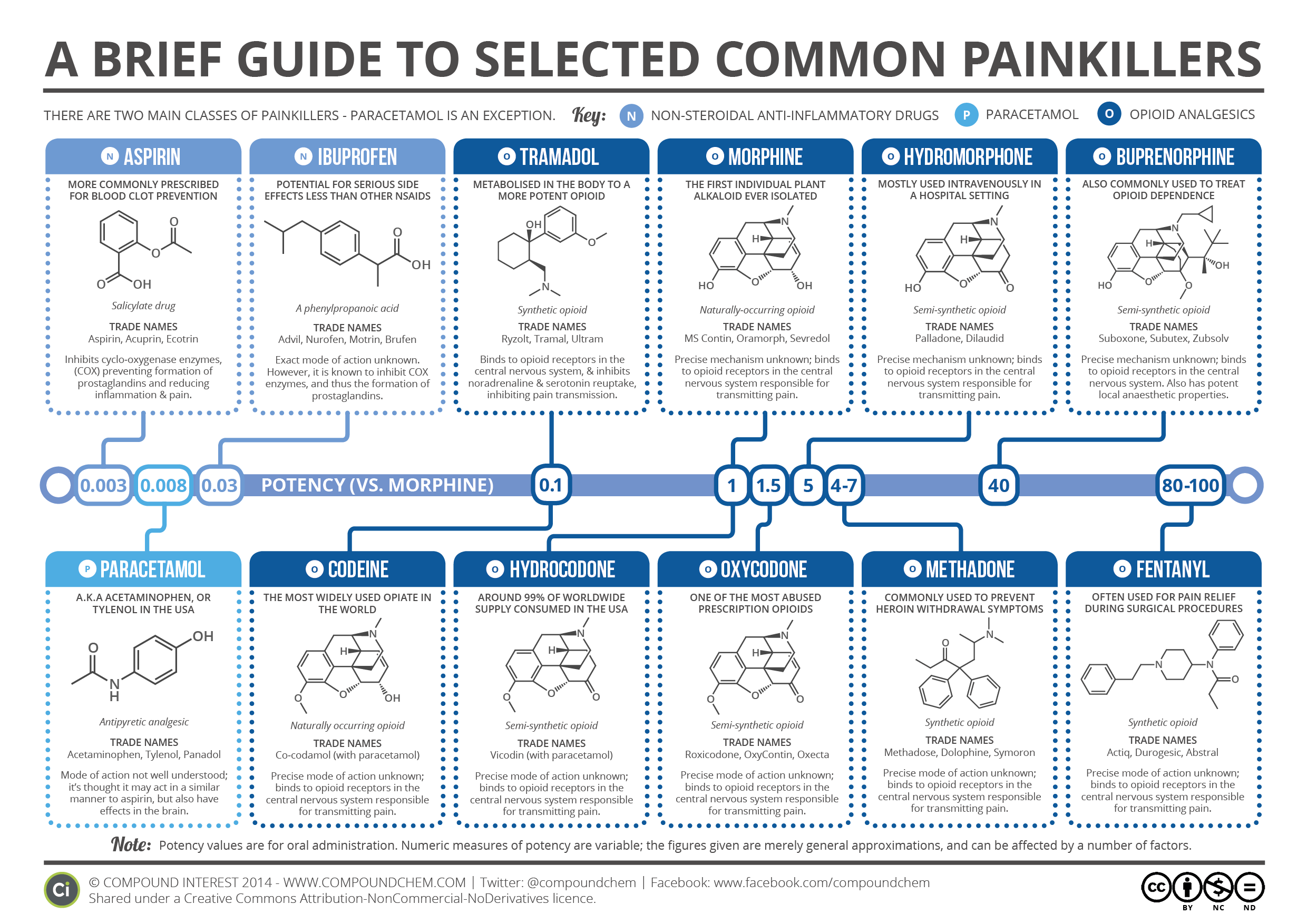
http://www.compoundchem.com/wp-content/uploads/2014/09/Brief-Guide-to-Common-Painkillers-Oct-14.png
Click to enlarge


For pain associated with inflammation, such as back pain or headaches, paracetamol and anti-inflammatory painkillers work best.

If the pain is caused by sensitive or damaged nerves, as is the case with shingles or sciatica, it is usually treated with tablets that are also used for epilepsy and depression. These tablets change the way the central nervous system works.

The aim of taking medication is to improve your quality of life. All painkillers have potential side effects, so you need to weigh up the advantages of taking them against the disadvantages


For more information visit:-
http://www.compoundchem.com/2014/09/25/painkillers/
http://www.nhs.uk/Livewell/Pain/Pages/Whichpainkiller.aspx
http://en.wikipedia.org/wiki/Analgesic

Friday, 10 October 2014

On this day......Aspirin

On the 10th October 1897 German chemist Felix Hoffmann discovered an improved way of synthesizing acetylsalicylic acid or 'aspirin'.

Around c400 BC Hippocrates in Greece gives women willow leaf tea to relieve the pain of childbirth.  In 1763 Reverend Edward Stone of Chipping Norton near Oxford gives dried willow bark to 50 parishioners suffering rheumatic fever and describes his findings in a letter to the Royal Society of London.  In 1823 the active ingredient is extracted from willow and named salicin.  Salicylic acid is made from salicin by French scientists in 1853 butis found to irritate the gut.  In 1893 German scientists find that adding an acetyl group to salicylic acid reduces its irritant properties and in 1897 in Germany, Bayer's Felix Hoffmann develops and patents a process for synthesising acetyl salicylic acid or aspirin. First clinical trials begin.


Aspirin is often used as an analgesic to relieve minor aches and pains, as an antipyretic to reduce fever, and as an anti-inflammatory medication.

Aspirin is now accepted as an important weapon in the prevention of heart disease. A single dose of 300 mg is now recommended for patients in the acute stages of a heart attack followed by a daily dose of 75-100 mg. A similar low dose treatment regime is recommended for patients with angina, a history of heart problems or who have undergone coronary by pass surgery.

Aspirin is also used in other medical situations:-

  • Strokes - to reduce the risk


  • Pregnancy Complications - Pre-eclampsia and foetal growth retardation, both caused by blockages of the blood vessels of the placenta, are two of the commonest complications of pregnancy - aspirin helps to reduce this risk.
  • Colon cancer - In a long term study of 90,000 US nurses between 1976 and 1995, those who took 4-6 tablets of aspirin a week had a reduced incidence of colorectal cancer. The benefits were greatest in those who had taken the drugs the longest.
  • Diabetes - Blindness, coronary artery disease, stroke and kidney failure are all common complications of diabetes resulting from impaired blood circulation. The benefits of taking one aspirin a day are now so widely accepted that it is considered unethical to perform placebo controlled trials to prove the case.
  • Dementia (including Alzheimer's disease)- There is some evidence that aspirin may help prevent both the condition resulting from impaired blood flow and the most serious form of dementia, Alzheimer's disease.
The most common use is as a painkiller for headaches or fevers.

For more information visit:-
http://en.wikipedia.org/wiki/Aspirin
http://www.aspirin-foundation.com/index.html