Total Lab Supplies - Everything for your laboratory

Total Lab Supplies - Everything for your laboratory
Our Head Office in St Helens
Showing posts with label space. Show all posts

Tuesday, 27 September 2016

Hubble spots possible water plumes erupting on Jupiter's moon Europa

Astronomers using NASA's Hubble Space Telescope have imaged what may be water vapor plumes erupting off the surface of Jupiter's moon Europa. This finding bolsters other Hubble observations suggesting the icy moon erupts with high altitude water vapor plumes.

The observation increases the possibility that missions to Europa may be able to sample Europa's ocean without having to drill through miles of ice.

"Europa's ocean is considered to be one of the most promising places that could potentially harbor life in the solar system," said Geoff Yoder, acting associate administrator for NASA's Science Mission Directorate in Washington. "These plumes, if they do indeed exist, may provide another way to sample Europa's subsurface."

Jupiter. By NASA, ESA, and A. Simon (Goddard Space Flight Center) [Public domain], via Wikimedia Commons
The plumes are estimated to rise about 125 miles (200 kilometers) before, presumably, raining material back down onto Europa's surface. Europa has a huge global ocean containing twice as much water as Earth's oceans, but it is protected by a layer of extremely cold and hard ice of unknown thickness. The plumes provide a tantalizing opportunity to gather samples originating from under the surface without having to land or drill through the ice.

The team, led by William Sparks of the Space Telescope Science Institute (STScI) in Baltimore observed these finger-like projections while viewing Europa's limb as the moon passed in front of Jupiter.

The original goal of the team's observing proposal was to determine whether Europa has a thin, extended atmosphere, or exosphere. Using the same observing method that detects atmospheres around planets orbiting other stars, the team realized if there was water vapor venting from Europa's surface, this observation would be an excellent way to see it.

"The atmosphere of an extrasolar planet blocks some of the starlight that is behind it," Sparks explained. "If there is a thin atmosphere around Europa, it has the potential to block some of the light of Jupiter, and we could see it as a silhouette. And so we were looking for absorption features around the limb of Europa as it transited the smooth face of Jupiter."

In 10 separate occurrences spanning 15 months, the team observed Europa passing in front of Jupiter. They saw what could be plumes erupting on three of these occasions.

This work provides supporting evidence for water plumes on Europa. In 2012, a team led by Lorenz Roth of the Southwest Research Institute in San Antonio, detected evidence of water vapor erupting from the frigid south polar region of Europa and reaching more than 100 miles (160 kilometers) into space. Although both teams used Hubble's Space Telescope Imaging Spectrograph instrument, each used a totally independent method to arrive at the same conclusion.

"When we calculate in a completely different way the amount of material that would be needed to create these absorption features, it's pretty similar to what Roth and his team found," Sparks said. "The estimates for the mass are similar, the estimates for the height of the plumes are similar. The latitude of two of the plume candidates we see corresponds to their earlier work."

But as of yet, the two teams have not simultaneously detected the plumes using their independent techniques. Observations thus far have suggested the plumes could be highly variable, meaning that they may sporadically erupt for some time and then die down. For example, observations by Roth's team within a week of one of the detections by Sparks' team failed to detect any plumes.

If confirmed, Europa would be the second moon in the solar system known to have water vapor plumes. In 2005, NASA's Cassini orbiter detected jets of water vapor and dust spewing off the surface of Saturn's moon Enceladus.

Scientists may use the infrared vision of NASA's James Webb Space Telescope, which is scheduled to launch in 2018, to confirm venting or plume activity on Europa. NASA also is formulating a mission to Europa with a payload that could confirm the presence of plumes and study them from close range during multiple flybys.

"Hubble's unique capabilities enabled it to capture these plumes, once again demonstrating Hubble's ability to make observations it was never designed to make," said Paul Hertz, director of the Astrophysics Division at NASA Headquarters in Washington. "This observation opens up a world of possibilities, and we look forward to future missions - such as the James Webb Space Telescope - to follow up on this exciting discovery."

The work by Sparks and his colleagues will be published in the Sept. 29 issue of The Astrophysical Journal.

The Hubble Space Telescope is a project of international cooperation between NASA and ESA (the European Space Agency.) NASA's Goddard Space Flight Center in Greenbelt, Maryland, manages the telescope. STScI, which is operated for NASA by the Association of Universities for Research in Astronomy in Washington, conducts Hubble science operations.

For more information, visit:


Friday, 24 October 2014

On this day...

After the end of World War II on October 24, 1946 and a good while before the Sputnik satellite opened the space age, a group of soldiers and scientists in the New Mexico desert saw something new and wonderful—the first pictures of Earth as seen from space.


The White Sands rocket (official name V-2 No. 13) was the first man-made object to take a photograph of the Earth from outer space.   Launched from the White Sands Missile Range in White Sands, New Mexico, the rocket reached a maximum altitude of 107.5 miles (173 km), well above the commonly accepted boundary of space at 100 kilometres.

The famous photograph was taken from an altitude of 65 miles (104 km) with an attached 35 mm black-and-white camera.

Snapping a new frame every second and a half, the rocket-borne camera climbed straight up, then fell back to Earth minutes later, slamming into the ground at 500 feet per second. The camera itself was smashed, but the film, protected in a steel cassette, was unharmed.

It was one of many firsts for the V-2 research program of the late 1940s, during which the Army fired dozens of captured German missiles brought to White Sands in 300 railroad cars at the end of the war. While the missileers used the V-2s to refine their own rocket designs, scientists were invited to pack instruments inside the nosecone to study temperatures, pressures, magnetic fields and other physical characteristics of the unexplored upper atmosphere.


Earth from Space in colour


For more information visit

http://www.airspacemag.com/space/the-first-photo-from-space-13721411/#ixzz3D70AhqTN

http://en.wikipedia.org/wiki/V-2_No._13

Friday, 25 July 2014

A Solar Eclipse

A solar eclipse is a type of eclipse that occurs when the Moon passes between the Sun and Earth, and the Moon fully or partially blocks ("occults") the Sun. This can happen only at new moon, when the Sun and the Moon are inconjunction as seen from Earth in an alignment referred to as syzygy. In a total eclipse, the disk of the Sun is fully obscured by the Moon. In partial and annular eclipses only part of the Sun is obscured.

If the Moon were in a perfectly circular orbit, a little closer to the Earth, and in the same orbital plane, there would be total solar eclipses every single month. However, the Moon's orbit is inclined (tilted) at more than 5 degrees to Earth's orbit around the Sun (see ecliptic) so its shadow at new moon usually misses Earth.

Earth's orbit is called the ecliptic plane as the Moon's orbit must cross this plane in order for an eclipse (both solar as well as lunar) to occur. In addition, the Moon's actual orbit is elliptical, often taking it far enough away from Earth that its apparent size is not large enough to block the Sun totally. The orbital planes cross each year at a line of nodes resulting in at least two, and up to five, solar eclipses occurring each year; no more than two of which can be total eclipses.

However, total solar eclipses are rare at any particular location because totality exists only along a narrow path on Earth's surface traced by the Moon's shadow or umbra.

Special eye protection or indirect viewing techniques must be used when viewing a solar eclipse to avoid eye damage.

When at a spot from which a 'total eclipse' is visible, an observer can see a number of exciting effects.  One such effect occasionally seen is Baily's Beads where a sequence of spots of light appears along the edge of the Moon. This is caused by the sun shining through the valleys of the Moon's mountainous regions


The following table shows the upcoming total solar eclipses for the next few years:
DateRegion Visible
20 March 2015North Atlantic regions, Faroe Islands and the North Pole
9 March 2016Indonesia
21 August 2017Parts of the mid- and west USA
2 July 2019central Argentina, Chile, the Tuamotus (French Polynesia), parts of the South Pacific Ocean

For more information visit:-
http://en.wikipedia.org/wiki/Solar_eclipse
http://h2g2.com/approved_entry/A143812

Friday, 7 March 2014

On this day......

On March 7th 2009, the Kepler space observatory, designed to discover Earth-like habitable planets orbiting other stars, is launched.  The spacecraft is named after the Renaissance astronomer Johannes Kepler who is best known for his laws of planetary motion.

Kepler is designed to survey a portion of our region of the Milky Way to discover dozens of Earth-size extrasolar planets in or near the habitable zone and estimate how many of the billions of stars in our galaxy have such planets.


Kepler uses a photometer that continually monitors the brightness of over 145,000 main sequence stars in a fixed field of view. This data is transmitted to Earth and analysed to detect periodic dimming caused by extrasolar planets that cross in front of their host star.

As of July 2013, Kepler had found 134 confirmed exoplanets in 76 stellar systems, along with a further 3,277 unconfirmed planet candidates. In November 2013, astronomers reported, based on Kepler space mission data, that there could be as many as 40 billion Earth-sized planets orbiting in the habitable zones of sun-like stars and red dwarf stars within the Milky Way Galaxy.  11 billion of these estimated planets may be orbiting sun-like stars.  The nearest such planet may be 12 light-years away, according to the scientists.

For more information visit:-
http://en.wikipedia.org/wiki/Kepler_(spacecraft)
http://kepler.nasa.gov/

Friday, 7 February 2014

Back in 1984

On this day in 1984....

The first untethered spacewalk was made by American Bruce McCandless II on February 7, 1984, during Challenger mission STS-41-B, utilising the Manned Maneuvering Unit. He was subsequently joined by Robert L. Stewart during the 5 hour 55 minute spacewalk. Such a self-contained spacewalk was first attempted by Eugene Cernan in 1966 on Gemini 9A, but Cernan could not reach the maneuvering unit without tiring.

Untethered U.S. astronaut Bruce McCandless uses a manned maneuvering unit. photo taken by Robert "Hoot" Gibson

The Manned Maneuvering Unit (MMU) is an astronaut propulsion unit that was used by NASA on three Space Shuttle missions in 1984. The MMU allowed the astronauts to perform untethered EVA spacewalks at a distance from the shuttle. The MMU was used in practice to retrieve a pair of faulty communications satellites, Westar VI and Palapa B2. Following the third mission the unit was retired from use. A smaller successor, the Simplified Aid for EVA Rescue (SAFER), was first flown in 1994, and is intended for emergency use only.

While orbiting around the Earth at a speed of 17,500 miles per hour, McCandless floated from the cargo bay into outer space, 150 nautical miles above Earth, an experience he described as "a heck of a big leap." Mission specialist Robert L. Stewart, an Army lieutenant colonel, also flew the MMU on shuttle mission 41-B.

While flying the MMU, these men were in a journalistic phrase of the time "human satellites." They checked out the equipment, maneuvered within the cargo bay, flew away from and back to the orbiter, performed docking exercises, recharged the MMU nitrogen tanks, and collected engineering data. The MMU, according to Martin Marietta's post mission report, "performed as expected and no anomalies were reported.

Gaseous nitrogen was used as the propellant for the MMU. Two aluminium tanks with Kevlar wrappings contained 5.9 kilograms of nitrogen each, enough propellant for a six-hour EVA depending on the amount of manoeuvring done. Typical MMU delta-v (velocity change) capability was about 80 feet per second (24.4 m/s).


There were 24 nozzle thrusters placed at different locations on the MMU. To operate the propulsion system, the astronaut used his fingertips to manipulate hand controllers at the ends of the MMU's two arms. The right controller produced rotational acceleration for roll, pitch, and yaw. The left controller produced translational acceleration for moving forward-back, up-down, and left-right. Coordination of the two controllers produced intricate movements in the unit. Once a desired orientation was achieved, the astronaut could engage an automatic attitude-hold function that maintained the inertial attitude of the unit in flight. This freed both hands for work.

Yet the MMU has not been used since 1984. There are several reasons for this. First, most extravehicular activities were effective without use of the MMU. Tethers, safety grips, hand bars, and other restraints allowed astronauts to work in the open cargo bay. Furthermore, the maneuverability of the Space Shuttle itself and the utility of the shuttle's robotic manipulator arm had proved capable of rescuing satellites-the primary function for which the MMU had been designed.


For more information visit:-
http://history.nasa.gov/SP-4219/Chapter13.html
http://en.wikipedia.org/wiki/Manned_Maneuvering_Unit

Friday, 26 July 2013

Sprites!

Sprites are a fleeting, ethereal and a relatively unknown aspect of lightning storms.
 
Since the 1960s, and probably before then, pilots have been seeing but seldom reporting what have become known as sprites and elves above the clouds. Sprites are electrically-charged lightning funnels which shoot up from the top of a cloud as much as 60 miles into the atmosphere. These charges are vivid red and usually occur in clusters of three or more but are only visible for nanoseconds. They are sometimes preceded by lower altitude red flashes known as elves, and can have striking blue tendrils which are easily mistaken for blue jets. While they are a similar visual phenomenon, blue jets are less powerful than the sprites and travel neither as quickly nor as far.

 
Because 'everyone knows' lightning goes to ground, pilots were naturally reluctant to report this phenomenon in case they found themselves grounded for hallucinating. As a result, serious research was delayed until the last 15 years or so.

While sprites are more common during positively-charged lightning storms, this is not due to any preference on the part of the sprite, but rather due to the greater internal energy of a positively charged storm. It was not until 1999 that the first sprites of a negatively-charged storm were recorded.

 
During a powerful storm it is possible to see red sprites, elves and blue  jets, but the exact atmospheric conditions which create such a show are uncertain.
 
As sprites are relatively new to the science world there is still a lot more to learn about them.

It is only with the advent of high speed photography that the existence of these light shows could be confirmed, and even with that they were first photographed by accident in 1989. Amazingly, there have since been more than 10,000 confirmed sightings. They are also known to create a very low-frequency thunder which was only recently captured with the use of specialist listening equipment.

 
As their energy is spread more thinly than the traditional thunderbolt due to the cone like dispersal from cloud to atmosphere, they are thought to be relatively weak. Sprites are cold plasma phenomena that lack the hot channel temperatures of tropospheric lightning, so they are more akin to fluorescent tube discharges than to lightning discharges.

The effects of sprites are currently being investigated by various agencies including NASA who seriously addressed them as a possible cause for the tragic loss of the space shuttle Columbia, which was, incidentally, on a mission to record data about the very same sprite phenomenon.
 
The link below shows footage from the ISS and shows a red sprite over East Asia at around 0:06.
http://upload.wikimedia.org/wikipedia/commons/f/f8/Red_Sprite.ogv

Sprite Halos
Sprites are sometimes preceded, by about 1 millisecond, by a sprite halo, a pancake-shaped region of weak, transient optical emissions approximately 50 kilometres (31 mi) across and 10 kilometres (6.2 mi) thick. The halo is centred at about 70 kilometres (43 mi) altitude above the initiating lightning strike. These halos are thought to be produced by the same physical process that produces sprites, but for which the ionization is too weak to cross the threshold required for streamer formation.

Recent research carried out at the University of Houston in 2002 indicates that some normal (negative) lightning discharges produce a sprite halo, and that every lightning bolt between cloud and ground attempts to produce a sprite or a sprite halo.

For more information visit:-
http://en.wikipedia.org/wiki/Sprite_(lightning)
http://h2g2.com/approved_entry/A13492398
http://apod.nasa.gov/apod/ap990616.html

Friday, 22 February 2013

Saturn's Rings


Saturn’s rings.

Saturn is the sixth planet from the sun. Image Credit: NASA
 
Saturn is not the only planet with rings. Jupiter, Uranus and Neptune have rings, too. But Saturn's rings are the biggest and brightest.

Galileo was the first person to see Saturn's rings. He spotted them while looking into space through a telescope in 1610 and scientists have been trying to learn more about Saturn's rings ever since.

Saturn's rings are made of ice and rock. These pieces vary in size. Some are as small as a grain of sand. Others are as large as a house. Scientists aren't sure though when or how Saturn's rings formed but think they have something to do with Saturn's many moons.

Earth has only one moon. But Saturn has at least 60 moons orbiting it that we know about. Asteroids and meteoroids sometimes crash into these moons and break them into pieces. The rings could be made from these broken pieces of moons. The rings may also be made from material left over from when Saturn first formed.

This close-up view of Saturn's rings shows that many tiny rings make up the larger rings around the planet. Image Credit: NASA
 
From far away, Saturn looks like it has seven large rings. Each large ring is named for a letter of the alphabet. The rings were named in the order they were discovered. The first ring discovered was named the A ring, but it is not the ring closest to or farthest from Saturn.

Some of the rings are close together. Others have large gaps between them. The rings do not sit still. They circle around Saturn at very high speeds. A closer look shows that each large ring is made up of many small rings. The small rings are sometimes called ringlets. More rings and ringlets could still be discovered.

Saturn is much larger than Earth. More than 700 Earths could fit inside Saturn. Saturn's rings are thousands of miles wide. If there were cars in space, it would take more than a week to drive across some of Saturn’s rings. On the other hand, the rings are quite thin. They are only about 30 to 300 feet thick.

Cassini is the latest NASA spacecraft to explore Saturn. Cassini left Earth in 1997 and arrived at Saturn seven years later, in 2004. The spacecraft has been orbiting the planet since then. Cassini sends new pictures and information back to Earth all the time. Cassini has taken amazing pictures of Saturn's rings.


For more information on Saturn or to view additional images visit:-
http://ciclops.org/

PUXUC3PSCJV9
 

Friday, 25 January 2013

Hello Sunshine!!


Space Instrument Adds Big Piece to the Solar Corona Puzzle
The Sun is a fascinating object and is not fully understood.  It's a complex entity and a recent scientific instrument has helped to unlock some of its secrets.

The Sun's visible surface, or photosphere, is 10,000 degrees Fahrenheit. As you move outward from it, you pass through a tenuous layer of hot, ionized gas or plasma called the corona. The corona is familiar to anyone who has seen a total solar eclipse, since it glimmers ghostly white around the hidden Sun.

But how can the solar atmosphere get hotter, rather than colder, the farther you go from the Sun's surface? This mystery has puzzled solar astronomers for decades. A suborbital rocket mission that launched in July 2012 has just provided a major piece of the puzzle.

The High-resolution Coronal Imager, or Hi-C, revealed one of the mechanisms that pumps energy into the corona, heating it to temperatures up to 7 million degrees F. The secret is a complex process known as magnetic reconnection.

"This is the first time we've had images at high enough resolution to directly observe magnetic reconnection," explained Smithsonian astronomer Leon Golub (Harvard-Smithsonian Center for Astrophysics). "We can see details in the corona five times finer than any other instrument."

"Our team developed an exceptional instrument capable of revolutionary image resolution of the solar atmosphere. Due to the level of activity, we were able to clearly focus on an active sunspot, thereby obtaining some remarkable images," said heliophysicist Jonathan Cirtain (Marshall Space Flight Center).

Magnetic braids and loops

The Sun's activity, including solar flares and plasma eruptions, is powered by magnetic fields. Most people are familiar with the simple bar magnet, and how you can sprinkle iron filings around one to see its field looping from one end to the other. The Sun is much more complicated.

The Sun's surface is like a collection of thousand-mile-long magnets scattered around after bubbling up from inside the Sun. Magnetic fields poke out of one spot and loop around to another spot. Plasma flows along those fields, outlining them with glowing threads.

The images from Hi-C showed interweaved magnetic fields that were braided just like hair. When those braids relax and straighten, they release energy. Hi-C witnessed one such event during its flight.

It also detected an area where magnetic field lines crossed in an X, then straightened out as the fields reconnected. Minutes later, that spot erupted with a mini solar flare.

Hi-C showed that the Sun is dynamic, with magnetic fields constantly warping, twisting, and colliding in bursts of energy. Added together, those energy bursts can boost the temperature of the corona to 7 million degrees F when the Sun is particularly active.

Selecting the target

The telescope aboard Hi-C provided a resolution of 0.2 arcseconds - about the size of a dime seen from 10 miles away. That allowed astronomers to tease out details just 100 miles in size. (For comparison, the Sun is 865,000 miles in diameter.)

Hi-C photographed the Sun in ultraviolet light at a wavelength of 19.3 nanometers - 25 times shorter than wavelengths of visible light. That wavelength is blocked by Earth's atmosphere, so to observe it astronomers had to get above the atmosphere. The rocket's suborbital flight allowed Hi-C to collect data for just over 5 minutes before returning to Earth.

Hi-C could only view a portion of the Sun, so the team had to point it carefully. And since the Sun changes hourly, they had to select their target at the last minute - the day of the launch. They chose a region that promised to be particularly active.

"We looked at one of the largest and most complicated active regions I've ever seen on the Sun," said Golub. "We hoped that we would see something really new, and we weren't disappointed."

Next steps

Golub said that data from Hi-C continues to be analyzed for more insights. Researchers are hunting areas where other energy release processes were occurring.

In the future, the scientists hope to launch a satellite that could observe the Sun continuously at the same level of sharp detail.

"We learned so much in just five minutes. Imagine what we could learn by watching the Sun 24/7 with this telescope," said Golub.

This research is being published in the journal Nature in a paper co-authored by Cirtain, Golub, A. Winebarger (Marshall), B. De Pontieu (Lockheed Martin), K. Kobayashi (University of Alabama - Huntsville), R. Moore (Marshall), R. Walsh (University of Central Lancashire), K. Korreck, M. Weber and P. McCauley (CfA), A. Title (Lockheed Martin), S. Kuzin (Lebedev Physical Institute), and C. DeForest (Southwest Research Institute).

Headquartered in Cambridge, Mass., the Harvard-Smithsonian Center for Astrophysics (CfA) is a joint collaboration between the Smithsonian Astrophysical Observatory and the Harvard College Observatory. CfA scientists, organized into six research divisions, study the origin, evolution and ultimate fate of the universe.

Friday, 21 September 2012

What is a Black Hole?


What Is a Black Hole?

 
A black hole with gas spiraling into it
An artist's drawing shows a large black hole pulling gas away from a nearby star. Image Credit: NASA E/PO, Sonoma State University, Aurore SimonnetView Larger Image →

A black hole is a place in space where gravity pulls so much that even light can not get out. The gravity is so strong because matter has been squeezed into a tiny space. This can happen when a star is dying.

Because no light can get out, people can't see black holes. They are invisible. Space telescopes with special tools can help find black holes. The special tools can see how stars that are very close to black holes act differently than other stars.


How Big Are Black Holes?

Black holes can be big or small. Scientists think the smallest black holes are as small as just one atom. These black holes are very tiny but have the mass of a large mountain. Mass is the amount of matter, or "stuff," in an object.

Another kind of black hole is called "stellar." Its mass can be up to 20 times more than the mass of the sun. There may be many, many stellar mass black holes in Earth's galaxy. Earth's galaxy is called the Milky Way.
The spiraled Milky Way galaxy
An artist's drawing shows the current view of the Milky Way galaxy. Scientific evidence shows that in the middle of the Milky Way is a supermassive black hole. Image Credit: NASA/JPL-CaltechView Larger Image

The largest black holes are called "supermassive." These black holes have masses that are more than 1 million suns together. Scientists have found proof that every large galaxy contains a supermassive black hole at its center. The supermassive black hole at the center of the Milky Way galaxy is called Sagittarius A. It has a mass equal to about 4 million suns and would fit inside a very large ball that could hold a few million Earths.


How Do Black Holes Form?

Scientists think the smallest black holes formed when the universe began.

Stellar black holes are made when the center of a very big star falls in upon itself, or collapses. When this happens, it causes a supernova. A supernova is an exploding star that blasts part of the star into space.

Scientists think supermassive black holes were made at the same time as the galaxy they are in.
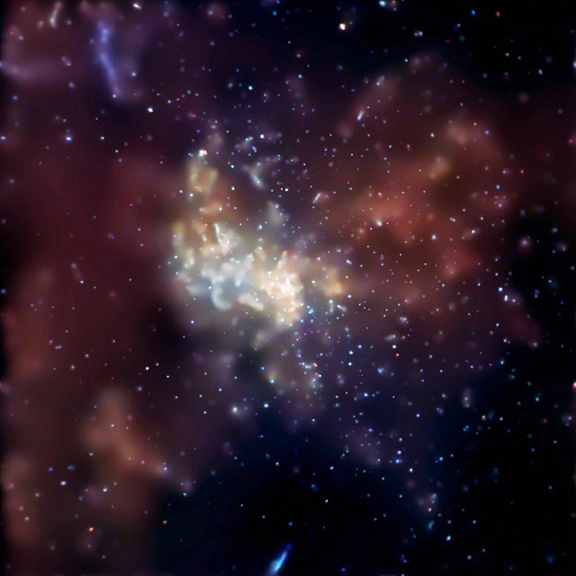
The center of the Milky Way galaxy
This image of the center of the Milky Way galaxy was taken by the Chandra X-ray Observatory. Image Credit: NASA/CXC/MIT/F.K. Baganoff et al.View Larger Image →

If Black Holes Are "Black," How Do Scientists Know They Are There?

A black hole can not be seen because strong gravity pulls all of the light into the middle of the black hole. But scientists can see how the strong gravity affects the stars and gas around the black hole. Scientists can study stars to find out if they are flying around, or orbiting, a black hole.

When a black hole and a star are close together, high-energy light is made. This kind of light can not be seen with human eyes. Scientists use satellites and telescopes in space to see the high-energy light.


Could a Black Hole Destroy Earth?

Black holes do not go around in space eating stars, moons and planets. Earth will not fall into a black hole because no black hole is close enough to the solar system for Earth to do that.
An active galaxy with light shooting out of its center
This artist's drawing shows a supermassive black hole in the center of a galaxy. The black hole is surrounded by a cloud of material that is spiraling into it. Image Credit: NASA E/PO, Sonoma State University, Aurore SimonnetView Larger Image →

Even if a black hole the same mass as the sun were to take the place of the sun, Earth still would not fall in. The black hole would have the same gravity as the sun. Earth and the other planets would orbit the black hole as they orbit the sun now.

The sun will never turn into a black hole. The sun is not a big enough star to make a black hole.

For more information head over to http://www.nasa.gov/audience/forstudents/k-4/stories/what-is-a-black-hole-k4.html

Friday, 3 August 2012

Mars Rover Curiosity

On 5th August NASA's Mars Rover Curiosity will begin it's descent to the red planets surface.  It will land in a way never attempted before.


The spacecraft has been designed to steer itself during descent through Mars’ atmosphere with a series of S-curve maneuvers similar to those used by astronauts piloting NASA space shuttles. During the three minutes before touchdown, the spacecraft slows its descent with a parachute, then uses retro rockets mounted around the rim of an upper stage. In the final seconds, the upper stage acts as a sky crane, lowering the upright rover on a tether to the surface.


Curiosity is about twice as long (about 3 meters or 10 feet) and five times as heavy as NASA’s twin Mars Exploration Rovers, Spirit and Opportunity, launched in 2003. It inherited many design elements from them, including six-wheel drive, a rocker-bogie suspension system and cameras mounted on a mast to help the mission’s team on Earth select exploration targets and driving routes. Unlike earlier rovers, Curiosity carries equipment to gather samples of rocks and soil, process them and distribute them to onboard test chambers inside analytical instruments.


Also for an excellent little video animation showing the landing visit :-


"Entry, descent and landing is referred to as the 'seven minutes of terror' because we've got literally seven minutes to get from the top of the atmosphere to the surface of Mars, going from 13,000 miles an hour to zero in perfect sequence, perfect choreography and perfect timing, and the computer has to do it all by itself with no help from the ground," said Adam Steltzner, a NASA engineer, in a video interview. "If any one thing doesn't work just right, it's game-over."


Thursday, 21 June 2012

Data From NASA's Voyager 1 Point to Interstellar Future


Voyager 1 reaching Interstellar Future


This artist's concept shows NASA's two Voyager spacecraft exploring a turbulent region of space known as the heliosheath, the outer shell of the bubble of charged particles around our sun. Image credit: NASA/JPL-Caltech

Artist concept of NASA's Voyager spacecraft

Artist concept of NASA's Voyager spacecraft. Image credit: NASA/JPL-Caltech

Data from NASA's Voyager 1 spacecraft indicate that the venerable deep-space explorer has encountered a region in space where the intensity of charged particles from beyond our solar system has markedly increased. Voyager scientists looking at this rapid rise draw closer to an inevitable but historic conclusion – that humanity's first emissary to interstellar space is on the edge of our solar system.

"The laws of physics say that someday Voyager will become the first human-made object to enter interstellar space, but we still do not know exactly when that someday will be," said Ed Stone, Voyager project scientist at the California Institute of Technology in Pasadena. "The latest data indicate that we are clearly in a new region where things are changing more quickly. It is very exciting. We are approaching the solar system's frontier."

The data making the 16-hour-38 minute, 11.1-billion-mile (17.8-billion-kilometer), journey from Voyager 1 to antennas of NASA's Deep Space Network on Earth detail the number of charged particles measured by the two High Energy telescopes aboard the 34-year-old spacecraft. These energetic particles were generated when stars in our cosmic neighborhood went supernova.

"From January 2009 to January 2012, there had been a gradual increase of about 25 percent in the amount of galactic cosmic rays Voyager was encountering," said Stone. "More recently, we have seen very rapid escalation in that part of the energy spectrum. Beginning on May 7, the cosmic ray hits have increased five percent in a week and nine percent in a month."

This marked increase is one of a triad of data sets which need to make significant swings of the needle to indicate a new era in space exploration. The second important measure from the spacecraft's two telescopes is the intensity of energetic particles generated inside the heliosphere, the bubble of charged particles the sun blows around itself. While there has been a slow decline in the measurements of these energetic particles, they have not dropped off precipitously, which could be expected when Voyager breaks through the solar boundary.

The final data set that Voyager scientists believe will reveal a major change is the measurement in the direction of the magnetic field lines surrounding the spacecraft. While Voyager is still within the heliosphere, these field lines run east-west. When it passes into interstellar space, the team expects Voyager will find that the magnetic field lines orient in a more north-south direction. Such analysis will take weeks, and the Voyager team is currently crunching the numbers of its latest data set.

"When the Voyagers launched in 1977, the space age was all of 20 years old," said Stone. "Many of us on the team dreamed of reaching interstellar space, but we really had no way of knowing how long a journey it would be -- or if these two vehicles that we invested so much time and energy in would operate long enough to reach it.”

Launched in 1977, Voyager 1 and 2 are in good health. Voyager 2 is more than 9.1 billion miles (14.7 billion kilometers) away from the sun. Both are operating as part of the Voyager Interstellar Mission, an extended mission to explore the solar system outside the neighborhood of the outer planets and beyond. NASA's Voyagers are the two most distant active representatives of humanity and its desire to explore.

The Voyager spacecraft were built by NASA's Jet Propulsion Laboratory in Pasadena, Calif., which continues to operate both. JPL is a division of the California Institute of Technology. The Voyager missions are a part of the NASA Heliophysics System Observatory, sponsored by the Heliophysics Division of the Science Mission Directorate in Washington.

More information about Voyager is available at: http://www.nasa.gov/voyager