Total Lab Supplies - Everything for your laboratory

Our Head Office in St Helens
Tuesday, 30 September 2014
The New OHAUS Adventurer Preview
Our blog is normally reserved for science news & facts and other interesting things! However we thought we'd share this video featuring the new range of Ohaus Adventurer balances. With dual USB ports, one at the front and one at the back connectivity is easy. With colour touchscreen, fast stabilisation and accuracy these balances are worth a look. Visit our website news page on the link below to download a brochure.
Visit http://www.prlabs.co.uk/news/article.php?Id=314

Friday, 26 September 2014
Flamin' hot colours!
Back in your school days there was probably an experiment where you placed a small amount of a compound into a flame and observed it's colour. This is the flame test and depending on the colour observed it can tell you what elements are present.

Scientifically put, A flame test is an analytic procedure used in chemistry to detect the presence of certain elements, primarily metal ions, based on each element's characteristic emission spectrum. The colour of flames in general also depends on temperature.
The test involves introducing a sample of the element or compound to a hot, non-luminous flame, and observing the colour of the flame that results. The idea of the test is that sample atoms evaporate and since they are hot, they emit light when being in flame.
The flame test is relatively quick and simple to perform, and can be carried out with the basic equipment found in most chemistry laboratories. However, the range of elements positively detectable under these conditions is small, as the test relies on the subjective experience of the experimenter rather than any objective measurements. The test has difficulty detecting small concentrations of some elements, while too strong a result may be produced for certain others, which tends to cause fainter colours to not appear.
The table above from www.compoundchem.com shows the range of colours chemicals produce. These tests work better for some metal ions than other; in particular, those ions shown on the bottom row of the infographic are generally quite faint and hard to distinguish. Sodium’s flame colour is also very strong, and can easily mask the colours of other metal ions.
For more information and more pictures visit:-
http://www.compoundchem.com/2014/02/06/metal-ion-flame-test-colours-chart/
http://en.wikipedia.org/wiki/Flame_test
Scientifically put, A flame test is an analytic procedure used in chemistry to detect the presence of certain elements, primarily metal ions, based on each element's characteristic emission spectrum. The colour of flames in general also depends on temperature.
The test involves introducing a sample of the element or compound to a hot, non-luminous flame, and observing the colour of the flame that results. The idea of the test is that sample atoms evaporate and since they are hot, they emit light when being in flame.
The flame test is relatively quick and simple to perform, and can be carried out with the basic equipment found in most chemistry laboratories. However, the range of elements positively detectable under these conditions is small, as the test relies on the subjective experience of the experimenter rather than any objective measurements. The test has difficulty detecting small concentrations of some elements, while too strong a result may be produced for certain others, which tends to cause fainter colours to not appear.
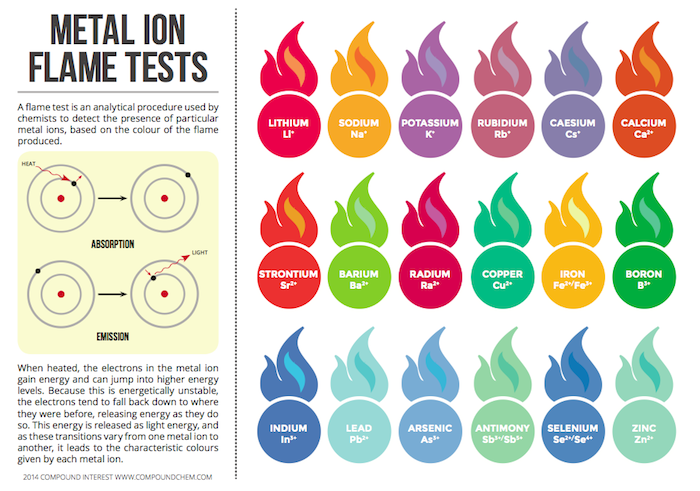 |
| Metal Ion Flame Tests-Click to enlarge |
For more information and more pictures visit:-
http://www.compoundchem.com/2014/02/06/metal-ion-flame-test-colours-chart/
http://en.wikipedia.org/wiki/Flame_test
Friday, 19 September 2014
Sodium Hypochlorite
Sodium hypochlorite is a chemical compound with the formula
NaClO. It is composed of a sodium cation (Na+) and a hypochlorite anion (ClO−);
it may also be viewed as the sodium salt of hypochlorous acid. When dissolved
in water it is commonly known as bleach or liquid bleach, and is frequently
used as a disinfectant or a bleaching agent.
 |
| Click to enlarge |
Potassium hypochlorite was first produced in 1789 by Claude
Louis Berthollet in his laboratory on the quay Javel in Paris, France, by
passing chlorine gas through a solution of potash lye. The resulting liquid,
known as "Eau de Javel" ("Javel water"), was a weak
solution of potassium hypochlorite. Antoine Labarraque replaced potash lye by
the cheaper soda lye, thus obtaining sodium hypochlorite (Eau de Labarraque).
Various methods have been used since to produce this but the modern method, the Hooker process, is the only one producing this in any bulk capacity.
Sodium Hypochlorite has many uses as can be seen above:-
In bleach cleaning products and to remove stains.
In Swimming pools as a disinfectant.
In Antibacterial sprays
To neutralise nerve agents
To reduce skin damage - using very low concentrations.
Sodium Hypochlorite although used in household bleach is not the only component. There is often Sodium Hydroxide and Calcium Hypochlorite amongst others. it must be remembered not to mix household cleaning products as some may contain hydrochloric acid. If these are mixed with bleach, it can react with sodium hypochlorite, and form toxic chlorine gas
Visit the following for more information:-
http://www.compoundchem.com/2014/07/06/sodium-hypochlorite-bleach-swimming-pools-cleaning-products/
http://en.wikipedia.org/wiki/Sodium_hypochlorite
Friday, 12 September 2014
Mercury
Mercury is a chemical element with the symbol Hg and atomic
number 80. It is commonly known as quicksilver and was formerly named
hydrargyrum (from Greek "hydr-" water and "argyros" silver)

Mercury is remarkable because it is the only metal that is liquid at room temperature. It is a dense, lustrous grey metal. Mercury is extremely rare in the Earth's crust and in the wild, it typically is concentrated near volcanically active areas, either as the pure metal or in a number of minerals.
Mercury is used in thermometers, barometers, manometers,
sphygmomanometers, float valves, mercury switches, mercury relays, fluorescent
lamps and other devices, though concerns about the element's toxicity have led
to mercury thermometers and sphygmomanometers being largely phased out in
clinical environments in favour of alternatives such as alcohol- or
galinstan-filled glass thermometers and thermistor- or infrared-based
electronic instruments.
The reason mercury was so popular is because it readily forms stable amalgams with a number of other metals, particularly silver and gold, making them workable at lower temperatures, and these amalgams have been the source of many instances of mercury poisoning.
 |
| Amalgam Filling |
Biologists are quite interested in mercury because it is highly toxic to life, causing both acute and chronic poisoning. Mercury can be absorbed through the skin and mucous membranes and mercury vapors can be inhaled. Mercury is concentrated in the body over the lifetime of the individual, and it also becomes more concentrated when one animal eats another, which is how it moves up the food chain. This is the reason why the flesh of tuna, a long-lived apex predator in the oceans, contain such high levels of mercury.
Friday, 5 September 2014
Back to school
Where did the summertime break go? Time for kids to go back to school. And time for us too...chemistry basics.....Acids and bases
All acids:

Acids
Substances with a pH of less than 7 are acids. The more strongly acidic the solution, the lower its pH number. Acidic solutions turn blue litmus paper red. They turn universal indicator paper red if they are strongly acidic, and orange or yellow if they are weakly acidic.
Bases
Substances that can react with acids and neutralise them to make a salt and water are called bases. They are usually metal oxides or metal hydroxides. For example, copper oxide and sodium hydroxide are bases.
Alkalis
Bases that dissolve in water are called alkalis. Copper oxide is not an alkali because it does not dissolve in water. Sodium hydroxide is an alkali because it does dissolve in water.
Alkaline solutions have a pH of more than 7. The stronger the alkali, the higher the pH number. Alkalis turn red litmus paper blue. They turn universal indicator paper dark blue or purple if they are strongly alkaline, and blue-green if they are weakly alkaline.
Neutral solutions
Neutral solutions have a pH of 7. They do not change the colour of litmus paper, but they turn universal indicator paper green. Water is neutral.
For pH meters or pH test papers or buffer solutions give us a call.
For more information visit:-
http://www.prlabs.co.uk
http://en.wikipedia.org/wiki/PH
All acids:
- have a low pH (1-6) – the lower the number the stronger the acid
- react with bases to form neutral compounds
- are corrosive when they are strong
- are an irritant when they are weak.
Acids
Substances with a pH of less than 7 are acids. The more strongly acidic the solution, the lower its pH number. Acidic solutions turn blue litmus paper red. They turn universal indicator paper red if they are strongly acidic, and orange or yellow if they are weakly acidic.
Bases
Substances that can react with acids and neutralise them to make a salt and water are called bases. They are usually metal oxides or metal hydroxides. For example, copper oxide and sodium hydroxide are bases.
Alkalis
Bases that dissolve in water are called alkalis. Copper oxide is not an alkali because it does not dissolve in water. Sodium hydroxide is an alkali because it does dissolve in water.
Alkaline solutions have a pH of more than 7. The stronger the alkali, the higher the pH number. Alkalis turn red litmus paper blue. They turn universal indicator paper dark blue or purple if they are strongly alkaline, and blue-green if they are weakly alkaline.
Neutral solutions
Neutral solutions have a pH of 7. They do not change the colour of litmus paper, but they turn universal indicator paper green. Water is neutral.
For pH meters or pH test papers or buffer solutions give us a call.
For more information visit:-
http://www.prlabs.co.uk
http://en.wikipedia.org/wiki/PH
Friday, 29 August 2014
Red hot chilli peppers!!!
The chilli pepper or chilli is the fruit of plants from the genus Capsicum. The substances that give chili peppers their intensity when ingested or applied topically are capsaicin (8-methyl-N-vanillyl-6-nonenamide) and several related chemicals, collectively called capsaicinoids.
Chili peppers originated in the Americas but spread around the world and India is now the world's largest producer, consumer and exporter of chili peppers.
When consumed, capsaicinoids bind with pain receptors in the mouth and throat that are responsible for sensing heat. Once activated by the capsaicinoids, these receptors send a message to the brain that the person has consumed something hot. The brain responds to the burning sensation by raising the heart rate, increasing perspiration and release of endorphins.
The "heat" of chili peppers was historically measured in Scoville heat units (SHU), which is a measure of the dilution of an amount of chili extract added to sugar syrup before its heat becomes undetectable to a panel of tasters; the more it has to be diluted to be undetectable, the more powerful the variety and therefore the higher the rating. The modern commonplace method for quantitative analysis of SHU rating uses high-performance liquid chromatography to directly measure the capsaicinoid content of a chili pepper variety. Pure capsaicin is a hydrophobic, colorless, odorless, and crystalline-to-waxy solid at room temperature, and measures 16,000,000 SHU.
Capsaicin extracted from chillis is also used in pepper spray as an irritant, a form of less-lethal weapon.
Red chilies contain large amounts of vitamin C and small amounts of carotene (provitamin A). Yellow and especially green chilies (which are essentially unripe fruit) contain a considerably lower amount of both substances. In addition, peppers are a good source of most B vitamins, and vitamin B6 in particular. They are very high in potassium, magnesium, and iron. Their very high vitamin C content can also substantially increase the uptake of non-heme iron from other ingredients in a meal, such as beans and grains.
For more information visit:-
http://www.compoundchem.com/2014/01/15/why-chilli-peppers-are-spicy-the-chemistry-of-a-chilli/
http://en.wikipedia.org/wiki/Chilli_pepper
 |
| Cayenne pepper |
Chili peppers originated in the Americas but spread around the world and India is now the world's largest producer, consumer and exporter of chili peppers.
When consumed, capsaicinoids bind with pain receptors in the mouth and throat that are responsible for sensing heat. Once activated by the capsaicinoids, these receptors send a message to the brain that the person has consumed something hot. The brain responds to the burning sensation by raising the heart rate, increasing perspiration and release of endorphins.
The "heat" of chili peppers was historically measured in Scoville heat units (SHU), which is a measure of the dilution of an amount of chili extract added to sugar syrup before its heat becomes undetectable to a panel of tasters; the more it has to be diluted to be undetectable, the more powerful the variety and therefore the higher the rating. The modern commonplace method for quantitative analysis of SHU rating uses high-performance liquid chromatography to directly measure the capsaicinoid content of a chili pepper variety. Pure capsaicin is a hydrophobic, colorless, odorless, and crystalline-to-waxy solid at room temperature, and measures 16,000,000 SHU.
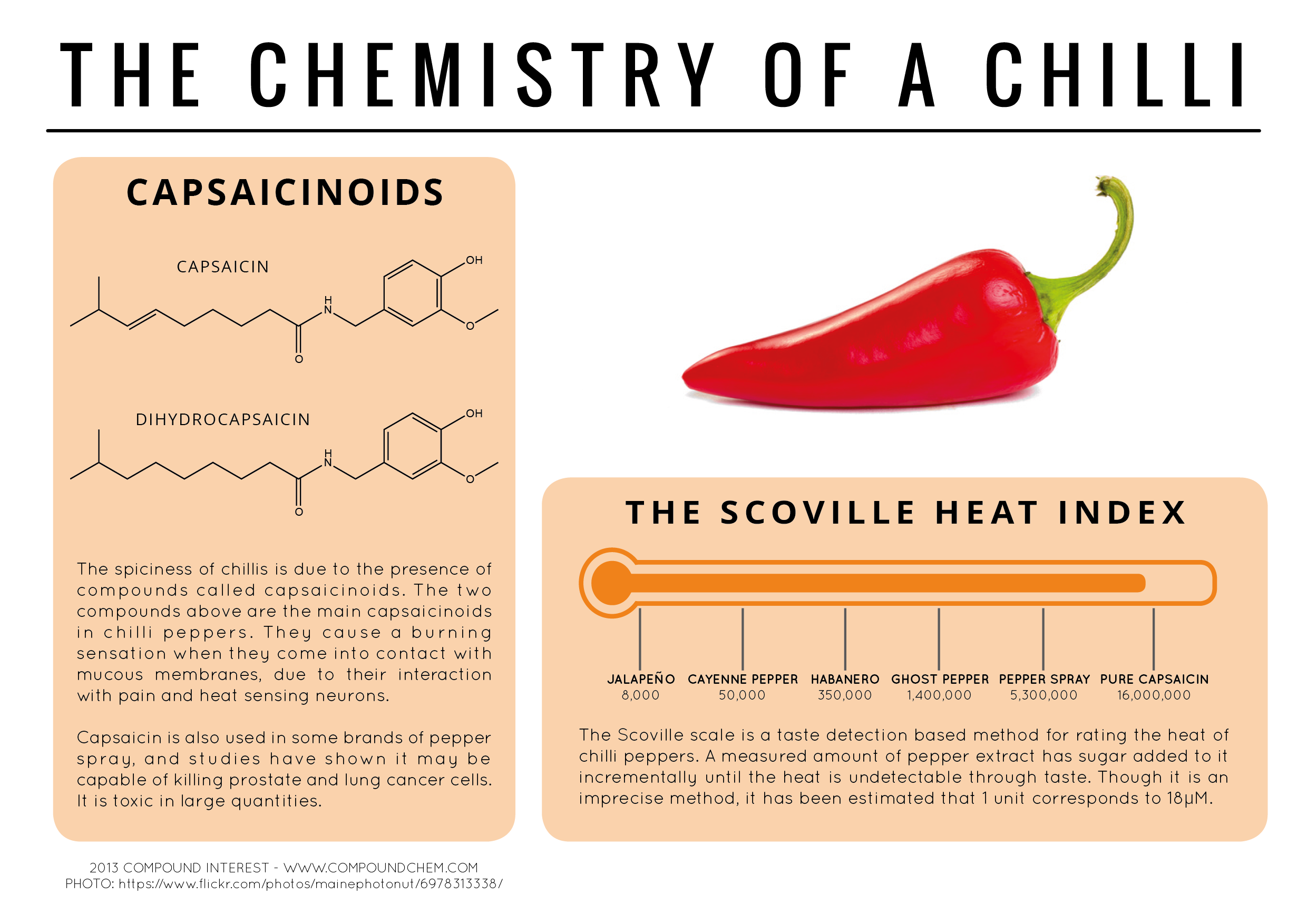 |
| Chemistry of a Chilli-click to enlarge |
Capsaicin extracted from chillis is also used in pepper spray as an irritant, a form of less-lethal weapon.
Red chilies contain large amounts of vitamin C and small amounts of carotene (provitamin A). Yellow and especially green chilies (which are essentially unripe fruit) contain a considerably lower amount of both substances. In addition, peppers are a good source of most B vitamins, and vitamin B6 in particular. They are very high in potassium, magnesium, and iron. Their very high vitamin C content can also substantially increase the uptake of non-heme iron from other ingredients in a meal, such as beans and grains.
For more information visit:-
http://www.compoundchem.com/2014/01/15/why-chilli-peppers-are-spicy-the-chemistry-of-a-chilli/
http://en.wikipedia.org/wiki/Chilli_pepper
Friday, 22 August 2014
Hayfever!!!
It's still summer - or at least it was sunny when I wrote this. Knowing the British weather it could be raining now. However rain doesn't always stop the effects of hayfever.
Allergic rhinitis is an allergic inflammation of the nasal airways. It occurs when an allergen, such as pollen, dust or animal dander (particles of shed skin and hair) is inhaled by an individual with a sensitized immune system. In such individuals, the allergen in affected individuals is mistakenly identified as a threat and triggers the production of the antibody immunoglobulin E (IgE), which binds to mast cells and basophils containing histamine. When caused by pollens of any plants, it is called pollinosis, and, if specifically caused by grass pollens, it is known as hay fever. While symptoms resembling a cold or flu can be produced by an allergic reaction to pollen from plants and grasses it does not cause a fever.
Antihistamine drugs include those such as cetirizine and loratadine. They work by binding to the H1 receptors that histamine usually binds to, preventing it from inducing an inflammatory response to the allergens. As you can see from the infographic above some drugs must be taken before symptoms appear for them to be effective. Click here for a full screen image.
For more information visit:-
http://www.compoundchem.com/2014/06/20/hayfever/
http://en.wikipedia.org/wiki/Hayfever
 |
| Pollen |
Allergic rhinitis is an allergic inflammation of the nasal airways. It occurs when an allergen, such as pollen, dust or animal dander (particles of shed skin and hair) is inhaled by an individual with a sensitized immune system. In such individuals, the allergen in affected individuals is mistakenly identified as a threat and triggers the production of the antibody immunoglobulin E (IgE), which binds to mast cells and basophils containing histamine. When caused by pollens of any plants, it is called pollinosis, and, if specifically caused by grass pollens, it is known as hay fever. While symptoms resembling a cold or flu can be produced by an allergic reaction to pollen from plants and grasses it does not cause a fever.
IgE bound to mast cells are stimulated by allergens, causing
the release of inflammatory mediators such as histamine (and other chemicals).
This usually causes sneezing, itchy and watery eyes, swelling and inflammation
of the nasal passages, and an increase in mucus production.
To reduce the symptoms of hayfever science has developed a number of medications to alleviate or prevent the symptoms. A fantastic website (Compound Interest) goes into this in much more detail including the amazing infographic below. |
| Click to enlarge |
Antihistamine drugs include those such as cetirizine and loratadine. They work by binding to the H1 receptors that histamine usually binds to, preventing it from inducing an inflammatory response to the allergens. As you can see from the infographic above some drugs must be taken before symptoms appear for them to be effective. Click here for a full screen image.
For more information visit:-
http://www.compoundchem.com/2014/06/20/hayfever/
http://en.wikipedia.org/wiki/Hayfever
Subscribe to:
Posts (Atom)