Total Lab Supplies - Everything for your laboratory

Total Lab Supplies - Everything for your laboratory
Our Head Office in St Helens

Monday, 27 April 2015

Liquid mercury found under Mexican pyramid could lead to king's tomb

An archaeologist has discovered liquid mercury at the end of a tunnel beneath a Mexican pyramid, a finding that could suggest the existence of a king’s tomb or a ritual chamber far below one of the most ancient cities of the Americas.

Mexican researcher Sergio Gómez told Reuters on Friday that he had discovered “large quantities” of liquid mercury in a chamber below the Pyramid of the Feathered Serpent, the third largest pyramid of Teotihuacan, the ruined city in central Mexico.

Visitors look at the archaeological area of the Quetzalcoatl (Feathered Serpent) Temple near the Pyramid of the Sun at the Teotihuacan archaeological site, north of Mexico City. Photograph: Henry Romero/Reuters

Gómez has spent six years slowly excavating the tunnel, which was unsealed in 2003 after 1,800 years. Last November, Gómez and a team announced they had found three chambers at the tunnel’s 300ft end, almost 60ft below the the temple. Near the entrance of the chambers, they a found trove of strange artifacts: jade statues, jaguar remains, a box filled with carved shells and rubber balls.

Slowly working their way down the broad, dark and deep corridor beneath the pyramid, battling humidity and now obliged to wear protective gear against the dangers of mercury poisoning, Gómez and his team are meticulously exploring the three chambers.

Mercury is toxic and capable of devastating the human body through prolonged exposure; the liquid metal had no apparent practical purpose for ancient Mesoamericans. But it has been discovered at other sites. Rosemary Joyce, a professor of anthropology at the University of California, Berkeley, said that archaeologists have found mercury at three other sites around Central America.

Gómez speculated to Reuters that the mercury could be a sign that his team is close to uncovering the first royal tomb ever found in Teotihuacan after decades of excavation – and centuries of mystery surrounding the leadership of the cryptic but well-preserved city.

The mercury may have symbolized an underworld river or lake, Gómez postulated, an idea that resonated with Annabeth Headreck, a professor at the University of Denver and the author of works on Teotihuacan and Mesoamerican art.

The shimmering, reflective qualities of liquid mercury may have resembled “an underworld river, not that different from the river Styx,” Headrick said, “if only in the concept that it’s the entrance to the supernatural world and the entrance to the underworld.”

“Mirrors were considered a way to look into the supernatural world, they were a way to divine what might happen in the future,” she said. “It could be a sort of river, albeit a pretty spectacular one.”

Joyce said that archaeologists know that scintillation fascinated the ancient people generally, and that the liquid mercury may have held been regarded as “somewhat magical … there for ritual purposes or symbolic purposes.”

Headrick said that mercury was not the only object of fascination: “a lot of ritual objects were made reflective with mica,” a sparkling mineral likely imported to the region.

In 2013 archaeologists using a robot found metallic spheres which they dubbed “disco balls” in an un-excavated portion of the tunnel, near pyrite mirrors. “I wish I could understand all the things these guys are finding down there,” Headrick said, “but it’s unique and that’s why it’s hard.”

Water was also precious to many of the people of Mesoamerica, who knew of underground water systems and lakes that could be accessed through caves. Teotihuacan once had springs as well, though they are now dried out.

Joyce said the ancient Mesoamericans could produce liquid mercury by heating mercury ore, known as cinnabar, which they also used for its blood-red pigment. The Maya used cinnabar to decorate jade objects and color the bodies of their royalty, for instance; the people of Teotihuacan – for whom archaeologists have not agreed on a name – have not left any obvious royal remains for study.

The discovery of a tomb could help solve the enigma of how Teotihuacan was ruled, and Joyce said that the concentration of artifacts outside the tunnel chambers could be associated with a tomb – or a set of ritual chambers.

A royal tomb could lend credence to the theory that the city, which flourished between 100-700AD, was ruled by dynasties in the manner of the Maya, though with far less obvious flair for self-glorification.

But a royal tomb cold also hold the remains of a lord, which may fit with a competing idea about the city. Linda Manzanilla, a Mexican archaeologist acclaimed by many of her peers, contends that the city was governed by four co-rulers and notes that the city lacks a palace or apparent depiction of kings on its many murals. The excavation by Gomez my find one of those co-rulers, under this hypothesis.

Headrick suggested yet more fluid models, in which strong lineages or clans traded rule but never cemented into dynasties, or in which the rulers relied on agreements with the military to maintain power, and authority was vested more in an office than a family. Ancient Teotihuacan was a city with familiar factions vying for influence: the elite, the military, the merchants, the priests and the people.

For now, the archaeologists and anthropologists continue digging and deducing. Gomez says he hopes excavation of the chambers to be complete by October, and Headrick said that archeologists are looking at the city from new angles. Some are trying to decipher the paintings and hieroglyphics around the city, others trying to parse what may be a writing system without verbs or syntax.

Then there are the thousands of artifacts, some unprecedented and bizarre, that Gomez and his fellows are disinterring from beneath the pyramid. “It’s quite the mystery,” Headrick said. “It’s fun.”

For more information visit:-


Monday, 20 April 2015

Silver

Silver is a chemical element with symbol Ag (Greek: άργυρος árguros, Latin: argentum, both from the Indo-European root *h₂erǵ- for "grey" or "shining") and atomic number 47. 
A soft, white, lustrous transition metal, it possesses the highest electrical conductivity of any element, the highest thermal conductivity and reflectivity of any metal. The metal occurs naturally in its pure, free form (native silver), as an alloy with gold and other metals, and in minerals such as argentite and chlorargyrite. Most silver is produced as a byproduct of copper, gold, lead, and zinc refining.

Silver has long been valued as a precious metal. More abundant than gold, silver metal has in many premodern monetary systems functioned as coinable specie, sometimes even alongside gold. In addition, silver has numerous applications beyond currency, such as in solar panels, water filtration, jewelry and ornaments, high-value tableware and utensils (hence the term silverware), and also as an investment in the forms ofcoins and bullion.

Silver is used industrially in electrical contacts and conductors, in specialized mirrors, window coatings and in catalysis of chemical reactions. Its compounds are used in photographic film and X-rays. Dilute silver nitrate solutions and other silver compounds are used as disinfectants and microbiocides (oligodynamic effect), added to bandages and wound-dressings, catheters and other medical instruments.

Electrolytically refined silver

Thursday, 9 April 2015

On this day


1959 - NASA selects first US astronauts.


On this day in 1959 NASA announced the selection of the first seven US astronauts.
These astronauts were selected for the Mercury program to test if humans could survive in space.
Mercury astronauts had to be male, less than 40 years old and not more than 5'11" tall, less than 180 lbs. and in excellent physical condition.
The seven astronauts selected were: Scott Carpenter, Gordon Cooper, John Glenn, Gus Grissom, Wally Schirra, Alan Shepard and Donald Slayton.
For more information visit:-

Friday, 3 April 2015

Stained and Coloured Glass

Stained glass can refer to coloured glass as a material or to works created from it - most commonly seen in the stained glass windows of churches and other buildings.  Coloured glass is also found in everyday life such as green wine bottles.


As a material stained glass is glass that has been coloured by adding metallic salts during its manufacture.

There are two main types of glass - soda lime glass - commonly used in beverage bottles and the like and borosilicate glass - used in laboratory glassware and also some domestic glassware such as oven proof dishes.

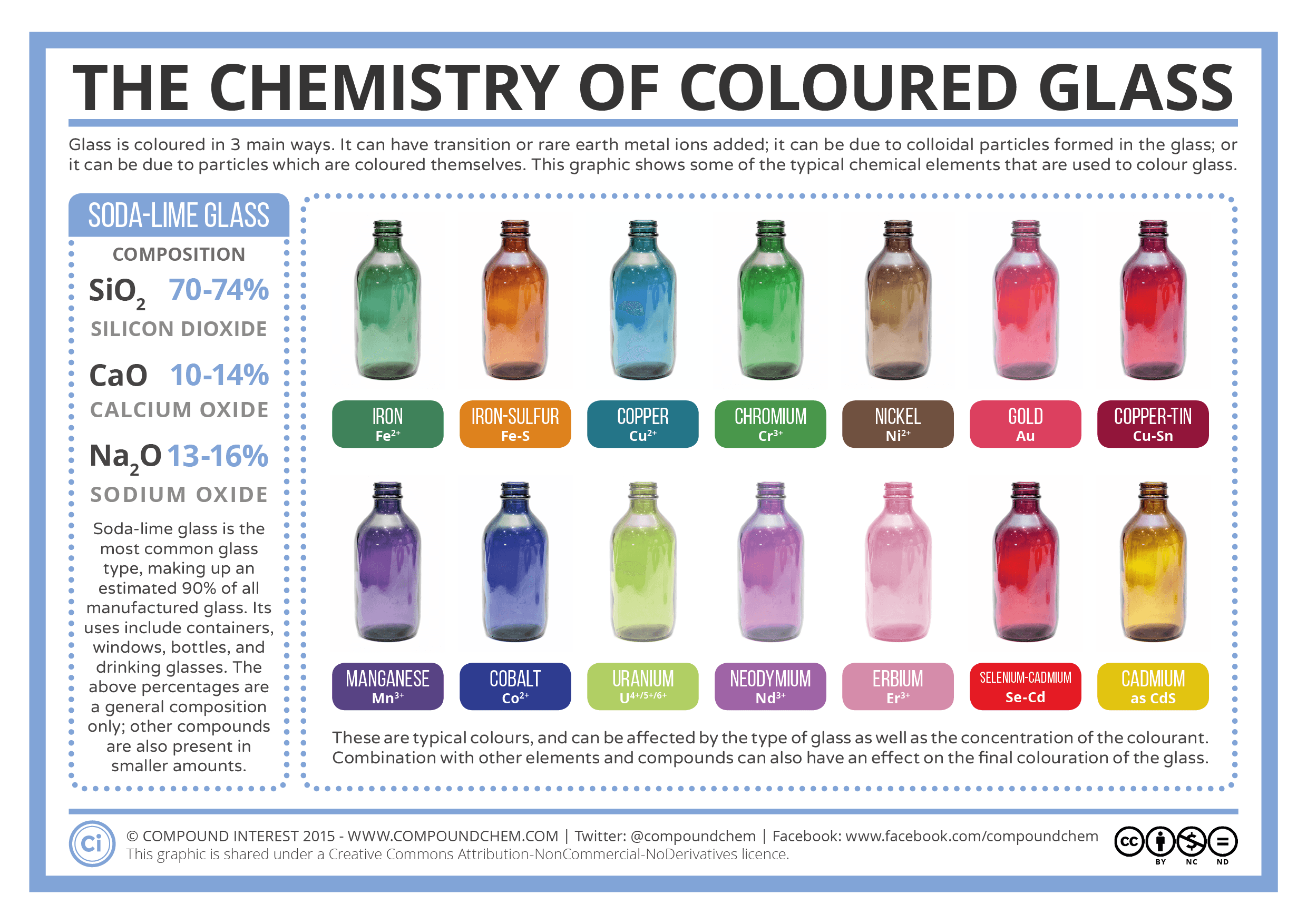
Coloured glass is made in a number of ways.  There are three main ways.

The first involves introducing metallic or rare earth metal oxides to the glass as mentioned above.

Silver compounds for example such as silver nitrate are used as stain applied to the surface of glass and fired on. They can produce a range of colours from orange-red to yellow. The way the glass is heated and cooled can significantly affect the colours produced by these compounds.

Another way is by formation of colloidal particles. This means particles of a substance are suspended throughout the glass. The particles scatter light of particular frequencies as it passes through the glass, causing colouration.

Gold gives a ruby red colour, and selenium gives a pink to intense red.

The final main way in which colour can be introduced is through the addition of already coloured particles to the glass. Examples of this type of colouration include milk glass and smoked glass; milk glass is achieved by adding tin oxide.

The infographic below from Compound Interest shows what chemicals are involved in the colour process.  Click for a larger image.


Click to enlarge
For more information visit:-
http://en.wikipedia.org/wiki/Stained_glass
http://www.compoundchem.com/2015/03/03/coloured-glass/

Friday, 27 March 2015

On this day

On 27th March 1923, James Dewar, the Scottish chemist and physicist died.  He is probably best known for his invention of the Dewar Flask which he used in conjunction with extensive research into the liquefaction of gases. He was also particularly interested in atomic and molecular spectroscopy, working in these fields for more than 25 years.

 (20 September 1842 – 27 March 1923)
By 1891 James Dewar had designed and built machinery which yielded liquid oxygen in industrial quantities. Around 1892 the idea occurred to him of using vacuum-jacketed vessels for the storage of liquid gases – the Dewar flask (otherwise known as a Thermos or vacuum flask) – the invention for which he became most famous. The vacuum flask was so efficient at keeping heat out that it was found possible to preserve the liquids for comparatively long periods, making examination of their optical properties possible. Dewar did not profit from the widespread adoption of his vacuum flask – he lost a court case against Thermos concerning the patent for his invention. While Dewar was recognised as the inventor, because he did not patent his invention there was no way to stop Thermos from using the design.

The vacuum flask consists of two flasks, placed one inside the other and joined at the neck. The gap between the two flasks is partially evacuated of air, creating a near-vacuum which prevents heat transfer by conduction or convection.  Vacuum flasks are used domestically to keep beverages hot or cold for extended periods of time and for many purposes in industry.

Dewar flasks
Various sizes of Dewar flask are available and are commonly used in Cryogenics for the storage of tissue samples for example.  See also, the safe use of liquid nitrogen by clicking here.

For more information visit:-
http://en.wikipedia.org/wiki/Vacuum_flask
http://en.wikipedia.org/wiki/James_Dewar


Friday, 20 March 2015

Copper Sulphate

Copper (II) sulfate, also known as cupric sulfate or copper sulphate, is the chemical compound with the chemical formula CuSO4. This salt exists as a series of compounds that differ in their degree of hydration. The anhydrous form is a pale green or grey-white powder, whereas the pentahydrate (CuSO4·5H2O), the most commonly encountered salt, is bright blue.
Copper Sulphate Crystals
Copper sulphate is normally produced industrially by treating copper metal with hot concentrated sulphuric acid.  Laboratories generally purchase their own - eg here.

At 650 °C (1,202 °F), copper (II) sulphate decomposes into copper (II) oxide (CuO) and sulphur trioxide (SO3).  Its blue colour is due to water of hydration. When heated in an open flame the crystals are dehydrated and turn greyish-white.
 
Copper sulphate pentahydrate is a fungicide.  Mixed with lime it is called Bordeaux mixture and used to control fungus on grapes, melons, and other berries.  Its use as a herbicide is not agricultural, but instead for control of invasive aquatic plants and the roots of plants near pipes containing water. It is used in swimming pools as an algicide. A dilute solution of copper sulphate is used to treat aquarium fish for parasitic infections.
 
Several chemical tests utilize copper sulphate. It is used in Fehling's solution and Benedict's solution to test for reducing sugars, which reduce the soluble blue copper(II) sulphate to insoluble red copper(I) oxide. Copper(II) sulphate is also used in the Biuret reagent to test for proteins.

Copper sulphate is a commonly included chemical in children's chemistry sets and is often used to grow crystals as can be seen here.

The chemical is also used in flame tests - again which can be seen here.

In 2008, the artist Roger Hiorns filled an abandoned waterproofed council flat in London with 75,000 litres of copper sulphate solution. The solution was left to crystallize for several weeks before the flat was drained, leaving crystal-covered walls, floors and ceilings. The work is titled Seizure.


For more information visit:-
http://en.wikipedia.org/wiki/Copper(II)_sulphate
http://prlabpak.blogspot.co.uk/2014/09/flamin-hot-colours.html
http://prlabpak.blogspot.co.uk/2012/09/making-chemical-garden.html

Friday, 13 March 2015

Vaccines


A vaccine is a biological preparation that provides active acquired immunity to a particular disease. A vaccine typically contains an agent that resembles a disease-causing microorganism and is often made from weakened or killed forms of the microbe, its toxins or one of its surface proteins. The agent stimulates the body's immune system to recognize the agent as a threat, destroy it, and keep a record of it, so that the immune system can more easily recognize and destroy any of these microorganisms that it later encounters

Vaccines have historically been the most effective means to fight and eradicate infectious diseases. Limitations to their effectiveness do exist.  Sometimes, protection fails because the host's immune system doesn’t respond adequately or at all. Lack of response commonly results from clinical factors such as diabetes, steroid use, HIV infection or age. However it also might fail for genetic reasons.

Adjuvants commonly are used to boost immune response, particularly for older people (50–75 years and up), whose immune response to a simple vaccine may have weakened.

Vaccines are dead or inactivated organisms or purified products derived from them.

There are several types of vaccines in use.  These represent different strategies used to try to reduce risk of illness, while retaining the ability to induce a beneficial immune response.
Some vaccines contain inactivated, but previously virulent, micro-organisms that have been destroyed with chemicals, heat, radioactivity, or antibiotics. Examples are influenza, cholera, bubonic plague, polio, hepatitis A, and rabies.
Some vaccines contain live, attenuated microorganisms. Many of these are active viruses that have been cultivated under conditions that disable their virulent properties, or that use closely related but less dangerous organisms to produce a broad immune response. Although most attenuated vaccines are viral, some are bacterial in nature. Examples include the viral diseases yellow fever, measles, rubella, and mumps, and the bacterial disease typhoid.
The infographic above from Compound Interest shows the common components of vaccines. 
When making vaccines, antibiotics can be used to prevent bacterial contamination. Although these are removed after manufacture, trace amounts can still remain in the final vaccine. Antibiotics that often cause adverse allergic reactions, such as penicillins, are avoided, in favour of antibiotics such as gentamycin and neomycin.
For more information visit:-