Total Lab Supplies - Everything for your laboratory

Total Lab Supplies - Everything for your laboratory
Our Head Office in St Helens

Friday, 3 April 2015

Stained and Coloured Glass

Stained glass can refer to coloured glass as a material or to works created from it - most commonly seen in the stained glass windows of churches and other buildings.  Coloured glass is also found in everyday life such as green wine bottles.


As a material stained glass is glass that has been coloured by adding metallic salts during its manufacture.

There are two main types of glass - soda lime glass - commonly used in beverage bottles and the like and borosilicate glass - used in laboratory glassware and also some domestic glassware such as oven proof dishes.

Coloured glass is made in a number of ways.  There are three main ways.

The first involves introducing metallic or rare earth metal oxides to the glass as mentioned above.

Silver compounds for example such as silver nitrate are used as stain applied to the surface of glass and fired on. They can produce a range of colours from orange-red to yellow. The way the glass is heated and cooled can significantly affect the colours produced by these compounds.

Another way is by formation of colloidal particles. This means particles of a substance are suspended throughout the glass. The particles scatter light of particular frequencies as it passes through the glass, causing colouration.

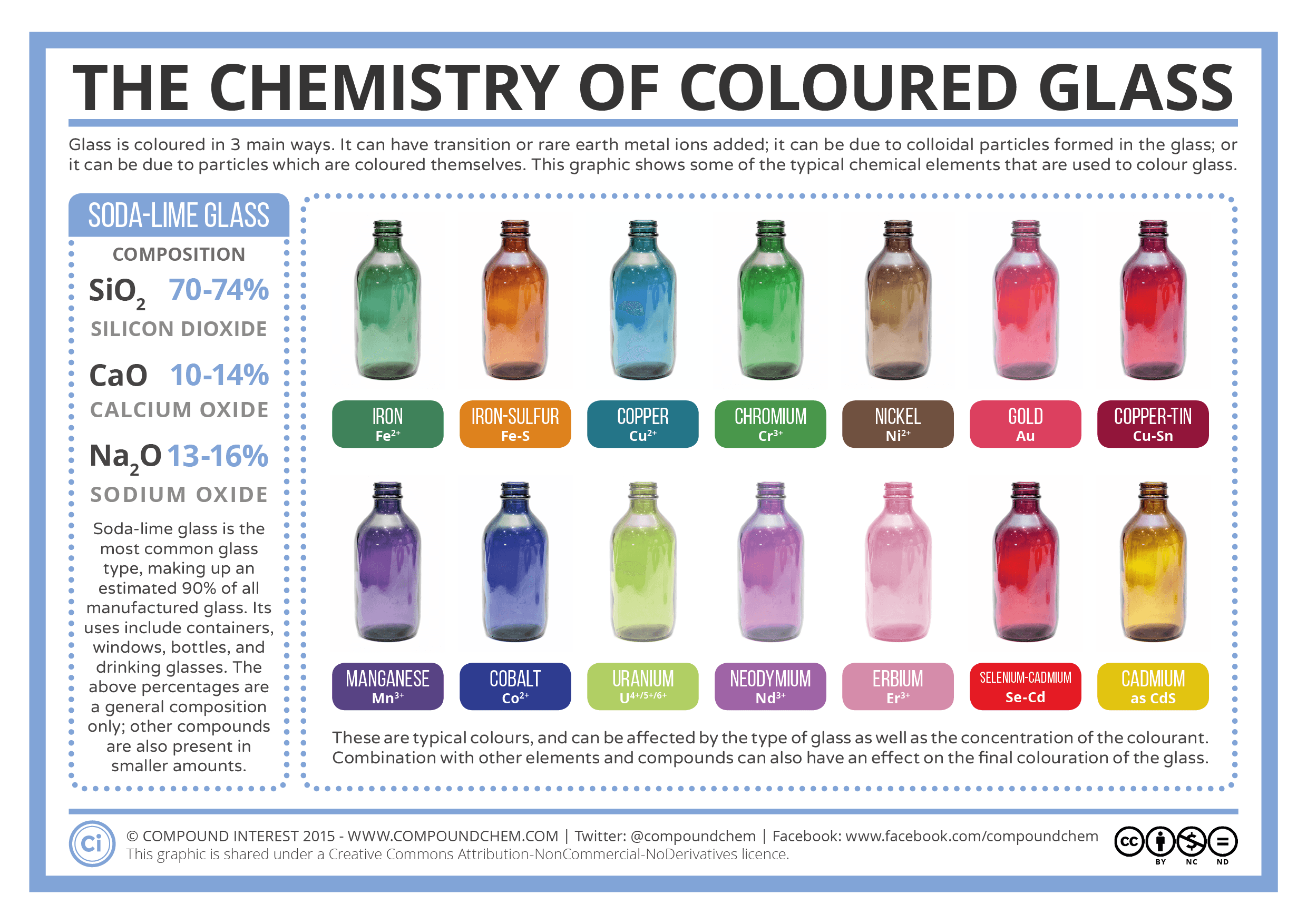
Gold gives a ruby red colour, and selenium gives a pink to intense red.

The final main way in which colour can be introduced is through the addition of already coloured particles to the glass. Examples of this type of colouration include milk glass and smoked glass; milk glass is achieved by adding tin oxide.

The infographic below from Compound Interest shows what chemicals are involved in the colour process.  Click for a larger image.

Click to enlarge
For more information visit:-
http://en.wikipedia.org/wiki/Stained_glass
http://www.compoundchem.com/2015/03/03/coloured-glass/

Friday, 27 March 2015

On this day

On 27th March 1923, James Dewar, the Scottish chemist and physicist died.  He is probably best known for his invention of the Dewar Flask which he used in conjunction with extensive research into the liquefaction of gases. He was also particularly interested in atomic and molecular spectroscopy, working in these fields for more than 25 years.

 (20 September 1842 – 27 March 1923)
By 1891 James Dewar had designed and built machinery which yielded liquid oxygen in industrial quantities. Around 1892 the idea occurred to him of using vacuum-jacketed vessels for the storage of liquid gases – the Dewar flask (otherwise known as a Thermos or vacuum flask) – the invention for which he became most famous. The vacuum flask was so efficient at keeping heat out that it was found possible to preserve the liquids for comparatively long periods, making examination of their optical properties possible. Dewar did not profit from the widespread adoption of his vacuum flask – he lost a court case against Thermos concerning the patent for his invention. While Dewar was recognised as the inventor, because he did not patent his invention there was no way to stop Thermos from using the design.

The vacuum flask consists of two flasks, placed one inside the other and joined at the neck. The gap between the two flasks is partially evacuated of air, creating a near-vacuum which prevents heat transfer by conduction or convection.  Vacuum flasks are used domestically to keep beverages hot or cold for extended periods of time and for many purposes in industry.

Dewar flasks
Various sizes of Dewar flask are available and are commonly used in Cryogenics for the storage of tissue samples for example.  See also, the safe use of liquid nitrogen by clicking here.

For more information visit:-
http://en.wikipedia.org/wiki/Vacuum_flask
http://en.wikipedia.org/wiki/James_Dewar


Friday, 20 March 2015

Copper Sulphate

Copper (II) sulfate, also known as cupric sulfate or copper sulphate, is the chemical compound with the chemical formula CuSO4. This salt exists as a series of compounds that differ in their degree of hydration. The anhydrous form is a pale green or grey-white powder, whereas the pentahydrate (CuSO4·5H2O), the most commonly encountered salt, is bright blue.
Copper Sulphate Crystals
Copper sulphate is normally produced industrially by treating copper metal with hot concentrated sulphuric acid.  Laboratories generally purchase their own - eg here.

At 650 °C (1,202 °F), copper (II) sulphate decomposes into copper (II) oxide (CuO) and sulphur trioxide (SO3).  Its blue colour is due to water of hydration. When heated in an open flame the crystals are dehydrated and turn greyish-white.
 
Copper sulphate pentahydrate is a fungicide.  Mixed with lime it is called Bordeaux mixture and used to control fungus on grapes, melons, and other berries.  Its use as a herbicide is not agricultural, but instead for control of invasive aquatic plants and the roots of plants near pipes containing water. It is used in swimming pools as an algicide. A dilute solution of copper sulphate is used to treat aquarium fish for parasitic infections.
 
Several chemical tests utilize copper sulphate. It is used in Fehling's solution and Benedict's solution to test for reducing sugars, which reduce the soluble blue copper(II) sulphate to insoluble red copper(I) oxide. Copper(II) sulphate is also used in the Biuret reagent to test for proteins.

Copper sulphate is a commonly included chemical in children's chemistry sets and is often used to grow crystals as can be seen here.

The chemical is also used in flame tests - again which can be seen here.

In 2008, the artist Roger Hiorns filled an abandoned waterproofed council flat in London with 75,000 litres of copper sulphate solution. The solution was left to crystallize for several weeks before the flat was drained, leaving crystal-covered walls, floors and ceilings. The work is titled Seizure.


For more information visit:-
http://en.wikipedia.org/wiki/Copper(II)_sulphate
http://prlabpak.blogspot.co.uk/2014/09/flamin-hot-colours.html
http://prlabpak.blogspot.co.uk/2012/09/making-chemical-garden.html

Friday, 13 March 2015

Vaccines


A vaccine is a biological preparation that provides active acquired immunity to a particular disease. A vaccine typically contains an agent that resembles a disease-causing microorganism and is often made from weakened or killed forms of the microbe, its toxins or one of its surface proteins. The agent stimulates the body's immune system to recognize the agent as a threat, destroy it, and keep a record of it, so that the immune system can more easily recognize and destroy any of these microorganisms that it later encounters

Vaccines have historically been the most effective means to fight and eradicate infectious diseases. Limitations to their effectiveness do exist.  Sometimes, protection fails because the host's immune system doesn’t respond adequately or at all. Lack of response commonly results from clinical factors such as diabetes, steroid use, HIV infection or age. However it also might fail for genetic reasons.

Adjuvants commonly are used to boost immune response, particularly for older people (50–75 years and up), whose immune response to a simple vaccine may have weakened.

Vaccines are dead or inactivated organisms or purified products derived from them.

There are several types of vaccines in use.  These represent different strategies used to try to reduce risk of illness, while retaining the ability to induce a beneficial immune response.
Some vaccines contain inactivated, but previously virulent, micro-organisms that have been destroyed with chemicals, heat, radioactivity, or antibiotics. Examples are influenza, cholera, bubonic plague, polio, hepatitis A, and rabies.
Some vaccines contain live, attenuated microorganisms. Many of these are active viruses that have been cultivated under conditions that disable their virulent properties, or that use closely related but less dangerous organisms to produce a broad immune response. Although most attenuated vaccines are viral, some are bacterial in nature. Examples include the viral diseases yellow fever, measles, rubella, and mumps, and the bacterial disease typhoid.
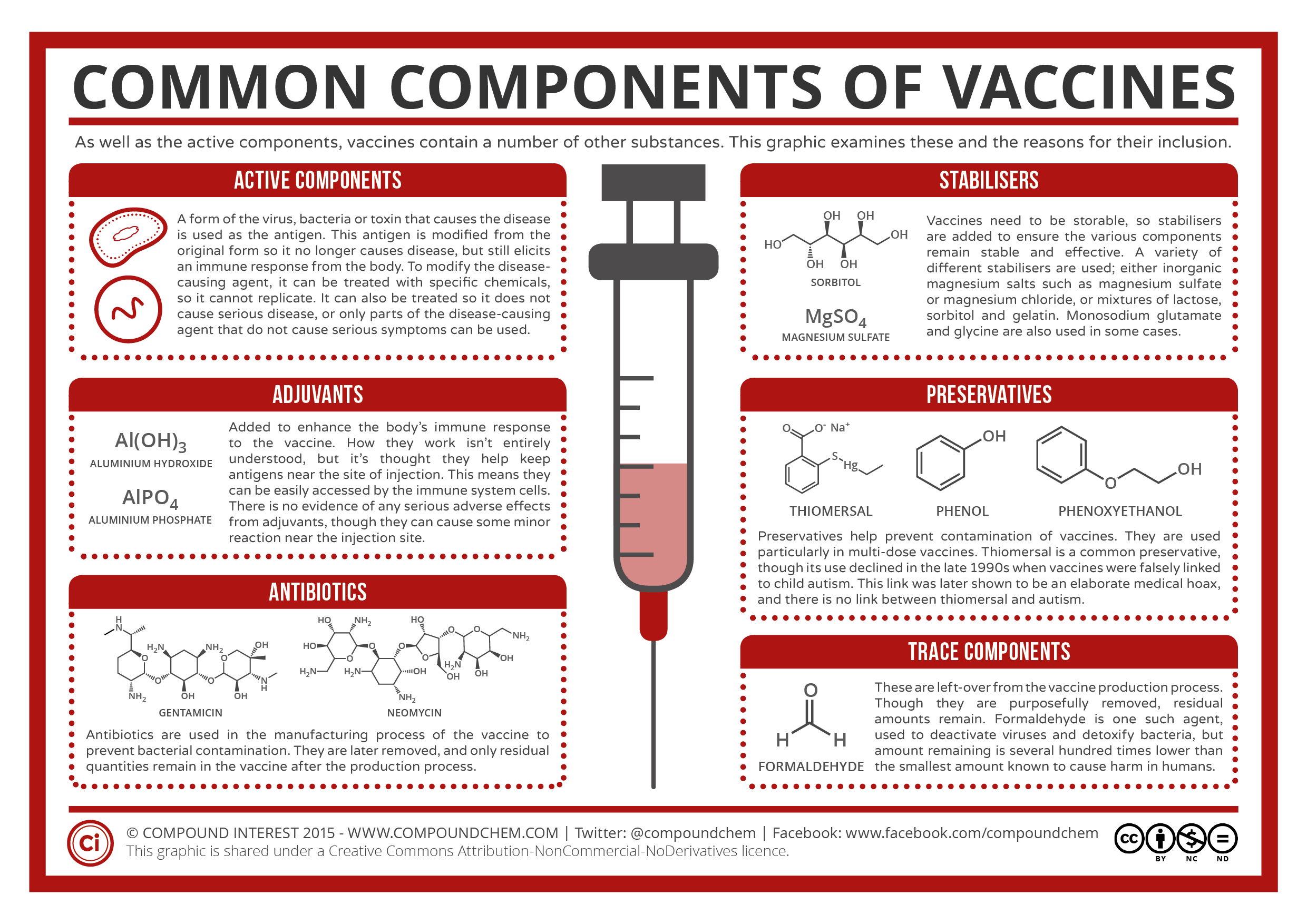
The infographic above from Compound Interest shows the common components of vaccines. 
When making vaccines, antibiotics can be used to prevent bacterial contamination. Although these are removed after manufacture, trace amounts can still remain in the final vaccine. Antibiotics that often cause adverse allergic reactions, such as penicillins, are avoided, in favour of antibiotics such as gentamycin and neomycin.
For more information visit:-


Friday, 6 March 2015

The smell of the earth!

Ever wondered what the smell of the earth is?  Maybe you've visited the countryside while farmers have been ploughing their fields and smelled it.  The smell is caused by Geosmin which is an organic compound with a distinct earthy aroma produced by a type of Actinobacteria.


Geosmin is produced by the bacteria Streptomyces, a genus of Actinobacteria and released when these microorganisms die.

Geosmin is a colourless liquid, with a boiling point of 270°C.  The human nose is extremely sensitive to geosmin and is able to detect it at concentrations as low as 5 parts per trillion.  It is the smell after a rainstorm when the ground is wet.

Geosmin is often responsible for unpleasant tastes in water supplies. Cyanobacteria (blue-green algae) and actinobacteria release geosmin when they die, and this can be absorbed by bottom-feeding freshwater fish such as carp and catfish. Geosmin combines with 2-methylisoborneol, which concentrates in the fatty skin and dark muscle tissues. Geosmin breaks down in acid conditions; hence, vinegar, lemon and other acidic ingredients are used in fish recipes to help reduce the muddy flavour.

Geosmin can sometimes be tasted in wine or drinking water.

It has also been suggested that camels can detect the smell of geosmin that had been released by Streptomyces miles away in wet ground, and track the geosmin to find an oasis; in return the camel could carry away and disperse the spores of the Streptomyces bacterium.


Soil is considered to be the "skin of the earth" and consists of a solid phase (minerals and organic matter) as well as a porous phase that holds gases and water.  It carries essential nutrients for plantlife and is a habitat for organisms that take part in decomposition of organic matter and the creation of a habitat for new organisms.

For more information visit:-
http://web.expasy.org/spotlight/back_issues/035/
http://en.wikipedia.org/wiki/Soil


Friday, 27 February 2015

On this day

Charles Herbert Best was born on 27th February 1899.  He was a scientist and co-discoverer of Insulin.

(February 27, 1899 – March 31, 1978)

Best was born in West Pembroke, Washington County, Maine and was the son of Luella Fisher and Herbert Huestis Best, Canadians from Nova Scotia.
Best married Margaret Hooper Mahon in Toronto in 1924 and they had two sons. One son, Dr. Henry Best was a well-regarded historian who later became president of Laurentian University in Sudbury, Ontario. Best's other son was Charles Alexander Best, a Canadian politician and geneticist.
 
As a 22-year-old medical student at the University of Toronto he worked as an assistant to Dr. Frederick Banting and played a major role in the discovery of the pancreatic hormone insulin—one of the more significant medical advances, enabling an effective treatment for diabetes.
 
Insulin is a peptide hormone produced by beta cells in the pancreas. It regulates the metabolism of carbohydrates and fats by promoting the absorption of glucose from the blood to skeletal muscles and fat tissue and by causing fat to be stored rather than used for energy.
 
When control of insulin levels fails, diabetes can result.  Insulin is used medically to treat some forms of diabetes. Patients with type 1 diabetes depend on external insulin (most commonly injected) for their survival because the hormone is no longer produced internally. Patients with type 2 diabetes are often insulin resistant and may suffer from a "relative" insulin deficiency. Some patients with type 2 diabetes may eventually require insulin if dietary modifications or other medications fail to control blood glucose levels adequately. Over 40% of those with Type 2 diabetes require insulin as part of their diabetes management plan.
 
Best received 18 Honorary Degrees from universities around the world.
 
For more information visit:-
 

Friday, 20 February 2015

Vitamins!

Ever wondered about the vitamins we need or that we eat as part of our breakfast cereal.  What they do?  How they help us?

A vitamin is an organic compound and a vital nutrient that an organism requires in limited amounts.  An organic chemical compound (or related set of compounds) is called a vitamin when the organism cannot synthesize the compound in sufficient quantities, and must be obtained through the diet; thus, the term "vitamin" is conditional upon the circumstances and the particular organism. For example, ascorbic acid (vitamin C) is a vitamin for humans, but not for most other animal organisms. Supplementation is important for the treatment of certain health problems, but there is little evidence of nutritional benefit when used by otherwise healthy people.


There are 13 recognised vitamins from A to E and K.  The reason that the set of vitamins skips directly from E to K is that the vitamins corresponding to letters F-J were either reclassified over time, discarded as false leads, or renamed because of their relationship to vitamin B, which became a complex of vitamins.
The German-speaking scientists who isolated and described vitamin K (in addition to naming it as such) did so because the vitamin is intimately involved in the coagulation of blood following wounding (from the German word Koagulation).

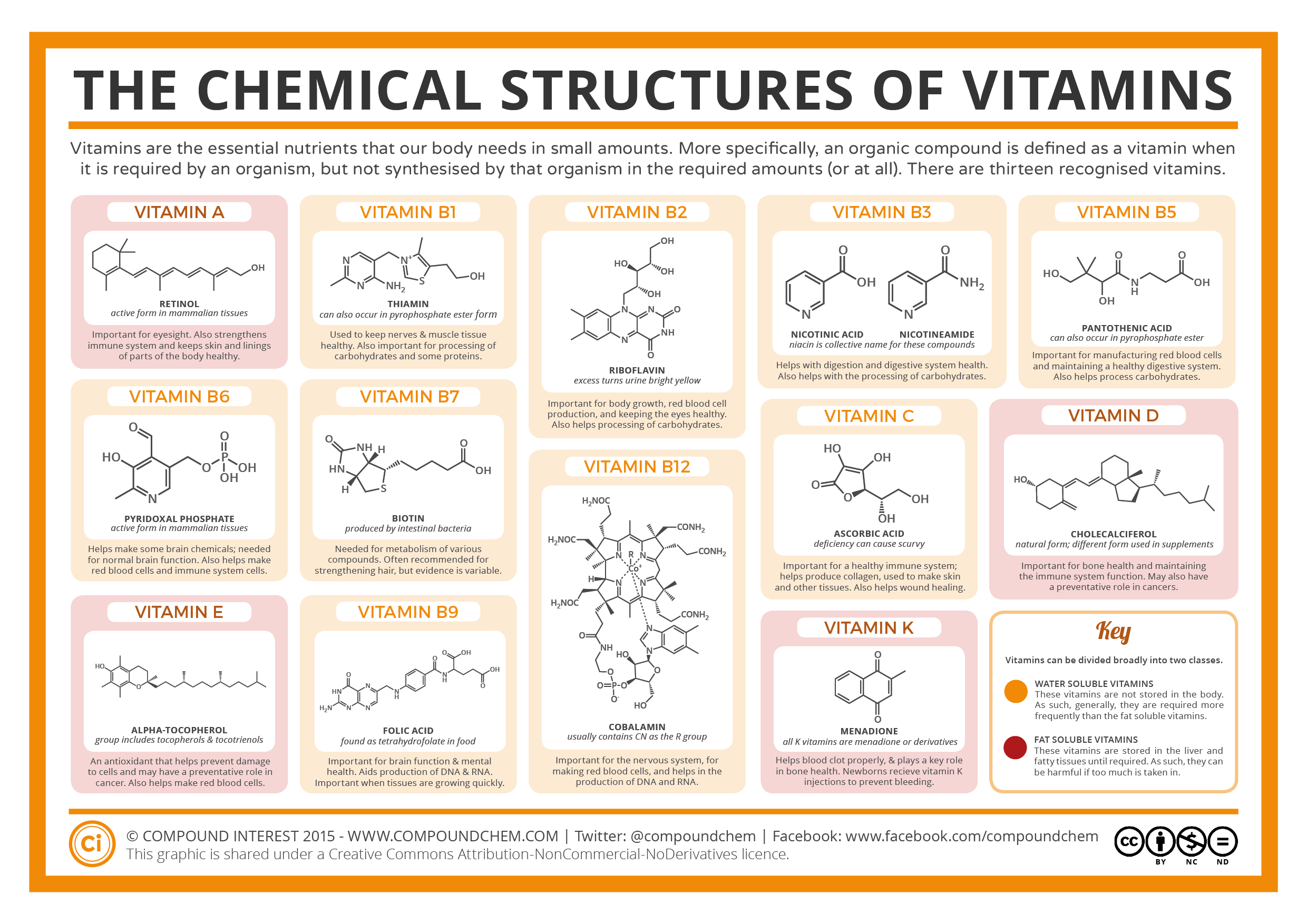
Again, the excellent Compound Interest has produced a detailed image of the chemical structures of vitamins as below.  Click on the image to enlarge.


http://www.compoundchem.com/wp-content/uploads/2015/01/Chemical-Structures-of-Vitamins-FINAL.png
Click to enlarge
 
Well-known human vitamin deficiencies involve thiamine (beriberi), niacin (pellagra), vitamin C (scurvy), and vitamin D (rickets). In much of the developed world, such deficiencies are rare; this is due to an adequate supply of food and the addition of vitamins and minerals to common foods, often called fortification.
For more information visit:-