Total Lab Supplies - Everything for your laboratory

Total Lab Supplies - Everything for your laboratory
Our Head Office in St Helens

Friday, 29 August 2014

Red hot chilli peppers!!!

The chilli pepper or chilli is the fruit of plants from the genus Capsicum.  The substances that give chili peppers their intensity when ingested or applied topically are capsaicin (8-methyl-N-vanillyl-6-nonenamide) and several related chemicals, collectively called capsaicinoids.
Cayenne pepper

Chili peppers originated in the Americas but spread around the world and India is now the world's largest producer, consumer and exporter of chili peppers.

When consumed, capsaicinoids bind with pain receptors in the mouth and throat that are responsible for sensing heat. Once activated by the capsaicinoids, these receptors send a message to the brain that the person has consumed something hot. The brain responds to the burning sensation by raising the heart rate, increasing perspiration and release of endorphins.

The "heat" of chili peppers was historically measured in Scoville heat units (SHU), which is a measure of the dilution of an amount of chili extract added to sugar syrup before its heat becomes undetectable to a panel of tasters; the more it has to be diluted to be undetectable, the more powerful the variety and therefore the higher the rating.  The modern commonplace method for quantitative analysis of SHU rating uses high-performance liquid chromatography to directly measure the capsaicinoid content of a chili pepper variety. Pure capsaicin is a hydrophobic, colorless, odorless, and crystalline-to-waxy solid at room temperature, and measures 16,000,000 SHU.
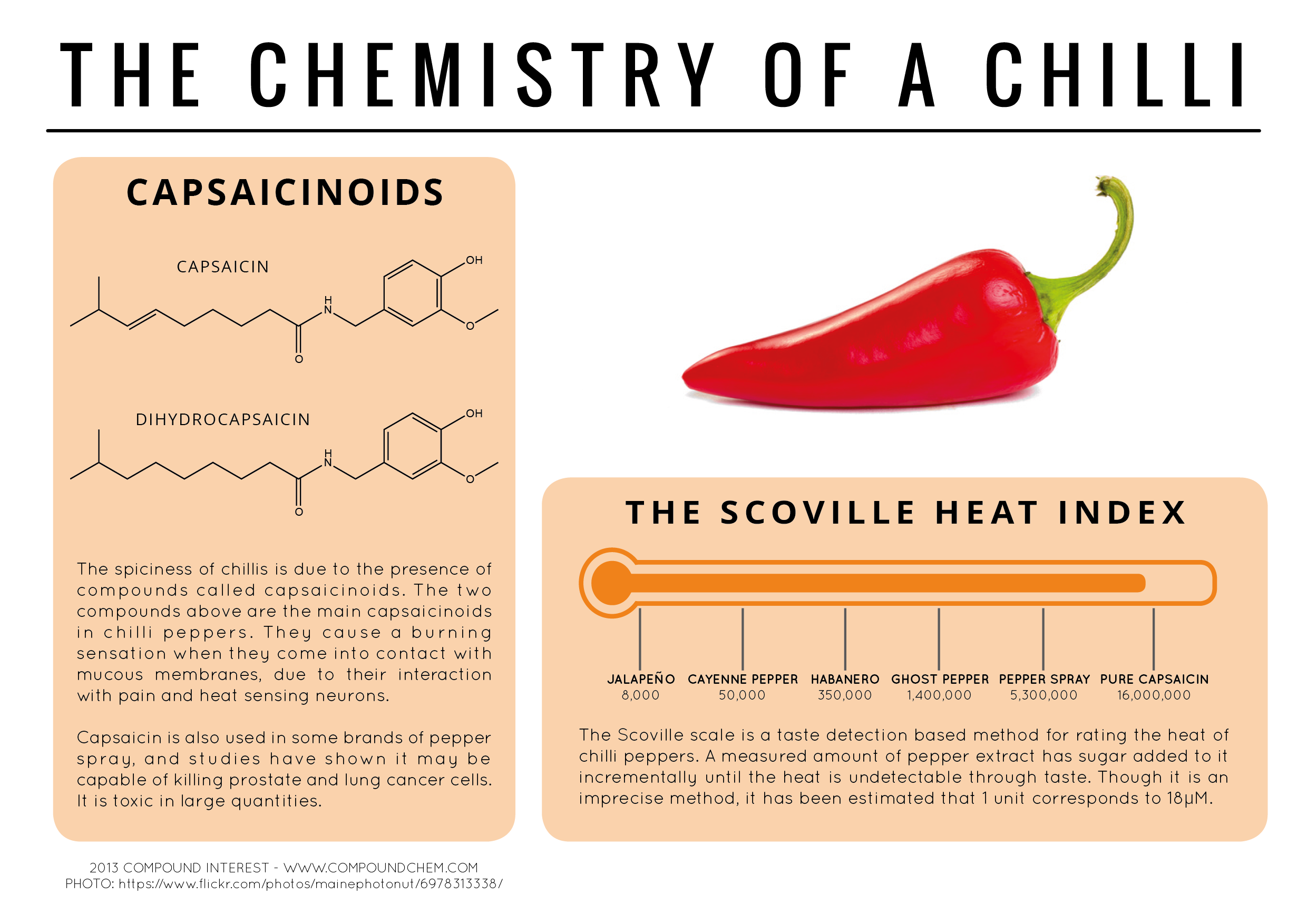

Chemistry of a Chilli-click to enlarge


Capsaicin extracted from chillis is also used in pepper spray as an irritant, a form of less-lethal weapon.

Red chilies contain large amounts of vitamin C and small amounts of carotene (provitamin A). Yellow and especially green chilies (which are essentially unripe fruit) contain a considerably lower amount of both substances. In addition, peppers are a good source of most B vitamins, and vitamin B6 in particular. They are very high in potassium, magnesium, and iron. Their very high vitamin C content can also substantially increase the uptake of non-heme iron from other ingredients in a meal, such as beans and grains.

For more information visit:-
http://www.compoundchem.com/2014/01/15/why-chilli-peppers-are-spicy-the-chemistry-of-a-chilli/
http://en.wikipedia.org/wiki/Chilli_pepper

Friday, 22 August 2014

Hayfever!!!

It's still summer - or at least it was sunny when I wrote this.  Knowing the British weather it could be raining now.  However rain doesn't always stop the effects of hayfever.

Pollen

Allergic rhinitis is an allergic inflammation of the nasal airways. It occurs when an allergen, such as pollen, dust or animal dander (particles of shed skin and hair) is inhaled by an individual with a sensitized immune system. In such individuals, the allergen in affected individuals is mistakenly identified as a threat and triggers the production of the antibody immunoglobulin E (IgE), which binds to mast cells and basophils containing histamine. When caused by pollens of any plants, it is called pollinosis, and, if specifically caused by grass pollens, it is known as hay fever. While symptoms resembling a cold or flu can be produced by an allergic reaction to pollen from plants and grasses it does not cause a fever.


IgE bound to mast cells are stimulated by allergens, causing the release of inflammatory mediators such as histamine (and other chemicals). This usually causes sneezing, itchy and watery eyes, swelling and inflammation of the nasal passages, and an increase in mucus production.
To reduce the symptoms of hayfever science has developed a number of medications to alleviate or prevent the symptoms.  A fantastic website (Compound Interest) goes into this in much more detail including the amazing infographic below.

http://www.compoundchem.com/wp-content/uploads/2014/06/Chemistry-Hayfever-Hayfever-Medications.png
Click to enlarge

Antihistamine drugs include those such as cetirizine and loratadine. They work by binding to the H1 receptors that histamine usually binds to, preventing it from inducing an inflammatory response to the allergens.  As you can see from the infographic above some drugs must be taken before symptoms appear for them to be effective.  Click here for a full screen image.

For more information visit:-
http://www.compoundchem.com/2014/06/20/hayfever/
http://en.wikipedia.org/wiki/Hayfever

Friday, 15 August 2014

What is Brownian Motion?

The term 'Brownian motion' (or 'Brownian movement') refers to the apparently random, haphazard movement of microscopic particles which are suspended in a fluid - (a liquid or a gas) resulting from their collision with the quick atoms or molecules in the gas or liquid.

This is a simulation of the Brownian motion of a big particle (dust particle) that collides with a large set of smaller particles (molecules of a gas) which move with different velocities in different random directions.
Although a number of earlier workers had observed this phenomenon, it was first described, and therefore named after, the British botanist, Robert Brown, who was studying pollen grains in 1827. Brown was an accomplished microscopist. It was he who, for example, first identified the naked ovule in the gymnospermae; this is a difficult observation to make even with a modern instrument.

Brown was attempting to further his work on the mechanisms of fertilisation in flowering plants and was looking at pollen.  He believed that he would be able to examine the pollen grains more effectively through his microscope if they were suspended in water, a technique known as 'water-immersion'. To his annoyance, he observed that the pollen grains danced continuously and erratically around in the water, thus interfering with his observations. From these observations he satisfied himself that the movement:

'arose neither from currents in the fluid, nor from its gradual evaporation, but belonged to the particle itself'.

Decades later, Albert Einstein published a paper in 1905 that explained in precise detail how the motion that Brown had observed was a result of the pollen being moved by individual water molecules.

Despite all of this knowledge, scientists continue to be fascinated by the origin and nature of Brownian motion, which is still imperfectly understood. Articles concerning the mathematics of Brownian motion continue to be published in contemporary physics journals.

For more information visit:-
http://en.wikipedia.org/wiki/Brownian_motion

Friday, 8 August 2014

1000mph - along the ground - Bloodhound SSC.

BLOODHOUND SSC is a SuperSonic Car.  It's supersonic because it is designed to go faster than the speed of sound and it's a car because it has four wheels and is under full control of its driver.

BLOODHOUND SSC is a jet and rocket powered car designed to go at 1,000 mph (just over 1,600 kph). It has a slender body of approximately 14m length with two front wheels within the body and two rear wheels mounted externally within wheel fairings. It weighs over 7 tonnes and the engines produce more than 135,000 horsepower - more than 6 times the power of all the Formula 1 cars on a starting grid put together!

The Car is a mix of car and aircraft technology, with the front half being a carbon fibre monocoque like a racing car and the back half being a metallic framework and panels like an aircraft.

Runway testing of up to 200 miles per hour (320 km/h) is scheduled to take place early 2016. Bloodhound SSC will then be tested on the Hakskeen Pan in the Mier area of the Northern Cape, South Africa where a track 12 miles (19 km) long, 2 miles (3.2 km) wide has been cleared.

The car is an amazing feat of engineering.  A prototype Eurojet EJ200 jet engine developed for the Eurofighter and bound for a museum, was donated to the project. This will take the car to 300 mph (480 km/h), after which a bespoke hybrid rocket designed by Nammo will boost the car up to 1,000 miles per hour (1,609 km/h). A third engine, a 750 hp (560 kW) 2.4 Litre Cosworth CA2010 Formula 1 V8 petrol engine, is used as an auxiliary power unit and to drive the oxidiser pump for the rocket. The jet engine will provide nine tonnes of thrust and the rocket will add another 12. The supersonic car will have roughly the same power as 180 F1 cars.

The Bloodhound SSC project has a comprehensive website as below:-
http://www.bloodhoundssc.com/project/car

They are on Twitter and regularly post updates.  An example is the fascinating infographic below - 10 astounding facts about Bloodhound SSC.

Be sure to keep up to date and follow the Bloodhound SSC project.
http://www.twitter.com/BLOODHOUND_SSC
http://www.facebook.com/BLOODHOUNDSSC

Friday, 1 August 2014

Strontium

Strontium has the atomic symbol Sr and the atomic number 38. It is a soft silver-white or yellowish (when oxidised) metallic element that is even more chemically reactive than its neighbour calcium.

Strontium is a grey, silvery metal that is softer than calcium and even more reactive toward water, with which it reacts on contact to produce strontium hydroxide and hydrogen gas.  Finely powdered strontium metal ignites spontaneously in air at room temperature. Most of us will be familiar with strontium because strontium salts are commonly used in fireworks and flares to give a bright (some might say blinding) red color to flames.

Strontium is named after Strontian, a village in Scotland near which the mineral was first discovered in 1790.  Strontium is the 15th most abundant element on Earth, but because of its reactivity, strontium is not found roaming freely in the wild: it occurs in minerals, mostly in strontianite and celestite.

Because its nucleus is very nearly the same size as that of calcium, the body mistakenly takes up strontium and incorporates it into bones and tooth enamel in the place of calcium. Surprisingly, this is not a health problem and in fact, it can provide a health benefit. For example, in clinical trials, the drug strontium ranelate was found to aid bone growth, increase bone density, and lessen vertebral, peripheral, and hip fractures in women.

The radioactive isotope, 90Sr, is common in radioactive fallout. Since radioactive fallout doesn't respect national borders, it falls upon all living things regardless of nationality or species, contaminating water, food and even the air that we all breathe. This isotope is quite dangerous and can cause a variety of leukæmias, bone cancer and other debilitating bone diseases. Perhaps ironically, Strontium-90 is also used to treat cancer.

For more information visit:-
http://www.theguardian.com/science/punctuated-equilibrium/2011/nov/18/1?guni=Article:in%20body%20link
http://en.wikipedia.org/wiki/Strontium

Friday, 25 July 2014

A Solar Eclipse

A solar eclipse is a type of eclipse that occurs when the Moon passes between the Sun and Earth, and the Moon fully or partially blocks ("occults") the Sun. This can happen only at new moon, when the Sun and the Moon are inconjunction as seen from Earth in an alignment referred to as syzygy. In a total eclipse, the disk of the Sun is fully obscured by the Moon. In partial and annular eclipses only part of the Sun is obscured.

If the Moon were in a perfectly circular orbit, a little closer to the Earth, and in the same orbital plane, there would be total solar eclipses every single month. However, the Moon's orbit is inclined (tilted) at more than 5 degrees to Earth's orbit around the Sun (see ecliptic) so its shadow at new moon usually misses Earth.

Earth's orbit is called the ecliptic plane as the Moon's orbit must cross this plane in order for an eclipse (both solar as well as lunar) to occur. In addition, the Moon's actual orbit is elliptical, often taking it far enough away from Earth that its apparent size is not large enough to block the Sun totally. The orbital planes cross each year at a line of nodes resulting in at least two, and up to five, solar eclipses occurring each year; no more than two of which can be total eclipses.

However, total solar eclipses are rare at any particular location because totality exists only along a narrow path on Earth's surface traced by the Moon's shadow or umbra.

Special eye protection or indirect viewing techniques must be used when viewing a solar eclipse to avoid eye damage.

When at a spot from which a 'total eclipse' is visible, an observer can see a number of exciting effects.  One such effect occasionally seen is Baily's Beads where a sequence of spots of light appears along the edge of the Moon. This is caused by the sun shining through the valleys of the Moon's mountainous regions


The following table shows the upcoming total solar eclipses for the next few years:
DateRegion Visible
20 March 2015North Atlantic regions, Faroe Islands and the North Pole
9 March 2016Indonesia
21 August 2017Parts of the mid- and west USA
2 July 2019central Argentina, Chile, the Tuamotus (French Polynesia), parts of the South Pacific Ocean

For more information visit:-
http://en.wikipedia.org/wiki/Solar_eclipse
http://h2g2.com/approved_entry/A143812

Friday, 18 July 2014

How does a Laboratory Balance or Scale work?

There are two basic types of electronic balance designs.

1. Electromagnetic balancing type
2. Electrical resistance wire type (load cell type)


These are based on different principles, but both have neither directly measures mass. They measure the force that acts downward on the pan. This force is converted to an electrical signal and displayed on a digital display.
 

As a means of measuring force, the electromagnetic balance method uses the electromagnetic force generated from a magnet and coil, whereas the electrical resistance wire method uses the change in resistance value of a strain gauge attached to a piece of metal that bends in response to a force.
 
 
So why do electronic balances display mass values when that is not what they measure? It's because the reference standards for mass are weights, which are placed on a pan to inform the electronic balance that a given force is equivalent to a given number of grams, which is used for conversion. Consequently, electronic balances that do not perform this conversion accurately cannot display accurate mass values.

Readability and accuracy are not the same thing?
The readability of a balance is the smallest quantity that the balance will display. Accuracy is the difference between the known weight of a sample and the displayed weight. The accuracy of a balance can be measured only when the balance is in its operating environment

Location of the Balance

The precision and reproducibility of weighing results is closely associated with the location of the balance. To ensure that your balance can work under the best conditions, please observe the following guidelines:

Weighing bench
  • Stable (lab bench, lab table, stone bench).  Your weighing bench should not sag when work is carried out on it and should transfer as few vibrations as possible.
  • Antimagnetic (no steel plate).
  • Protected against electrostatic charges (no plastic or glass).
  • Wall or floor installation.  The weighing bench should be fixed either to the floor or on the wall.  Mounting the bench on both places at once transfers vibrations from wall and floor.
  • Reserved for the balance.

The place of installation and the weighing bench must be stable enough that the balance display does not change when someone leans on the table or steps up to the weighing station. Do not use soft pads underneath, such as writing mats.  It is better to position the balance directly over the legs of the bench, since the area is subject to the fewest vibrations.
 
The article above is a very brief outline of laboratory balances or scales.  many factors affect the weighing accuracy besides location - eg temperature, humidity etc..Visit the last link below to download a complete guide to weighing.

For more information visit:-
http://www.shimadzu.com/an/hplc/support/lib/lctalk/66/66lab.html
http://electronics.howstuffworks.com/everyday-tech/digital-scale.htm
http://www.prlabs.co.uk/news/article.php?Id=140