Total Lab Supplies - Everything for your laboratory

Total Lab Supplies - Everything for your laboratory
Our Head Office in St Helens

Wednesday, 15 May 2019

Sieve Shakers and Sieves

Total Lab Supplies can supply a wide range of sieves and sieve shakers.  A sieve shaker is basically a device used to shake a stacked column of standard sieve-test trays to cause solids to sift progressively from the top (large openings) to the bottom (small openings and a final pan), according to particle size.

A sieve stack can consist of anywhere between 1 and a number of sieves. The number and mesh sizes of the sieves in a sieve stack are dictated by industry/application standards or the stated production standards of specific products.

Glenammer Engineering’s range of Sieve Shakers is constantly evolving as Glenammer manufactures shakers to order and also to customer’s particular requirements.  All systems are 220/240 volt single phase. 


At present, customers can save 10% off the models on the flyer!

Also available - a FULL range of Glenammer sieves – all produced to comply with the relevant specifications set out – eg BS410/ISO3310, ASTM E11 etc….

Glenammer woven wire test sieves are one of the most widely used type of test sieves and are made to stringent engineering standards – save money now compared to other well known brands.  You wont be disappointed.  Get in touch with your requirements.

Friday, 22 February 2019

Hotplate Safety

Total Lab Supplies offer a wide range of hotplates and hotplate/stirrers.  The Stuart range is well known in laboratories and they offer some good advice on the operation of these units.

  • Do not use hotplates to heat inflammable liquids.
  • Never lift or carry a hotplate until it has been switched off and allowed to cool for at least 30 minutes. A hot warning light will give guidance.
  • A hotplate should be carried using both hands with the fingers under the side edges.
  • Never move or carry a unit with containers on the top plate or while still connected to the mains supply.
  • There is a danger of liquid spillage if containers are over-filled and stirred at high speed. Always build stirrer speed slowly and never stir more rapidly than necessary
  • NEVER place a cold glass vessel onto a hotplate which is already hot.

When using a ceramic hotplates like the Stuart UC152 at temperatures over 180ºC, the base of any equipment used must not make contact with the ceramic plate outside the Hot Zone or heated plate area.

The use of a Stuart SCT1 temperature controller allows accurate temperature control of aqueous and oil based samples in the laboratory and can be used in two different modes, as a precise temperature controller from 20 to 200°C or as a digital thermometer from -4 to 325°C.

Care when preparing media
Take particular care when heating liquids having a high viscosity. Viscous liquids can act as thermal insulators and can cause thermal breakage of the glassware. This is very important with media solutions as the viscosity will usually increase as the temperature rises.

  • Check that the stirring action is sufficient to agitate the whole of the liquid.  Unstirred areas in the liquid can result in uneven heat transfer and “hot spots” in the glassware. This can induce thermal stress and so cause failure.
  • Check the stirring action regularly to ensure that it remains adequate as the viscosity of the solution increases.
  • Always use the largest magnetic follower possible and if necessary, use a mechanical overhead stirrer.
  • Do not use glass vessels with thick walls, e.g. Pyrex Heavy Duty Ware or standard beakers and flasks having capacities of 5 litres or greater.
  • NEVER heat glass bottles on a hotplate.
  • Ensure that the heat is built up slowly to avoid localised overheating.
  • Ensure the glassware is completely free from scratches or other defects.
  • Place the hotplate in a tray large enough to contain the liquid in the event of glassware failure.
  • Wear the appropriate safety clothing e.g. gloves, goggles, protective apron etc.

Following these guidelines using a stirrer/hotplate should ensure trouble free use.

 For all your hotplate/stirrer needs please get in touch

Tuesday, 8 January 2019

2019 Safety Catalogue

The 2019 Total Lab Supplies Safety Catalogue is out now.

It covers safety signs, posters, GHS labels, first aid, fire extinguishers, PPE, Spill kits, safety storage cabinets and much more.


Contact our sales desk now to request your copy.

Thursday, 6 December 2018

Christmas Closure Times

Total Lab Supplies closes on Friday 21st December and re-opens on Wednesday 2nd January 2019.  There will be no deliveries during this period.

We would like to take this opportunity to thank for your custom this year, and look forward to continuing our relationships in 2019.


Please don't hesitate to contact us with your requirements however large or small.  We're here to help.

Monday, 3 September 2018

Asbestos - The dangers!

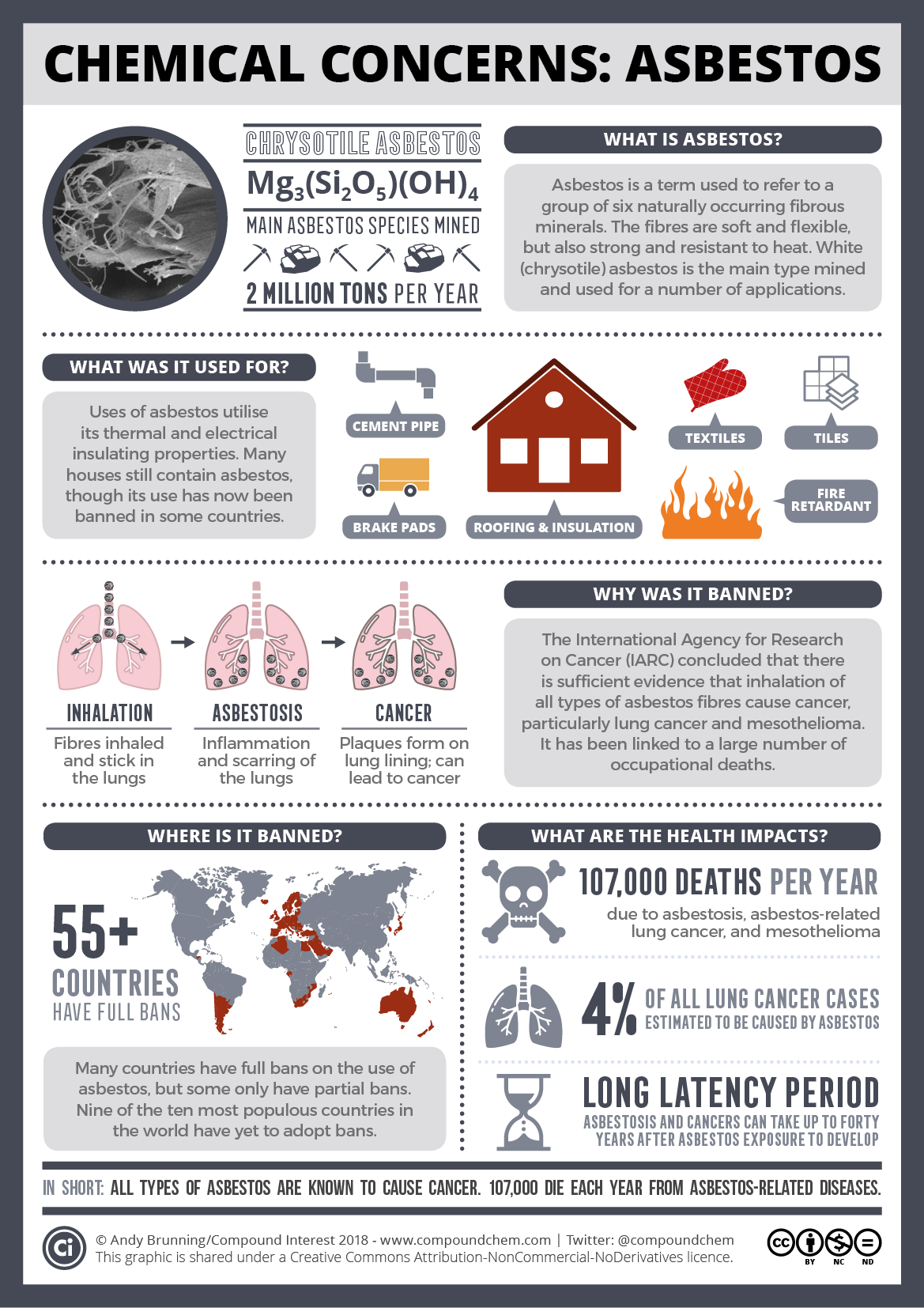
Asbestos is a set of six naturally occurring silicate minerals which all have in common their eponymous asbestiform habit: i.e. long (roughly 1:20 aspect ratio), thin fibrous crystals, with each visible fibre composed of millions of microscopic "fibrils" that can be released by abrasion and other processes. They are commonly known by their colours, as blue asbestos, brown asbestos, white asbestos, and green asbestos.


Asbestos mining existed more than 4,000 years ago, but large-scale mining began at the end of the 19th century, when manufacturers and builders began using asbestos for its desirable physical properties. Some of those properties are sound absorption, average tensile strength, affordability, and resistance to fire, heat, and electricity. It was used in such applications as electrical insulation for hotplate wiring and in building insulation. When asbestos is used for its resistance to fire or heat, the fibers are often mixed with cement or woven into fabric or mats. These desirable properties made asbestos very widely used. Asbestos use continued to grow through most of the 20th century until public knowledge of the health hazards of asbestos dust led to its outlawing by courts and legislatures in mainstream construction and fireproofing in most countries.

Many countries have discontinued these uses since the health risks of asbestos became apparent. However, their legacy is that many buildings more than 20 years old contain asbestos. It’s estimated that 94% of hospitals in London contain asbestos, and it can also be found in older homes. It does not pose a danger unless disturbed, but can be costly to remove

For more information

Visit https://en.wikipedia.org/wiki/Asbestos
Visit http://www.compoundchem.com/2018/08/14/asbestos/

The excellent Compound Chem website has a graphic as below explaining the dangers of Asbestos in simple terms.  Click on it to enlarge.


Friday, 20 July 2018

Caesium

Cæsium is a soft, silvery-gold alkali metal with the symbol Cs and atomic number 55.


It has a melting point of 28°C (82°F), which means it will be liquid on a warm summer day, and revert to a solid later that night after the ambient temperature cools. Cæsium is just one of five elemental metals that are liquids at or near room temperature.


Its name comes from the Latin word for sky-blue because when burned, cæsium turns the flame a lovely blue colour.

Since the 1990s, the largest application of the element has been as caesium formate for drilling fluids, but it has a range of applications in the production of electricity, in electronics, and in chemistry. The radioactive isotope caesium-137 has a half-life of about 30 years and is used in medical applications, industrial gauges, and hydrology. Nonradioactive caesium compounds are only mildly toxic, but the pure metal's tendency to react explosively with water means that caesium is considered a hazardous material, and the radioisotopes present a significant health and ecological hazard in the environment.

Caesium is also know for its use in atomic clocks and use the electromagnetic transitions in the hyperfine structure of caesium-133 atoms as a reference point. The first accurate caesium clock was built by Louis Essen in 1955 at the National Physical Laboratory in the UK. 

These clocks measure frequency with an error of 2 to 3 parts in 1014, which corresponding to an accuracy of 2 nanoseconds per day, or one second in 1.4 million years. The latest versions are more accurate than 1 part in 1015, about 1 second in 20 million years.  The Caesium standard is the primary standard for standards-compliant time and frequency measurements. Caesium clocks regulate the timing of cell phone networks and the Internet.

For more information visit
https://en.wikipedia.org/wiki/Caesium
https://www.theguardian.com/science/grrlscientist/2012/mar/23/1

Friday, 29 June 2018

On this day in history

On July 29th in 1927, the first iron lung (electric respirator) was installed at Bellevue hospital in New York for the post war polio epidemic. The first iron lung was developed at Harvard University by Phillip Drinker and Louis Agassiz Shaw built with two vacuum cleaners. The iron lung is a negative pressure machine which surrounds the patient's body except for the head, and alternates a negative atmospheric pressure with the ambient one, resulting in rhythmic expansion of the chest cage (and thus inhalation) in response to the negative extra thoracic pressure. During periods of ambient extrathoracic pressure, the lungs deflate. This type of machine is rarely used today.


The first patients of the iron lung were polio sufferers with chest paralysis.

Historically, in 1670, John Mayow demonstrated that air is drawn into the lungs by enlarging the thoracic cavity. He built a model using bellows inside which was inserted a bladder. Expanding the bellows caused air to fill the bladder and compressing the bellows expelled air from the bladder. This was the principle of artificial respiration called "external negative pressure ventilation" or ENPV that would lead to the invention of the iron lung and other respirators.

For more information visit https://en.wikipedia.org/wiki/Iron_lung