Total Lab Supplies - Everything for your laboratory

Total Lab Supplies - Everything for your laboratory
Our Head Office in St Helens

Friday, 13 March 2015

Vaccines


A vaccine is a biological preparation that provides active acquired immunity to a particular disease. A vaccine typically contains an agent that resembles a disease-causing microorganism and is often made from weakened or killed forms of the microbe, its toxins or one of its surface proteins. The agent stimulates the body's immune system to recognize the agent as a threat, destroy it, and keep a record of it, so that the immune system can more easily recognize and destroy any of these microorganisms that it later encounters

Vaccines have historically been the most effective means to fight and eradicate infectious diseases. Limitations to their effectiveness do exist.  Sometimes, protection fails because the host's immune system doesn’t respond adequately or at all. Lack of response commonly results from clinical factors such as diabetes, steroid use, HIV infection or age. However it also might fail for genetic reasons.

Adjuvants commonly are used to boost immune response, particularly for older people (50–75 years and up), whose immune response to a simple vaccine may have weakened.

Vaccines are dead or inactivated organisms or purified products derived from them.

There are several types of vaccines in use.  These represent different strategies used to try to reduce risk of illness, while retaining the ability to induce a beneficial immune response.
Some vaccines contain inactivated, but previously virulent, micro-organisms that have been destroyed with chemicals, heat, radioactivity, or antibiotics. Examples are influenza, cholera, bubonic plague, polio, hepatitis A, and rabies.
Some vaccines contain live, attenuated microorganisms. Many of these are active viruses that have been cultivated under conditions that disable their virulent properties, or that use closely related but less dangerous organisms to produce a broad immune response. Although most attenuated vaccines are viral, some are bacterial in nature. Examples include the viral diseases yellow fever, measles, rubella, and mumps, and the bacterial disease typhoid.
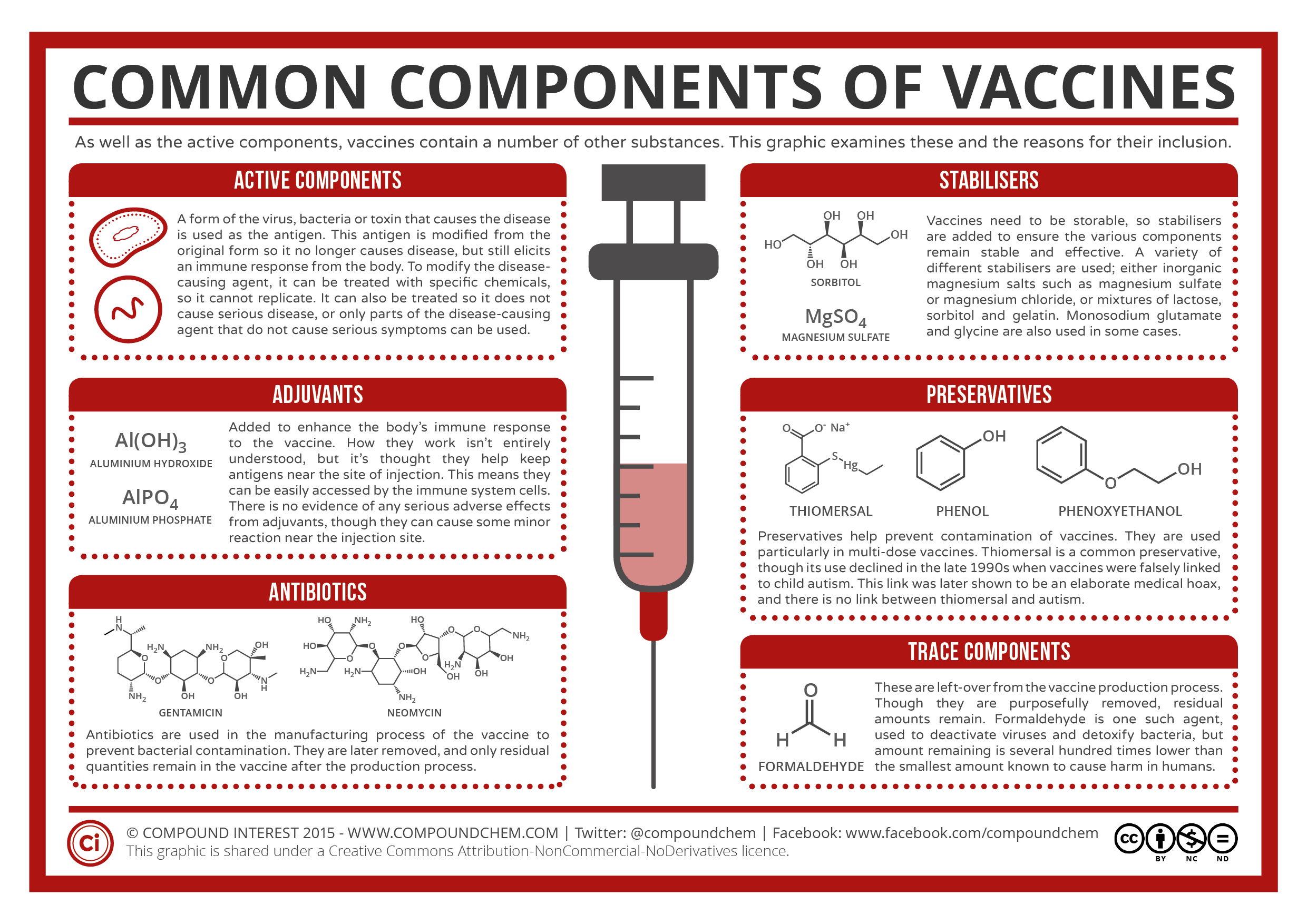
The infographic above from Compound Interest shows the common components of vaccines. 
When making vaccines, antibiotics can be used to prevent bacterial contamination. Although these are removed after manufacture, trace amounts can still remain in the final vaccine. Antibiotics that often cause adverse allergic reactions, such as penicillins, are avoided, in favour of antibiotics such as gentamycin and neomycin.
For more information visit:-


Friday, 6 March 2015

The smell of the earth!

Ever wondered what the smell of the earth is?  Maybe you've visited the countryside while farmers have been ploughing their fields and smelled it.  The smell is caused by Geosmin which is an organic compound with a distinct earthy aroma produced by a type of Actinobacteria.


Geosmin is produced by the bacteria Streptomyces, a genus of Actinobacteria and released when these microorganisms die.

Geosmin is a colourless liquid, with a boiling point of 270°C.  The human nose is extremely sensitive to geosmin and is able to detect it at concentrations as low as 5 parts per trillion.  It is the smell after a rainstorm when the ground is wet.

Geosmin is often responsible for unpleasant tastes in water supplies. Cyanobacteria (blue-green algae) and actinobacteria release geosmin when they die, and this can be absorbed by bottom-feeding freshwater fish such as carp and catfish. Geosmin combines with 2-methylisoborneol, which concentrates in the fatty skin and dark muscle tissues. Geosmin breaks down in acid conditions; hence, vinegar, lemon and other acidic ingredients are used in fish recipes to help reduce the muddy flavour.

Geosmin can sometimes be tasted in wine or drinking water.

It has also been suggested that camels can detect the smell of geosmin that had been released by Streptomyces miles away in wet ground, and track the geosmin to find an oasis; in return the camel could carry away and disperse the spores of the Streptomyces bacterium.


Soil is considered to be the "skin of the earth" and consists of a solid phase (minerals and organic matter) as well as a porous phase that holds gases and water.  It carries essential nutrients for plantlife and is a habitat for organisms that take part in decomposition of organic matter and the creation of a habitat for new organisms.

For more information visit:-
http://web.expasy.org/spotlight/back_issues/035/
http://en.wikipedia.org/wiki/Soil


Friday, 27 February 2015

On this day

Charles Herbert Best was born on 27th February 1899.  He was a scientist and co-discoverer of Insulin.

(February 27, 1899 – March 31, 1978)

Best was born in West Pembroke, Washington County, Maine and was the son of Luella Fisher and Herbert Huestis Best, Canadians from Nova Scotia.
Best married Margaret Hooper Mahon in Toronto in 1924 and they had two sons. One son, Dr. Henry Best was a well-regarded historian who later became president of Laurentian University in Sudbury, Ontario. Best's other son was Charles Alexander Best, a Canadian politician and geneticist.
 
As a 22-year-old medical student at the University of Toronto he worked as an assistant to Dr. Frederick Banting and played a major role in the discovery of the pancreatic hormone insulin—one of the more significant medical advances, enabling an effective treatment for diabetes.
 
Insulin is a peptide hormone produced by beta cells in the pancreas. It regulates the metabolism of carbohydrates and fats by promoting the absorption of glucose from the blood to skeletal muscles and fat tissue and by causing fat to be stored rather than used for energy.
 
When control of insulin levels fails, diabetes can result.  Insulin is used medically to treat some forms of diabetes. Patients with type 1 diabetes depend on external insulin (most commonly injected) for their survival because the hormone is no longer produced internally. Patients with type 2 diabetes are often insulin resistant and may suffer from a "relative" insulin deficiency. Some patients with type 2 diabetes may eventually require insulin if dietary modifications or other medications fail to control blood glucose levels adequately. Over 40% of those with Type 2 diabetes require insulin as part of their diabetes management plan.
 
Best received 18 Honorary Degrees from universities around the world.
 
For more information visit:-
 

Friday, 20 February 2015

Vitamins!

Ever wondered about the vitamins we need or that we eat as part of our breakfast cereal.  What they do?  How they help us?

A vitamin is an organic compound and a vital nutrient that an organism requires in limited amounts.  An organic chemical compound (or related set of compounds) is called a vitamin when the organism cannot synthesize the compound in sufficient quantities, and must be obtained through the diet; thus, the term "vitamin" is conditional upon the circumstances and the particular organism. For example, ascorbic acid (vitamin C) is a vitamin for humans, but not for most other animal organisms. Supplementation is important for the treatment of certain health problems, but there is little evidence of nutritional benefit when used by otherwise healthy people.


There are 13 recognised vitamins from A to E and K.  The reason that the set of vitamins skips directly from E to K is that the vitamins corresponding to letters F-J were either reclassified over time, discarded as false leads, or renamed because of their relationship to vitamin B, which became a complex of vitamins.
The German-speaking scientists who isolated and described vitamin K (in addition to naming it as such) did so because the vitamin is intimately involved in the coagulation of blood following wounding (from the German word Koagulation).

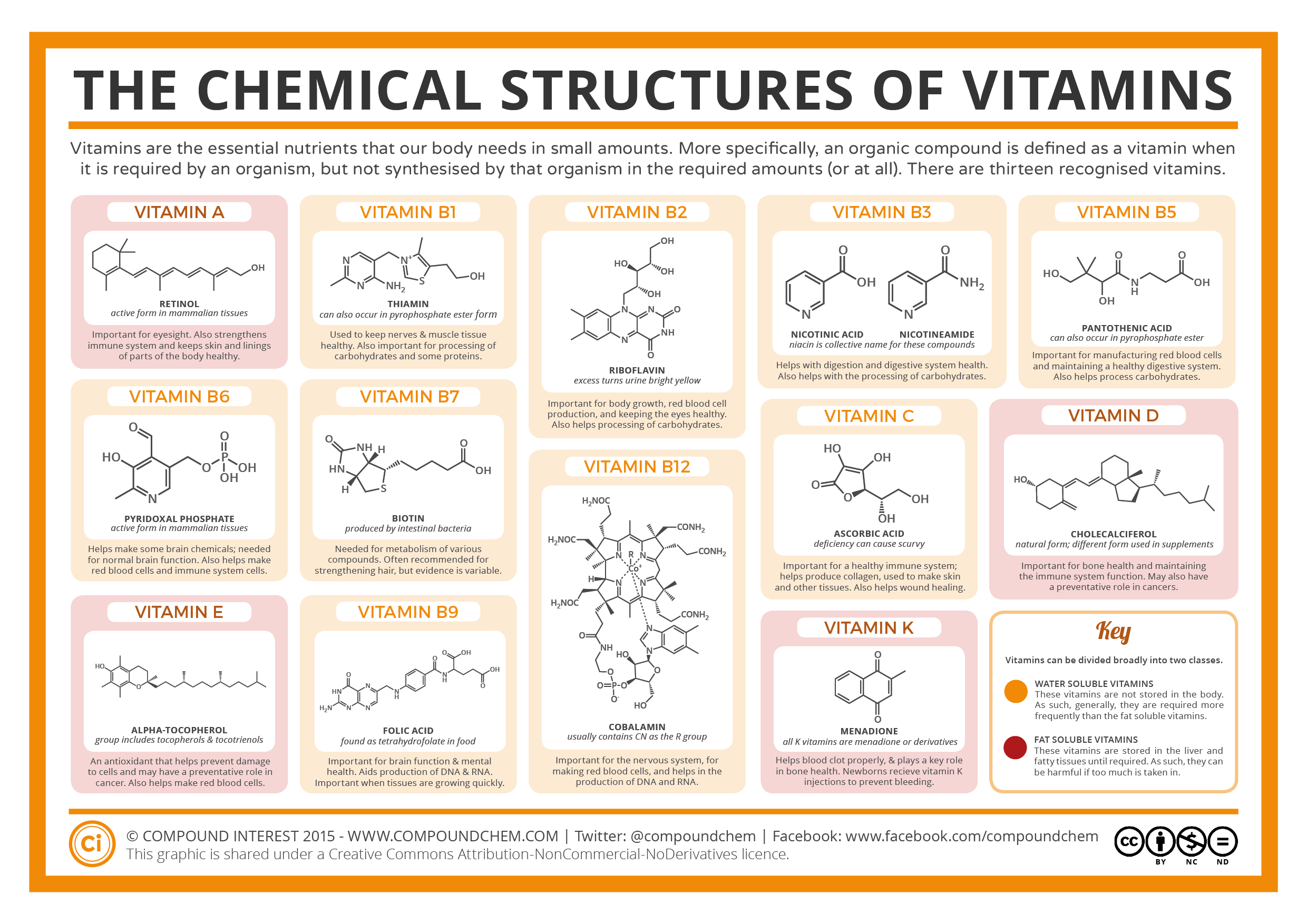
Again, the excellent Compound Interest has produced a detailed image of the chemical structures of vitamins as below.  Click on the image to enlarge.


http://www.compoundchem.com/wp-content/uploads/2015/01/Chemical-Structures-of-Vitamins-FINAL.png
Click to enlarge
 
Well-known human vitamin deficiencies involve thiamine (beriberi), niacin (pellagra), vitamin C (scurvy), and vitamin D (rickets). In much of the developed world, such deficiencies are rare; this is due to an adequate supply of food and the addition of vitamins and minerals to common foods, often called fortification.
For more information visit:-
 

Friday, 13 February 2015

Friday 13th February

Today is Friday the 13th of February!  The 13th and in particular a Friday is commonly known as being an unlucky day according to Western Superstition.  It is also known as Black Friday in some countries.


There is no written evidence for a "Friday the 13th" superstition before the 19th century, and the superstition only gained widespread distribution in the 20th century. The fear of the number 13 has been given a scientific name: triskadekaphobia; and on analogy to this the fear of Friday the 13th is called paraskevidekatriaphobia.

It is thought that Friday and the number 13 were traditionally considered unlucky because of their connection with the crucifixion of Christ (Friday being the day the crucifixion took place and was commemorated weekly in Catholic practice, and 13 being the number of people present at the last supper.

In Spanish-speaking countries, instead of Friday, Tuesday the 13th (martes trece) is considered a day of bad luck as it is in Greece.

Research in America has shown that Friday the 13th adversely affects the economy with people changing their daily routines on this day and avoiding certain things like transport and flights.  They estimate that this day can affect the economy in America meaning it loses $800 or $900 million in business on this day.

For more information visit:-
http://en.wikipedia.org/wiki/Friday_the_13th
http://en.wikipedia.org/wiki/Triskaidekaphobia

Friday, 6 February 2015

Boron!

Boron is a chemical element with symbol B and atomic number 5. It is a low-abundance element in both the Solar system and the Earth's crust and is concentrated on Earth by the water-solubility of its more common naturally occurring compounds, the borate minerals. These are mined industrially as evaporites, such as borax and kernite. The largest proven boron deposits are in Turkey, which is also the largest producer of boron minerals.


This rare element is a metalloid; which means that it can can act both as an acid and a base, and it also behaves as a semiconductor.  Boron never occurs in a pure state in the wild, and can only be purified with difficulty by chemists. Boron is a poor conductor of electricity, and is fairly non-reactive, although it is water soluble. The most common uses for boron-containing compounds includes a bleach for clothing, a swimming pool disinfectant and to produce green flames.

About half of global consumption of boron compounds is as additives for glass fibres in boron-containing fibreglass used for insulation or as structural materials. The next leading use is to make boron polymers and ceramics, that play specialised roles as high-strength lightweight structural and refractory materials. Borosilicate glass glassware is used for its greater strength and breakage resistance (thermal shock resistance) than ordinary soda lime glass.


For more information visit:-
http://en.wikipedia.org/wiki/Boron
http://www.theguardian.com/science/punctuated-equilibrium/2011/mar/11/1

Friday, 30 January 2015

The Computer Mouse

A mouse is a pointing device that detects two-dimensional motion relative to a surface. This motion is typically translated into the motion of a pointer on a display, which allows for fine control of a graphical user interface.

Physically, a mouse consists of an object held in one's hand, with one or more buttons. Mice often also feature other elements, such as touch surfaces and "wheels", which enable additional control and dimensional input.

The history of the mouse starts with the trackball, a related pointing device, which was invented in 1946 by Ralph Benjamin as part of a post-World War II-era radar plotting system called Comprehensive Display System (CDS). Benjamin was then working for the British Royal Navy Scientific Service. Benjamin's project used analog computers to calculate the future position of target aircraft based on several initial input points provided by a user with a joystick. Benjamin felt that a more elegant input device was needed and invented a ball tracker called roller ball for this purpose.

The device was patented in 1947, but only a prototype using a metal ball rolling on two rubber-coated wheels was ever built and the device was kept as a military secret.

Douglas Engelbart at the Stanford Research Institute (now SRI International) invented his first mouse prototype in the 1960s with the assistance of his lead engineer Bill English. They christened the device the mouse as early models had a cord attached to the rear part of the device looking like a tail and generally resembling the common mouse. Engelbart never received any royalties for it, as his employer SRI held the patent, which ran out before it became widely used in personal computers.

Modern mice are now available wired or wireless.  Such a simple device changed the way we interacted with computers.  Modern laptops have built in track pads but many users still prefer a mouse.

Inventor Douglas Engelbart's computer mouse, showing the wheels that make contact with the working surface.

Modern wireless mouse


For more information visit:-
http://en.wikipedia.org/wiki/Mouse_(computing)