Total Lab Supplies closes on Friday 21st December and re-opens on Wednesday 2nd January 2019. There will be no deliveries during this period.
We would like to take this opportunity to thank for your custom this year, and look forward to continuing our relationships in 2019.
Please don't hesitate to contact us with your requirements however large or small. We're here to help.
Total Lab Supplies offer laboratory equipment, chemicals and consumables to a wide range of customers from industry through to education. We offer technical support to help you choose the right products and offer many well known brands. We are able to help pick the right product to fit your budget. If you need any help contact us by e-mail, fax or comment on our blog. Email sales@totallabsupplies.co.uk
Thursday, 6 December 2018
Monday, 3 September 2018
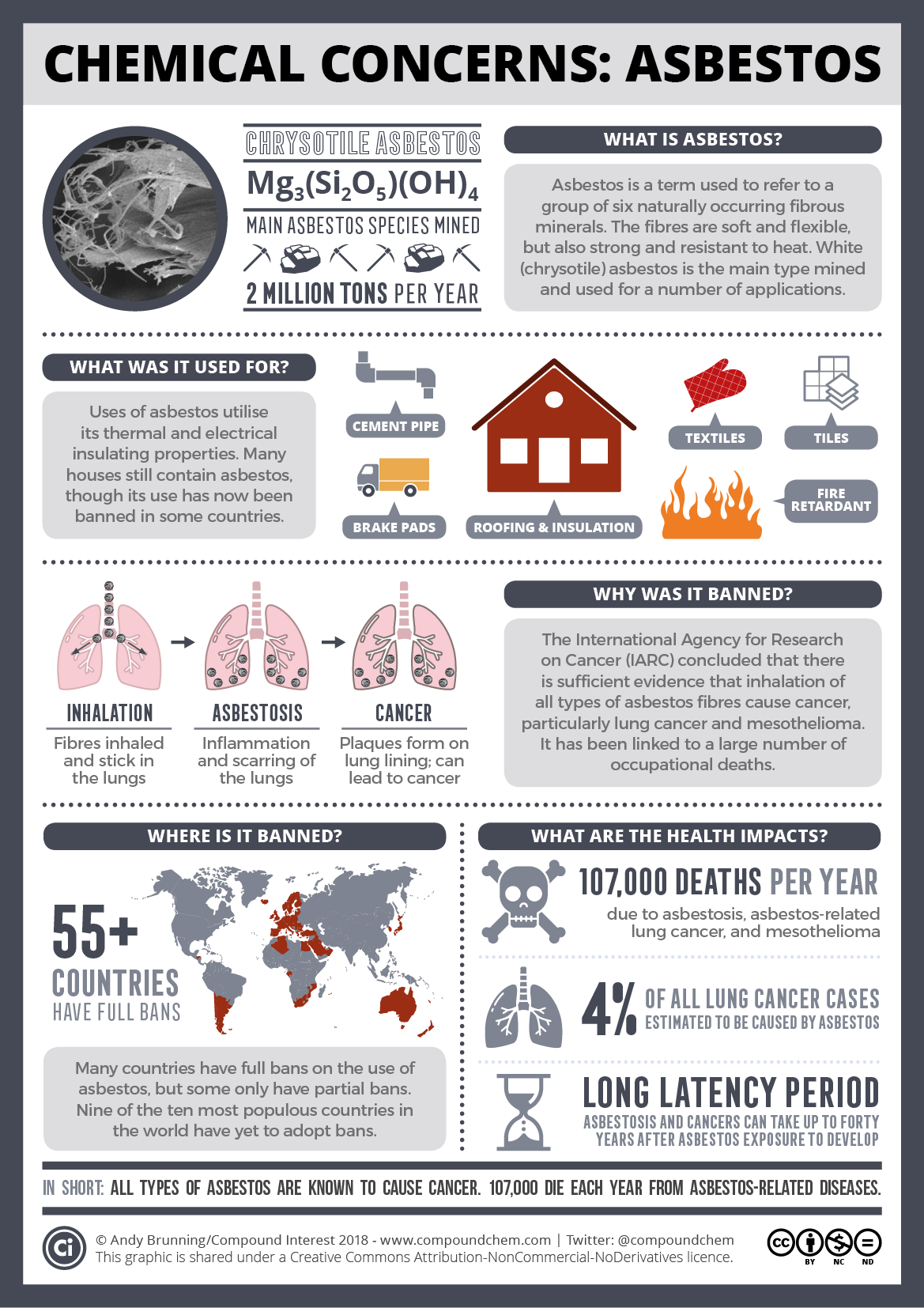
Asbestos - The dangers!
Asbestos is a set of six naturally occurring silicate
minerals which all have in common their eponymous asbestiform habit: i.e. long
(roughly 1:20 aspect ratio), thin fibrous crystals, with each visible fibre
composed of millions of microscopic "fibrils" that can be released by
abrasion and other processes. They are commonly known by their colours, as blue
asbestos, brown asbestos, white asbestos, and green asbestos.
Asbestos mining existed more than 4,000 years ago, but
large-scale mining began at the end of the 19th century, when manufacturers and
builders began using asbestos for its desirable physical properties. Some of
those properties are sound absorption, average tensile strength, affordability,
and resistance to fire, heat, and electricity. It was used in such applications
as electrical insulation for hotplate wiring and in building insulation. When
asbestos is used for its resistance to fire or heat, the fibers are often mixed
with cement or woven into fabric or mats. These desirable properties made
asbestos very widely used. Asbestos use continued to grow through most of the
20th century until public knowledge of the health hazards of asbestos dust led
to its outlawing by courts and legislatures in mainstream construction and
fireproofing in most countries.
Many countries have discontinued these uses since the health risks of asbestos became apparent. However, their legacy is that many buildings more than 20 years old contain asbestos. It’s estimated that 94% of hospitals in London contain asbestos, and it can also be found in older homes. It does not pose a danger unless disturbed, but can be costly to remove
For more information
Visit https://en.wikipedia.org/wiki/Asbestos
Visit http://www.compoundchem.com/2018/08/14/asbestos/
Friday, 20 July 2018
Caesium
Cæsium is a soft, silvery-gold alkali metal with the symbol Cs and atomic number 55.
It has a melting point of 28°C (82°F), which means it will be liquid on a warm summer day, and revert to a solid later that night after the ambient temperature cools. Cæsium is just one of five elemental metals that are liquids at or near room temperature.
Its name comes from the Latin word for sky-blue because when burned, cæsium turns the flame a lovely blue colour.
Since the 1990s, the largest application of the element has been as caesium formate for drilling fluids, but it has a range of applications in the production of electricity, in electronics, and in chemistry. The radioactive isotope caesium-137 has a half-life of about 30 years and is used in medical applications, industrial gauges, and hydrology. Nonradioactive caesium compounds are only mildly toxic, but the pure metal's tendency to react explosively with water means that caesium is considered a hazardous material, and the radioisotopes present a significant health and ecological hazard in the environment.
Caesium is also know for its use in atomic clocks and use the electromagnetic transitions in the hyperfine structure of caesium-133 atoms as a reference point. The first accurate caesium clock was built by Louis Essen in 1955 at the National Physical Laboratory in the UK.
These clocks measure frequency with an error of 2 to 3 parts in 1014, which corresponding to an accuracy of 2 nanoseconds per day, or one second in 1.4 million years. The latest versions are more accurate than 1 part in 1015, about 1 second in 20 million years. The Caesium standard is the primary standard for standards-compliant time and frequency measurements. Caesium clocks regulate the timing of cell phone networks and the Internet.
For more information visit
https://en.wikipedia.org/wiki/Caesium
https://www.theguardian.com/science/grrlscientist/2012/mar/23/1
It has a melting point of 28°C (82°F), which means it will be liquid on a warm summer day, and revert to a solid later that night after the ambient temperature cools. Cæsium is just one of five elemental metals that are liquids at or near room temperature.
Since the 1990s, the largest application of the element has been as caesium formate for drilling fluids, but it has a range of applications in the production of electricity, in electronics, and in chemistry. The radioactive isotope caesium-137 has a half-life of about 30 years and is used in medical applications, industrial gauges, and hydrology. Nonradioactive caesium compounds are only mildly toxic, but the pure metal's tendency to react explosively with water means that caesium is considered a hazardous material, and the radioisotopes present a significant health and ecological hazard in the environment.
Caesium is also know for its use in atomic clocks and use the electromagnetic transitions in the hyperfine structure of caesium-133 atoms as a reference point. The first accurate caesium clock was built by Louis Essen in 1955 at the National Physical Laboratory in the UK.
These clocks measure frequency with an error of 2 to 3 parts in 1014, which corresponding to an accuracy of 2 nanoseconds per day, or one second in 1.4 million years. The latest versions are more accurate than 1 part in 1015, about 1 second in 20 million years. The Caesium standard is the primary standard for standards-compliant time and frequency measurements. Caesium clocks regulate the timing of cell phone networks and the Internet.
For more information visit
https://en.wikipedia.org/wiki/Caesium
https://www.theguardian.com/science/grrlscientist/2012/mar/23/1
Friday, 29 June 2018
On this day in history
On July 29th in 1927, the first iron lung (electric respirator) was installed at Bellevue hospital in New York for the post war polio epidemic. The first iron lung was developed at Harvard University by Phillip Drinker and Louis Agassiz Shaw built with two vacuum cleaners. The iron lung is a negative pressure machine which surrounds the patient's body except for the head, and alternates a negative atmospheric pressure with the ambient one, resulting in rhythmic expansion of the chest cage (and thus inhalation) in response to the negative extra thoracic pressure. During periods of ambient extrathoracic pressure, the lungs deflate. This type of machine is rarely used today.
The first patients of the iron lung were polio sufferers with chest paralysis.
Historically, in 1670, John Mayow demonstrated that air is drawn into the lungs by enlarging the thoracic cavity. He built a model using bellows inside which was inserted a bladder. Expanding the bellows caused air to fill the bladder and compressing the bellows expelled air from the bladder. This was the principle of artificial respiration called "external negative pressure ventilation" or ENPV that would lead to the invention of the iron lung and other respirators.
For more information visit https://en.wikipedia.org/wiki/Iron_lung
The first patients of the iron lung were polio sufferers with chest paralysis.
Historically, in 1670, John Mayow demonstrated that air is drawn into the lungs by enlarging the thoracic cavity. He built a model using bellows inside which was inserted a bladder. Expanding the bellows caused air to fill the bladder and compressing the bellows expelled air from the bladder. This was the principle of artificial respiration called "external negative pressure ventilation" or ENPV that would lead to the invention of the iron lung and other respirators.
For more information visit https://en.wikipedia.org/wiki/Iron_lung
Friday, 8 June 2018
Why is Milk White?
Milk is mostly made up of water, with smaller amounts of fat, protein, minerals, and other compounds. Fats and water don’t usually mix, but in milk the fat and water form an emulsion. It is also a suspension of a multitude of different proteins in water.
![]() |
| The Chemistry of Milk - Click here for more. |
In milk, proteins cluster together to form structures called micelles. These clusters grow from small clusters of calcium phosphate, which help hold them together. There are a number of different models of these micelles, with the exact structure still being subject to scrutiny.
It’s the protein micelles which give milk its white appearance. The micelles are on average about 150 nanometres in diameter, and this very small size means they are able to scatter light that hits them. The overall effect of this scattering by the huge number of micelles in milk is that it looks white.
For a fuller explanation and for more information please visit:-
http://www.compoundchem.com/2018/06/02/milk/
Friday, 18 May 2018
On this day...
In 1980, following a weeklong series of earthquakes and smaller explosions of ash and smoke, the long-dormant Mount St. Helens volcano erupted in Washington state, U.S., hurling ash 15,000 feet into the air and setting off mudslides and avalanches.
An earthquake at 8:32:17 a.m. on Sunday, May 18, 1980, caused the entire weakened north face to slide away, creating the largest landslide ever recorded. This allowed the partly molten, high-pressure gas- and steam-rich rock in the volcano to suddenly explode northwards toward Spirit Lake in a hot mix of lava and pulverized older rock.
Approximately 57 people were killed directly. Hundreds of square miles were reduced to wasteland, causing over a billion U.S. dollars in damage, thousands of animals were killed, and Mount St. Helens was left with a crater on its north side.
Lakes nearest to Mount St. Helens have been partly covered with felled trees for more than thirty years. This photograph was taken in 2012.
For more information visit:-
https://en.wikipedia.org/wiki/1980_eruption_of_Mount_St._Helens
![]() |
| 18/05/1980 |
Approximately 57 people were killed directly. Hundreds of square miles were reduced to wasteland, causing over a billion U.S. dollars in damage, thousands of animals were killed, and Mount St. Helens was left with a crater on its north side.
For more information visit:-
https://en.wikipedia.org/wiki/1980_eruption_of_Mount_St._Helens
Friday, 11 May 2018
On this day in science
On this day in history, in 1947, the B.F. Goodrich Company of Akron, Ohio, announced the development of a tubeless tyre.
A technological innovation that would make cars safer and more efficient.
After more than three years of engineering, Goodrich’s tubeless tyre effectively eliminated the inner tube, trapping the pressurised air within the tire walls themselves. By reinforcing those walls, the company claimed, they were able to combine the puncture-sealing features of inner tubes with an improved ease of riding, high resistance to bruising and superior retention of air pressure. Testing proved successful, and in 1952, Goodrich won patents for the tyre’s various features. By 1955 tubeless tires became standard equipment on new cars.
Tyres have moved on since with run flat tyres but the basic design has remained the same.
Total Lab Supplies can't offer tyres but we can offer other safety items. If you have any requirements get in touch - we can supply safety storage cabinets, spill kits, safety spectacles, signs, labels, gloves and hazardous waste disposal and more
For more information visit:-
https://en.wikipedia.org/wiki/Tubeless_tire
Subscribe to:
Posts (Atom)