Total Lab Supplies - Everything for your laboratory

Total Lab Supplies - Everything for your laboratory
Our Head Office in St Helens

Friday, 23 January 2015

On this day....The flying disc, or Frisbee

Walter Frederick "Fred" Morrison (January 23, 1920 – February 9, 2010) was an American inventor and entrepreneur, best known as the inventor of the Frisbee.

Walter Frederick Morrison


Morrison claimed that the original idea for a flying disc toy came to him in 1937, while throwing a popcorn can lid with his girlfriend, Lu, whom he later married. The popcorn can lid soon dented which led to the discovery that cake pans flew better and were more common. Morrison and Lu developed a little business selling "Flyin' Cake Pans" on the beaches of Santa Monica, California..

In 1946, he sketched out a design (called the Whirlo-Way) for the world's first flying disc. In 1948 an investor, Warren Franscioni, paid for molding the design in plastic. They named it the Flyin-Saucer. After disappointing sales, Fred & Warren parted ways in early 1950. In 1954, Fred bought more of the Saucers from the original molders to sell at local fairs, but soon found he could produce his own disc more cheaply. In 1955, he and Lu designed the Pluto Platter, the archetype of all modern flying discs. On January 23, 1957, they sold the rights for the Pluto Platter to the Wham-O toy company. Initially Wham-O continued to market the toy solely as the "Pluto Platter", but by June 1957 they also began using the name Frisbee after learning that college students in the Northeast were calling the Pluto Platter by that name. Morrison also invented several other products for Wham-O, but none were as successful as the Pluto Platter.
 
How does a Frisbee fly?
Two factors influence the flight of a Frisbee, gravity and air. Gravity acts on all objects the same way, accelerating their mass towards the center of the Earth at 10 meters/second. Once in the air, lift and angular momentum act on the Frisbee giving it a ballet-type performance. Lift is generated by the Frisbee's shaped surfaces as it passes through the air. Maintaining a positive angle of attack, the air moving over the top of the Frisbee flows faster than the air moving underneath it.

Under the Bernoulli Principle, there is then a lower air pressure on top of the Frisbee than beneath it. The difference in pressure causes the Frisbee to rise or lift. This is the same principle that allows planes to take off, fly and land. Another significant factor in the Frisbee's lift is Newton's Third Law which states that for every action there is an equal and opposite reaction. The Frisbee forces air down (action) and the air forces the Frisbee upward (reaction). The air is deflected downward by the Frisbee's tilt, or angle of attack.


Spinning the Frisbee when it is thrown, or giving it angular momentum (gyroscopic inertia), provides it with stability. Angular momentum is a property of any spinning mass. Throwing a Frisbee without any spin allows it to tumble to the ground. The momentum of the spin also gives it orientational stability, allowing the Frisbee to receive a steady lift from the air as it passes through it. The faster the Frisbee spins, the greater its stability.

For more information visit:-
http://en.wikipedia.org/wiki/Walter_Frederick_Morrison

Friday, 16 January 2015

Arsenic


Arsenic is a chemical element with symbol As and atomic number 33. Arsenic occurs in many minerals, usually in conjunction with sulphur and metals, and also as a pure elemental crystal. Arsenic is a metalloid. It can exist in various allotropes, although only the grey form has important use in industry.
 
Arsenic atoms can assume several different bonding patterns which are the basis of its allotropes, each of which has a different colour; metallic grey, yellow and black arsenic. Interestingly, using a hammer to bang on arsenide minerals releases a garlic-like odour, which is the result of toxic fumes created by the oxidation of arsenic to arsenic trioxide.

Arsenic is notoriously poisonous to multicellular life, although a few species of bacteria are able to use arsenic compounds as respiratory metabolites. Arsenic contamination of groundwater is a problem that affects millions of people across the world.
Historically, Arsenic was commonly used as a rodent poison in English households, and it was also a convenient murder weapon, particularly amongst the ruling classes as you may have read in various novels and non-fiction books. However, Victorian England used arsenic in a number of ways; it was incorporated into wallpaper to prevent the growth of mould during the dark, damp English winters, it was used as the green colouring in paints, candies and candles, and as a preservative in lace.

The main use of metallic arsenic is for alloying with lead. Lead components in car batteries are strengthened by the presence of a very small percentage of arsenic.

Widespread arsenic contamination of groundwater has led to a massive epidemic of arsenic poisoning in Bangladesh and neighbouring countries. It is estimated that approximately 57 million people in the Bengal basin are drinking groundwater with arsenic concentrations elevated above the World Health Organization's standard of 10 parts per billion (ppb).

More recently arsenic has been in the news for being found in rice.  Rice holds higher levels of arsenic than other grains and acts as one of nature’s “great scavengers of metallic compounds.” Unlike, millet or polenta, rice planted in arsenic-contaminated fields acts as a vacuum for the toxin.

Rice from different countries contain differing levels of arsenic.  It's recommended that rice is washed before cooking and rinsed afterwards to lessen the effects.

Currently, the FDA in America doesn't have safety levels for arsenic in rice. They've cautioned against making state-by-state or country-by country comparisons in Inorganic Arsenic levels for rice, citing the varying factors that can influence arsenic concentrations, such as soil composition, fertilizers, seasonal variability, and water-use practices.


Evidence-based public health advocates also recommend that, given the lack of regulation or labelling for arsenic in the U.S., children should eat no more than 1 to 1.5 servings per week of rice and should not drink rice milk as part of their daily diet before age 5. They also offer recommendations for adults and infants on how to limit arsenic exposure from rice, drinking water, and fruit juice.

A 2014 World Health Organization advisory conference will consider limits of 200–300 ppb for rice.  The proposed new EU recommendations will limit 200 parts of arsenic per billion for adults and just 100 ppb for children and babies.

For more information visit:-
http://en.wikipedia.org/wiki/Arsenic
http://www.theguardian.com/science/punctuated-equilibrium/2011/oct/14/1
https://time.com/3592399/arsenic-rice/
http://www.dailymail.co.uk/news/article-2817542/More-half-rice-products-exceed-new-EU-limits-ARSENIC.html

Friday, 9 January 2015

On this day

On 8th January 1868, Søren Peder Lauritz Sørensen was born in Havrebjerg, Denmark.  He died on 12th February 1939.  He was a Danish chemist famous for the introduction of the concept of pH, a scale for measuring acidity and basicity.


From 1901 to 1938 he was head of the prestigious Carlsberg Laboratory, Copenhagen. While working there he studied the effect of ion concentration on proteins, and because the concentration of hydrogen ions was particularly important, he introduced the pH-scale as a simple way of expressing it in 1909.

The article in which he introduced the scale (using the notation pH), described two new methods for measuring acidity. The first method was based on electrodes, while the second involved comparing the colours of samples and a preselected set of indicators.

pH is a measure of the acidity or basicity of an aqueous solution. Solutions with a pH less than 7 are said to be acidic and solutions with a pH greater than 7 are basic or alkaline. Pure water has a pH very close to 7.
For more information visit:-

Friday, 2 January 2015

Happy New Year

Happy New Year!!
 
P&R Labpak are open for business on Monday 5th January but would like to wish all it's customers and contacts a very Happy New Year for 2015.

 
Normal blog posts will commence 9th January.


Friday, 19 December 2014

Christmas Closure

P&R Labpak closes on Wednesday 24th December 2014 and re-opens on 5th January 2015. There will be no deliveries during this period.


P&R Labpak would like to take this opportunity now to thank you for your custom this year, and look forward to continuing our relationships in 2015.

We hope you've enjoyed our blog posts over the last year and hope you will continue to read them in future.  If you want us to feature anything or try and answer a question for you then let us know.

Remember to LIKE us on Facebook and subscribe to our Twitter feed too!

Friday, 12 December 2014

Glow Sticks!

A glow stick is a self-contained, short-term light-source. It consists of a translucent plastic tube containing isolated substances that, when combined, make light through chemiluminescence, so it does not require an external energy source. The light cannot be turned off, and can be used only once. Glow sticks are often used for recreation, but may also be relied upon for light during military, police, fire, or Emergency operations.


Chemistry of Glow Stick Colours
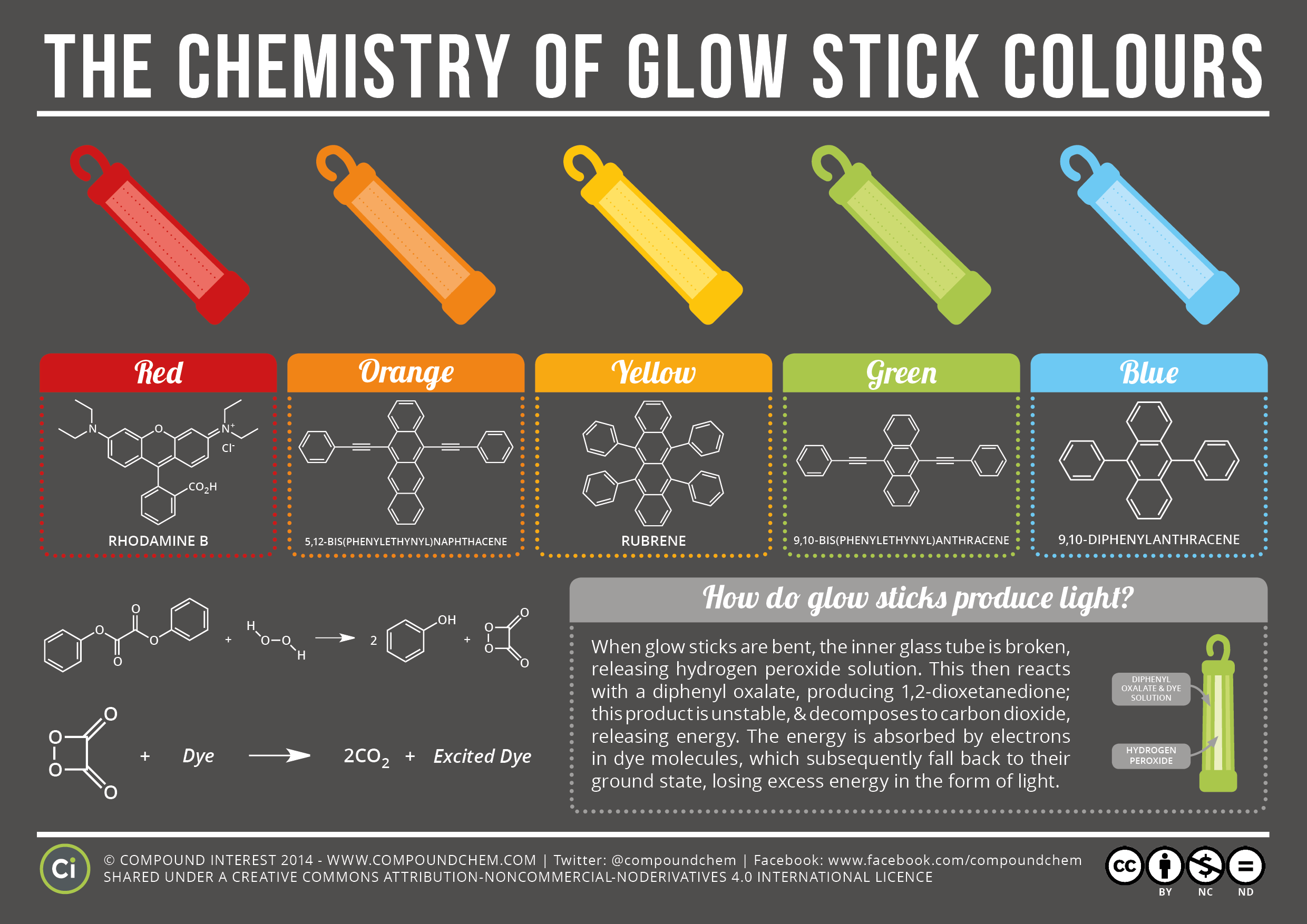
A glow stick contains two chemicals and a suitable dye. The chemicals inside the plastic tube are a mixture of the dye and diphenyl oxalate. The chemical in the glass vial is hydrogen peroxide. By mixing the peroxide with the phenyl oxalate ester, a chemical reaction takes place, yielding two molecules of phenol and one molecule of peroxyacid ester (1,2-dioxetanedione). The peroxyacid decomposes spontaneously to carbon dioxide, releasing energy that excites the dye, which then relaxes by releasing a photon. The wavelength of the photon—the color of the emitted light—depends on the structure of the dye.

As stated by the excellent article by Compound Interest, a range of different chemicals can be used, including those shown above, as well as one or two additional dyes. Whilst the molecules of the dye are always present in the solution, the hydrogen peroxide and the diphenyl oxalate are slowly used up by the reaction, until one runs out and the reaction ceases – and it’s at this point that the glow stick will stop emitting its glow.

Friday, 5 December 2014

Christmas Tree Needle Drop

It's that time of year when we think about whether to get a 'real' Christmas tree or whether to get the artificial one out of the loft to decorate.

One of the problems of real trees is needle drop.  First you have to decorate the tree without getting too many injuries from the sharp needles.  Then you have to face the task of collecting the fallen needles on the carpet as the tree slowly withers.

Scientists have looked into the problem of needle drop.

Researchers identified a plant hormone, ethylene responsible for needle loss in balsam fir. They made the discovery by placing fir branches in containers of water inside a growth chamber. After ten days the branches began to produce ethylene and three days later the needles began to drop. After 40 days, the branches were completely bare.

To test that the needle loss was in fact due to the ethylene, the researchers used two chemical compounds that interfere with this hormone: 1-MCP and AVG. After exposing the branches to one of these two products, the needle retention period rose to 73 and 87 days, respectively.


It should be possible to dissolve AVG in the water added to the tree stand, which would prolong the tree's lifespan indoors.  Any Ethylene inhibitors should work.

There are other ways to prolong the life of your tree.

Choose your tree carefully.  Norway spruce (traditional choice but with a quick needle drop rate); Nordmann fir (dark green and expensive but also boasts of a slow needle drop); Noble fir (the king of Christmas trees and again holds a better track record of needle drop than the Norway spruce); Fraser fir (excellent needle-holding properties and a lovely pine fragrance to boot and resembles the Norway spruce).

Make a new cut on the stump when you first buy it or get it home, at least an inch above the previous cut. Put the tree in water immediately, and maintain the water level. Keep temperatures in your home slightly cooler, if possible, and position the tree away from the kitchen. Also, keep fruits away from the tree as they give off ethylene. Lastly, leave the lights on at night. Being left in the dark causes a tree to respire more, using up its carbohydrates. As a result, says Dr. Raj Lada of the Christmas Tree Research Center, "it can be starved to death."

Above all else - decorate and enjoy - don't eat all the chocolates on the tree before Christmas!

For more information visit:-
http://www.sciencedaily.com/releases/2010/12/101206111450.htm
http://theweek.com/article/index/210597/why-christmas-trees-lose-their-needles