Total Lab Supplies - Everything for your laboratory

Total Lab Supplies - Everything for your laboratory
Our Head Office in St Helens

Wednesday, 28 December 2016

On this day in science history: chewing gum was patented

In 1869, William Finley Semple of Mount Vernon, Ohio, was issued the first U.S. patent for chewing gum (No. 98,304), made of "the combination of rubber with other articles adapted to the formation of an acceptable chewing gum", but he never commercially produced gum. That was done by Thomas Adams of Staten Island, N.Y., who knew that chicle, a natural tree gum, could be chewed. His first experiments to vulcanize chicle for use as a rubber substitute were unsuccessful until he boiled a small batch of chicle in his kitchen and created the first chicle-based chewing gum. Testing sales at a local store, he found people liked his gum. In 1871, Adams patented a gum-producing machine so he could increase production.

Chewing gum stick by Lusheeta, via Wikimedia Commons

Humans have used chewing gum in some form for at least 100,000 years. Modern chewing gum today is made from butadiene-based synthetic rubber. Most chewing gums are considered polymers. Longer polymers can produce larger bubbles due to increased intermolecular forces.

Chewing gum in many forms has existed since the Neolithic period. 6,000-year-old chewing gum made from birch bark tar, with tooth imprints, has been found in Kierikki in Finland. The tar from which the gums were made is believed to have antiseptic properties and other medicinal benefits. It is chemically similar to petroleum tar and is in this way different from most other early gums. The Aztecs, as the ancient Mayans before them, used chicle as a base for making a gum-like substance and to stick objects together in everyday use. Forms of chewing gums were also chewed in Ancient Greece. The Ancient Greeks chewed mastic gum, made from the resin of the mastic tree. Mastic gum, like birch bark tar, has antiseptic properties and is believed to have been used to maintain oral health. Both chicle and mastic are tree resins. Many other cultures have chewed gum-like substances made from plants, grasses, and resins.

The American Indians chewed resin made from the sap of spruce trees. The New England settlers picked up this practice, and in 1848, John B. Curtis developed and sold the first commercial chewing gum called The State of Maine Pure Spruce Gum. In this way, the industrializing West, having forgotten about tree gums, rediscovered chewing gum through the First Americans. Around 1850 a gum made from paraffin wax, which is a petroleum product, was developed and soon exceeded the spruce gum in popularity. To sweeten these early gums the chewer would often make use of a plate of powdered sugar, which they would repeatedly dip the gum into to maintain sweetness.

For more information visit:-


Monday, 19 December 2016

How the Antarctic Ice Sheet is affecting climate change

Scientists have known for decades that small changes in climate can have significant impacts on the massive Antarctic Ice Sheet.

Now a new study suggests the opposite also is true. An international team of researchers has concluded that the Antarctic Ice Sheet actually plays a major role in regional and global climate variability - a discovery that may also help explain why sea ice in the Southern Hemisphere has been increasing despite the warming of the rest of the Earth.

Results of the study are being published this week in the journal Nature.

View of the Riiser-Larsen Ice Shelf in Antarctica. By Ben Holt  (NASA), via Wikimedia Commons

Global climate models that look at the last several thousand years have failed to account for the amount of climate variability captured in the paleoclimate record, according to lead author Pepijn Bakker, a former post-doctoral researcher at Oregon State University now with the MARUM Center for Marine Environmental Studies at the University of Bremen in Germany.

The research team's hypothesis was that climate modelers were overlooking one crucial element in the overall climate system - an aspect of the ocean, atmosphere, biosphere or ice sheets - that might affect all parts of the system.

"One thing we determined right off the bat was that virtually all of the climate models had the Antarctic Ice Sheet as a constant entity," Bakker said. "It was a static blob of ice, just sitting there. What we discovered, however, is that the ice sheet has undergone numerous pulses of variability that have had a cascading effect on the entire climate system."

The Antarctic Ice Sheet, in fact, has demonstrated dynamic behavior over the past 8,000 years, according to Andreas Schmittner, a climate scientist in Oregon State's College of Earth, Ocean, and Atmospheric Sciences and co-author on the study.

"There is a natural variability in the deeper part of the ocean adjacent to the Antarctic Ice Sheet - similar to the Pacific Decadal Oscillation, or El Niño/La Niña but on a time scale of centuries - that causes small but significant changes in temperatures," Schmittner said. "When the ocean temperatures warm, it causes more direct melting of the ice sheet below the surface, and it increases the number of icebergs that calve off the ice sheet."

Those two factors combine to provide an influx of fresh water into the Southern Ocean during these warm regimes, according to Peter Clark, a paleoclimatologist in OSU's College of Earth, Ocean, and Atmospheric Sciences and co-author on the study.

"The introduction of that cold, fresh water lessens the salinity and cools the surface temperatures, at the same time, stratifying the layers of water," Clark said. "The cold, fresh water freezes more easily, creating additional sea ice despite warmer temperatures that are down hundreds of meters below the surface."

The discovery may help explain why sea ice has expanded in the Southern Ocean despite global warming, the researchers say. The same phenomenon doesn't occur in the Northern Hemisphere with the Greenland Ice Sheet because it is more landlocked and not subject to the same current shifts that affect the Antarctic Ice Sheet.

"One message that comes out of this study is that the Antarctic Ice Sheet is very sensitive to small changes in ocean temperatures, and humans are making the Earth a lot warmer than it has been," Bakker said.

Sediment cores from the sea floor around Antarctica contain sand grains delivered there by icebergs calving off the ice sheet. The researchers analyzed sediments from the last 8,000 years, which showed evidence that many more icebergs calved off the ice sheet in some centuries than in others. Using sophisticated computer modeling, the researchers traced the variability in iceberg calving to small changes in ocean temperatures.

The Antarctic Ice Sheet covers an area of more than 5 million square miles and is estimated to hold some 60 percent of all the fresh water on Earth. The east part of the ice sheet rests on a major land mass, but in West Antarctica, the ice sheet rests on bedrock that extends into the ocean at depths of more than 2,500 meters, or more than 8,000 feet, making it vulnerable to disintegration.

Scientists estimate that if the entire Antarctic Ice Sheet were to melt, global sea levels would rise some 200 feet.

Other authors on the study include Nicholas Golledge of Victoria University of Wellington in New Zealand and Michael Weber of the University of Bonn in Germany.

For more information visit:-


Tuesday, 13 December 2016

The Chemistry of Mummification

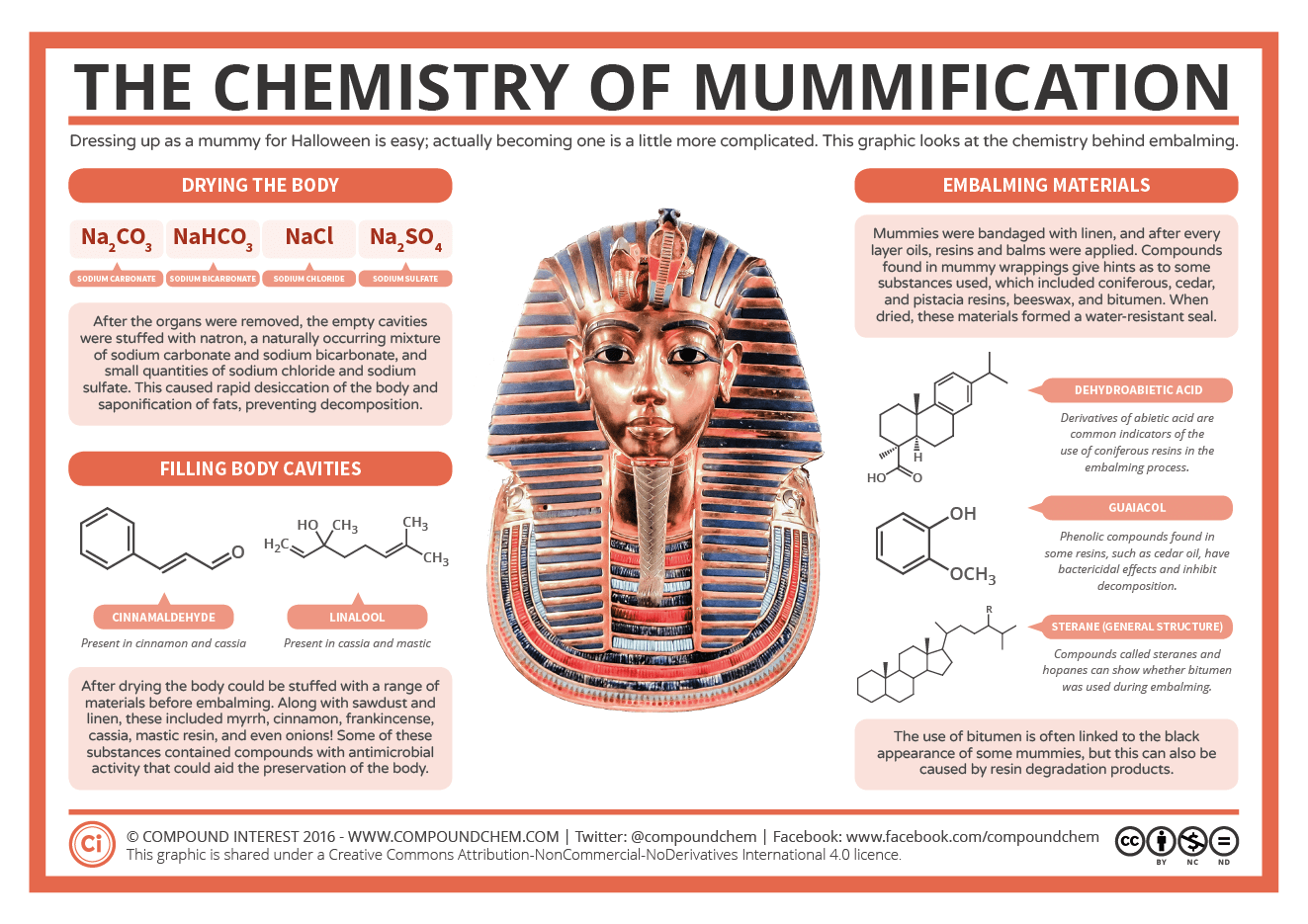
These days, when we think of the preservation of bodies, we think of cryogenics, but as we all know, the Ancient Egyptians were as fascinated with life after death as we are. Click on the infographic below to find out more about the chemistry of mummification.


It takes about 70 days to completely mummify a dead body and in Ancient Egypt there were no restrictions on who could be mummified, as long as you could pay! The Egyptians believed that when they died they would make a journey to another world where they would lead a new life. They would need all the things they had used when they were alive so their family would put those things in their grave. Egyptians paid vast amounts of money to have their bodies properly preserved. 

For more information visit:-


Wednesday, 7 December 2016

On this day in science history - Galileo spacecraft orbits Jupiter

In 1995, the Galileo spacecraft arrived at Jupiter and entered orbit after 6 years of travel including a flyby of Venus and two asteroids, Gaspra and Ida. The orbiter had also carried an atmospheric probe with scientific instruments, which it had released from the main spacecraft in July 1995, five months before reaching Jupiter. Galileo then spent a further 8 years examining Jupiter and its moons Io and Europa. 

Jupiter. By NASA, ESA, and A. Simon (Goddard Space Flight Center) [Public domain], via Wikimedia Commons
In 1994, the Galileo orbiter was present to watch the fragments of comet Shoemaker-Levy 9 crash into Jupiter. Its mission was concluded 21 September 2003 by sending the orbiter into Jupiter's atmosphere at a speed of nearly 50 km/sec, destroying it to avoid any chance of it contaminating local moons with bacteria from Earth.

Jupiter is the fifth planet from the Sun and the largest in the Solar System. It is a giant planet with a mass one-thousandth that of the Sun, but two and a half times that of all the other planets in the Solar System combined. Jupiter is a gas giant, along with Saturn, with the other two giant planets, Uranus and Neptune, being ice giants. Jupiter was known to astronomers of ancient times. The Romans named it after their god Jupiter. When viewed from Earth, Jupiter can reach an apparent magnitude of −2.94, bright enough for its reflected light to cast shadows, and making it on average the third-brightest object in the night sky after the Moon and Venus.

Jupiter is primarily composed of hydrogen with a quarter of its mass being helium, though helium comprises only about a tenth of the number of molecules. It may also have a rocky core of heavier elements, but like the other giant planets, Jupiter lacks a well-defined solid surface. Because of its rapid rotation, the planet's shape is that of an oblate spheroid (it has a slight but noticeable bulge around the equator). The outer atmosphere is visibly segregated into several bands at different latitudes, resulting in turbulence and storms along their interacting boundaries. 

A prominent result is the Great Red Spot, a giant storm that is known to have existed since at least the 17th century when it was first seen by telescope. Surrounding Jupiter is a faint planetary ring system and a powerful magnetosphere. Jupiter has at least 67 moons, including the four large Galilean moons discovered by Galileo Galilei in 1610. Ganymede, the largest of these, has a diameter greater than that of the planet Mercury.

For more information visit:-


Tuesday, 29 November 2016

How sand 'holds its breath'

Researchers in Australia have made an important discovery about how sand 'holds its breath' - specifically, how diatoms survive in the ever-changing environmental conditions of a beach. The finding has major implications for the biofuels industry.

Sand. By Siim Sepp (Own work), via Wikimedia Commons
The popular Middle Park beach in Melbourne is under the international spotlight following a world-first study by Monash University chemists who have discovered how sand 'holds its breath'.

The discovery, published in Nature Geoscience, has major implications and potential uses in the biofuels industry, according to lead authors Associate Professor Perran Cook and PhD student Michael Bourke from the Water Studies Centre, School of Chemistry.

Sand is full of algae called diatoms, but this environment is mixed about continuously so these organisms might get light one minute then be buried in the sediment with no oxygen the next.

"This is a new mechanism by which this type of algae survive under these conditions," said Associate Professor Cook.

"Our work has found that they ferment, like yeast ferments sugar to alcohol.
"In this case, the products are hydrogen and 'fats', for example, oleate, which is a component of olive oil."

Sand often has high concentrations of algae, which are highly productive and an important food source for food webs in the bay.

It is important to understand how these organisms survive in the harsh environment in which they live.

In this work, scientists present the first study of the importance of anoxic micro-algal metabolism through fermentation in permeable sediments.

They combined flow-through reactor experiments with microbiological approaches to determine the dominant contributors and pathways of dissolved inorganic carbon production in permeable sediments.

They show that micro-algal dark fermentation is the dominant metabolic pathway, which is the first time this has been documented in an environmental setting.

"The finding that hydrogen is a by-product of this metabolism has important implications for the types of bacteria present in the sediment," said Associate Professor Cook.

"It is well known that bacteria in the sediment can 'eat' hydrogen, however, these hydrogen eating bacteria may be more common than we previously thought."

For more information visit:-


Tuesday, 22 November 2016

Why Lithium-ion Batteries Catch Fire

Why have some of Samsung’s phones been catching fire? Check out the infographic below to find out.

Source: Compound Interest 

So, who invented the lithium battery? 

Lithium batteries were proposed by M Stanley Whittingham, now at Binghamton University, while working for Exxon in the 1970s. Whittingham used titanium(IV) sulfide and lithium metal as the electrodes. However, this rechargeable lithium battery could never be made practical. Titanium disulfide was a poor choice, since it has to be synthesized under completely sealed conditions. This is extremely expensive (it cost $1000 per kilo for titanium disulfide raw material in the 1970s).

When exposed to air, titanium disulfide reacts to form hydrogen sulfide compounds, which have an unpleasant odour. For this, and other reasons, Exxon discontinued development of Whittingham's lithium-titanium disulfide battery. Batteries with metallic lithium electrodes presented safety issues, as lithium is a highly reactive element; it burns in normal atmospheric conditions because of the presence of water and oxygen. As a result, research moved to develop batteries where, instead of metallic lithium, only lithium compounds are present, being capable of accepting and releasing lithium ions.

Reversible intercalation in graphite and intercalation into cathodic oxides was discovered in the 1970s by J. O. Besenhard at TU Munich. Besenhard proposed its application in lithium cells. Electrolyte decomposition and solvent co-intercalation into graphite were severe early drawbacks for battery life.

There were two main trends in the research and development of electrode materials for lithium ion rechargeable batteries. One was the approach from the field of electrochemistry centering on graphite intercalation compounds, and the other was the approach from the field of new nano-carbonaceous materials.

History described above is based on the former stand point. On the other hand, in the recent interview article concerning the first stage of scientific research activity directly related to the LIB developments, it is stated that looking at the major streams in research development, the negative-electrode of today’s lithium ion rechargeable battery has its origins in PAS (polyacenic semiconductive material) discovered by Professor Tokio Yamabe and later Shjzukuni Yata at the beginning of 1980’s. The seed of this technology, furthermore, was the discovery of conductive polymers by Professor Hideki Shirakawa and his group, and it could also be seen as having started from the polyacetylene lithium ion battery developed by MacDiarmid and Heeger et al.

For more information visit:-

Tuesday, 15 November 2016

What molecules you leave on your phone reveal about your lifestyle

We leave behind trace chemicals, molecules and microbes on every object we touch. By sampling the molecules on cell phones, researchers at University of California San Diego School of Medicine and Skaggs School of Pharmacy and Pharmaceutical Sciences were able to construct lifestyle sketches for each phone's owner, including diet, preferred hygiene products, health status and locations visited. This proof-of-concept study, published November 14 by Proceedings of the National Academy of Sciences, could have a number of applications, including criminal profiling, airport screening, medication adherence monitoring, clinical trial participant stratification and environmental exposure studies.

"You can imagine a scenario where a crime scene investigator comes across a personal object - like a phone, pen or key - without fingerprints or DNA, or with prints or DNA not found in the database. They would have nothing to go on to determine who that belongs to," said senior author Pieter Dorrestein, PhD, professor in UC San Diego School of Medicine and Skaggs School of Pharmacy and Pharmaceutical Sciences. "So we thought - what if we take advantage of left-behind skin chemistry to tell us what kind of lifestyle this person has?"

Mobile phone evolution. By Anders (Own work) , via Wikimedia Commons

In a 2015 study, Dorrestein's team constructed 3D models to illustrate the molecules and microbes found at hundreds of locations on the bodies of two healthy adult volunteers. Despite a three-day moratorium on personal hygiene products before the samples were collected, the researchers were surprised to find that the most abundant molecular features in the skin swabs still came from hygiene and beauty products, such as sunscreen.

"All of these chemical traces on our bodies can transfer to objects," Dorrestein said. "So we realized we could probably come up with a profile of a person's lifestyle based on chemistries we can detect on objects they frequently use."

Thirty-nine healthy adult volunteers participated in Dorrestein's latest study. The team swabbed four spots on each person's cell phone - an object we tend to spend a lot of time touching - and eight spots on each person's right hand, for a total of nearly 500 samples. Then they used a technique called mass spectrometry to detect molecules from the samples. They identified as many molecules as possible by comparing them to reference structures in the GNPS database, a crowdsourced mass spectrometry knowledge repository and annotation website developed by Dorrestein and co-author Nuno Bandeira, PhD, associate professor at the Jacobs School of Engineering and Skaggs School of Pharmacy and Pharmaceutical Sciences at UC San Diego.

With this information, the researchers developed a personalized lifestyle "read-out" from each phone. Some of the medications they detected on phones included anti-inflammatory and anti-fungal skin creams, hair loss treatments, anti-depressants and eye drops. Food molecules included citrus, caffeine, herbs and spices. Sunscreen ingredients and DEET mosquito repellant were detected on phones even months after they had last been used by the phone owners, suggesting these objects can provide long-term composite lifestyle sketches.

"By analyzing the molecules they've left behind on their phones, we could tell if a person is likely female, uses high-end cosmetics, dyes her hair, drinks coffee, prefers beer over wine, likes spicy food, is being treated for depression, wears sunscreen and bug spray - and therefore likely spends a lot of time outdoors - all kinds of things," said first author Amina Bouslimani, PhD, an assistant project scientist in Dorrestein's lab. "This is the kind of information that could help an investigator narrow down the search for an object's owner."

There are limitations, Dorrestein said. First of all, these molecular read-outs provide a general profile of person's lifestyle, but they are not meant to be a one-to-one match, like a fingerprint. To develop more precise profiles and for this method to be more useful, he said more molecules are needed in the reference database, particularly for the most common foods people eat, clothing materials, carpets, wall paints and anything else people come into contact with. He'd like to see a trace molecule database on the scale of the fingerprint database, but it's a large-scale effort that no single lab will be able to do alone.

Moving forward, Dorrestein and Bouslimani have already begun extending their study with an additional 80 people and samples from other personal objects, such as wallets and keys. They also hope to soon begin gathering another layer of information from each sample - identities of the many bacteria and other microbes that cover our skin and objects. In a 2010 study, their collaborator and co-author, Rob Knight, PhD, professor in the UC San Diego School of Medicine and Jacobs School of Engineering and director of the Center for Microbiome Innovation at UC San Diego, contributed to a study in which his team found they could usually match a computer keyboard to its owner just based on the unique populations of microbes the person left on it. At that time, they could make the match with a fair amount of accuracy, though not yet precisely enough for use in an investigation.

Beyond forensics, Dorrestein and Bouslimani imagine trace molecular read-outs could also be used in medical and environmental studies. For example, perhaps one day physicians could assess how well a patient is sticking with a medication regimen by monitoring metabolites on his or her skin. Similarly, patients participating in a clinical trial could be divided into subgroups based on how they metabolize the medication under investigation, as revealed by skin metabolites - then the medication could be given only to those patients who can metabolize it appropriately. Skin molecule read-outs might also provide useful information about a person's exposure to environmental pollutants and chemical hazards, such as in a high-risk workplace or a community living near a potential pollution source.

For more information visit: