Total Lab Supplies - Everything for your laboratory

Total Lab Supplies - Everything for your laboratory
Our Head Office in St Helens

Friday, 3 August 2012

Mars Rover Curiosity

On 5th August NASA's Mars Rover Curiosity will begin it's descent to the red planets surface.  It will land in a way never attempted before.


The spacecraft has been designed to steer itself during descent through Mars’ atmosphere with a series of S-curve maneuvers similar to those used by astronauts piloting NASA space shuttles. During the three minutes before touchdown, the spacecraft slows its descent with a parachute, then uses retro rockets mounted around the rim of an upper stage. In the final seconds, the upper stage acts as a sky crane, lowering the upright rover on a tether to the surface.


Curiosity is about twice as long (about 3 meters or 10 feet) and five times as heavy as NASA’s twin Mars Exploration Rovers, Spirit and Opportunity, launched in 2003. It inherited many design elements from them, including six-wheel drive, a rocker-bogie suspension system and cameras mounted on a mast to help the mission’s team on Earth select exploration targets and driving routes. Unlike earlier rovers, Curiosity carries equipment to gather samples of rocks and soil, process them and distribute them to onboard test chambers inside analytical instruments.


Also for an excellent little video animation showing the landing visit :-


"Entry, descent and landing is referred to as the 'seven minutes of terror' because we've got literally seven minutes to get from the top of the atmosphere to the surface of Mars, going from 13,000 miles an hour to zero in perfect sequence, perfect choreography and perfect timing, and the computer has to do it all by itself with no help from the ground," said Adam Steltzner, a NASA engineer, in a video interview. "If any one thing doesn't work just right, it's game-over."


Friday, 20 July 2012

What is Temperature?


Introduction

The accurate measurement of temperature is vital across a broad spectrum of human activities, including industrial processes (e.g. making steel), manufacturing; monitoring (in food transport and storage), and in health and safety. In fact, in almost every sector, temperature is one of the key parameters to be measured.

King of Poland

History of Thermometry

The means of accurately measuring temperatures has long fascinated people. One of the differences between temperature and other physical concepts, such as mass or length, is that it is subjective: different people will have different perceptions of what is hot and what is cold. To make objective measurements, we must use a thermometer in which some physical property of a substance changes with temperature in a reliable and reproducible way.
Thermoscopes, the ancestors of modern thermometers, have been around since about 200 BC. The first recognisable, modern thermometers were made in the 16th century by both the Italian Galileo Galilei and Santorio Santorio, a physician to the King of Poland. The latter produced a thermometer incorporating a scale, and his writings show that he understood the importance of the temperature measurement in the diagnosis of disease. The first sealed thermometer was made by the Grand Duke Ferdinand of Tuscany in 1641. This thermometer was more accurate than its predecessors since it wasn’t dependent on atmospheric pressure. Later, the scientists Fahrenheit and Celsius both made glass thermometers containing mercury, and used reference points (the melting point of pure ice and the boiling point of water) to improve the accuracy.


Types of Thermometer

Liquid-in-Glass

Liquid-in-glass, in particular mercury, thermometers have been used for almost 300 years in science, medicine, metrology and in industry. They rely on the expansion of a fluid with temperature. The fluid is contained in a sealed glass bulb and the temperature is read using a scale etched along the stem of the thermometer.


Platinum Resistance

In the modern world, mercury and spirit-filled thermometers have largely given way to electrical devices, which can be digitised and automated. Platinum resistance thermometers are electrical thermometers which make use of the variation of resistance of high-purity platinum wire with temperature. This variation is predictable, enabling accurate measurements to be performed. They are sensitive and, with sophisticated equipment, measurements, can routinely be made to better than a thousandth part of 1°C

Thermocouples

Thermocouples are the most common sensors in industrial use. They have a long history, the original paper on thermoelectricity by Seebeck being published in 1822. They consist of two dissimilar metallic conductors joined at the point of measurement. When the conductors are heated a voltage is generated in the circuit, and this can be used to determine the temperature

Radiation (or Pyrometers)

Radiation thermometers, or pyrometers, make use of the fact that all objects emit thermal radiation, as seen when looking at the bars of an electric fire or a light bulb. The amount of radiation emitted can be measured and related to temperature using the Planck law of radiation. Temperatures can be measured remotely using this technique, with the sensor situated some distance away from the object. Hence it is useful for objects that are very hot, moving or in hazardous environments

Temperature Scales

The two temperature scales commonly in use today date from the eighteenth century and are named after Gabriel Daniel Fahrenheit and the Swedish astronomy professor Anders Celsius. Fahrenheit designed his scale to have two reference points that could be set up in his workshop. He originally chose the melting point of pure ice and the temperature of a normal human body, which he took as being 32° and 96° respectively. These conveniently gave positive values for all the temperatures he encountered. Later he changed to using the boiling point of water (212°) as the upper fixed point of the scale.
Celsius also used the ice and steam points, but took them to be 0°C and 100°C respectively. Although the Celsius scale has taken precedence over the Fahrenheit scale, the latter is still familiar in weather reports in the United Kingdom: a summer’s day temperature of 75°F seems much more pleasant than one of 23°C!
A third, fundamental, temperature scale was proposed in 1854 by the Scottish physicist William Thomson, Lord Kelvin. It is based on the idea of the absolute zero, the point of no discernible energy, which is independent of any particular material substance. The Kelvin scale is widely used by physicists and engineers to determine and apply fundamental laws of thermodynamics

The International Temperature Scale of 1990 (ITS-90)

Since 1954 the unit of (thermodynamic) temperature has been defined as the kelvin, and is the fraction 1/273.16 of the thermodynamic temperature of the triple point of water. This is the unique temperature and pressure at which the three phases of water (solid, liquid and vapour) co-exist in equilibrium. It is fractionally higher than the melting point, being 0.01°C or 273.16 K. From this single point it is possible to generate a thermodynamic temperature scale using gas thermometers and radiation thermometers which accurately obey known laws.
Such experiments are not easy and are rarely done, but good values have been established for a series of fixed points: freezing points of pure metals at high temperatures and triple points of gases at low temperatures. These are incorporated into the International Temperature Scale so that standard platinum resistance thermometers and radiation thermometers can be calibrated with excellent reproducibility. The National Physical Laboratory maintains the temperature scale (currently the International Temperature Scale of 1990, the ITS-90) in the UK, and compares this with the ITS-90 maintained in other national laboratories. In this way temperature standards around the world can be accurately equivalent, and all manner of thermometers can be reliably calibrated for everyday use.

Future of Thermometry

The international temperature community is working towards a redefinition of the kelvin. This would be based on a fundamental constant of nature known as the Boltzmann constant. The advantages of this is that the new definition would be freed from any physical artefact (i.e. the triple point of water) and allow the use of any appropriate thermodynamic method for temperature measurement.

The Spectrum of Temperature


Fusion200 million °CThe Joint European Torus (JET) nuclear fusion project, Culham Oxfordshire
Sun15 million °CTemperature of the centre of the Sun
Sun6 000 °CTemperature of the surface of the Sun
Molten Glass1 200 °C to 1 500 °CMolten glass / steel
Molten Gold1 064 °CMelting point of gold
Kettle100 °CBoiling point at one atmosphere of pressure
Snowman0 °CFreezing point of pure water at one atmosphere of pressure
Penguin- 89.2 °CAll time coldest point on earth
Cryogenic Storage- 196 °CCryogenic storage in liquid nitrogen
Cosmos- 270 °CCosmic background radiation


For more information visit www.npl.co.uk

Friday, 6 July 2012

Large Hadron Collider? Higgs-Boson? What's it all about?


The Large Hadron Collider

Our understanding of the Universe is about to change...

The Large Hadron Collider (LHC) is a gigantic scientific instrument near Geneva, where it spans the border between Switzerland and France about 100m underground. It is a particle accelerator used by physicists to study the smallest known particles – the fundamental building blocks of all things. It will revolutionise our understanding, from the minuscule world deep within atoms to the vastness of the Universe.

Two beams of subatomic particles called "hadrons" – either protons or lead ions – travel in opposite directions inside the circular accelerator, gaining energy with every lap. Physicists use the LHC to recreate the conditions just after the Big Bang, by colliding the two beams head-on at very high energy. Teams of physicists from around the world then analyse the particles created in the collisions using special detectors in a number of experiments dedicated to the LHC.

There are many theories as to what will result from these collisions. For decades, the Standard Model of particle physics has served physicists well as a means of understanding the fundamental laws of Nature, but it does not tell the whole story. Only experimental data using the high energies reached by the LHC can push knowledge forward, challenging those who seek confirmation of established knowledge, and those who dare to dream beyond the paradigm.

How the LHC works


The LHC, the world’s largest and most powerful particle accelerator, is the latest addition to CERN’s accelerator complex. It mainly consists of a 27-kilometre ring of superconducting magnets with a number of accelerating structures to boost the energy of the particles along the way.

Inside the accelerator, two beams of particles travel at close to the speed of light with very high energies before colliding with one another. The beams travel in opposite directions in separate beam pipes – two tubes kept at ultrahigh vacuum. They are guided around the accelerator ring by a strong magnetic field, achieved using superconducting electromagnets. These are built from coils of special electric cable that operates in a superconducting state, efficiently conducting electricity without resistance or loss of energy. This requires chilling the magnets to about ‑271°C – a temperature colder than outer space. For this reason, much of the accelerator is connected to a distribution system of liquid helium, which cools the magnets, as well as to other supply services.

Thousands of magnets of different varieties and sizes are used to direct the beams around the accelerator. These include 1232 dipole magnets of 15m length which are used to bend the beams, and 392 quadrupole magnets, each 5–7m long, to focus the beams. Just prior to collision, another type of magnet is used to "squeeze" the particles closer together to increase the chances of collisions. The particles are so tiny that the task of making them collide is akin to firing needles from two positions 10km apart with such precision that they meet halfway!


All the controls for the accelerator, its services and technical infrastructure are housed under one roof at the CERN Control Centre. From here, the beams inside the LHC are made to collide at four locations around the accelerator ring, corresponding to the positions of the particle detectors.

Higgs within reach


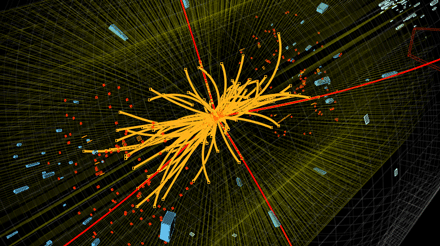
Proton-proton collision in the CMS experiment producing four high-energy muons (red lines). The event shows characteristics expected from the decay of a Higgs boson but it is also consistent with background Standard Model physics processes (Image: CMS)

At a seminar on 4 July, the ATLAS and CMS experiments at CERN presented their latest results in the search for the long-sought Higgs boson. Both experiments see strong indications for the presence of a new particle, which could be the Higgs boson, in the mass region around 126 gigaelectronvolts (GeV).

Both ATLAS and CMS gave the level of significance of the result as 5 sigma on the scale that particle physicists use to describe the certainty of a discovery. One sigma means the results could be random fluctuations in the data, 3 sigma counts as an observation and a 5-sigma result is a discovery. The results presented today are preliminary, as the data from 2012 is still under analysis. The complete analysis is expected to be published around the end of July.

The Higgs field has been likened to a kind of cosmic "treacle" spread through the universe.

According to Prof Higgs's theory, the field interacts with the tiny particles that make up atoms, and weighs them down so that they don’t just whizz around space at the speed of light.

Since then people have been trying to prove that the Higgs Field really exists.

Prof Higgs predicted that the field would have a signature particle, a massive boson which is what CERN have identified.

Visit http://public.web.cern.ch/public/ for more details.

Friday, 29 June 2012

Uses of Sodium Hydrogen Carbonate (Bicarbonate of Soda)

The number of chemicals in the home abound. Chemistry is at work in the bathroom, kitchen, laundry and medicine cabinet. Sodium bicarbonate is a most useful, versatile and cheaply available substance used in the home and for personal use.
Sodium bicarbonate is obtained by chemical process called the Solvay Process, or more directly by extraction from the ore. It is mildly alkaline and has a wide range of applications.
Sodium bicarbonate has the chemical formula CHNaO3. It is known under different household names: baking soda, sodium bicarb or bicarb soda, etc. but better known to chemists as sodium bicarbonate, bicarbonate of soda, sodium hydrogen carbonate, and sodium acid carbonate.
History of Production
The ancient Egyptians first mined the natural deposit called natron, which contains mostly sodium bicarbonate. The mixture was used as a cleansing agent such as soap. It was not until 1791 in France that Leblanc artificially manufactured sodium bicarbonate as we know it today. Later, in 1846, two bakers Dwight and Church refined the process of making baking soda from sodium carbonate and carbon dioxide. The ammonia-soda process was developed into its modern form by Ernest Solvay during the 1860s.
Baking soda is mainly prepared from the Solvay Process. However, commercial quantities are also produced from soda ash of the ore trona, which is dissolved in water and treated with carbon dioxide. Sodium bicarbonate then precipitates as a solid. The main reaction is:
Na2CO3 + CO2 + H2O -> 2NaHCO3
Key Properties
Sodium bicarbonate has a number of interesting properties, which makes it so versatile and useful:
  • Odourless, white crystalline solid or powder
  • Slightly alkaline in solution
  • Sparingly soluble in water
  • Decomposes to sodium carbonate and carbon dioxide on heating
  • Has relatively low toxicity
  • Non-flammable
  • The powder dust is not explosive

Applications of Baking Soda
Baking soda is a weak base and therefore not a powerful detergent compared to a strong alkali which breaks down fat. However, it does remove dirt with the properties already alluded to. In order to prevent any alkali from damaging your skin, rubber gloves should be worn.
For the Home:
  • Cleaning agent - fridges, garbage disposals, etc.
  • Water softener – use in washing machines and for washing dishes
  • Deodorizing - shoes, footwear cupboards, carpet refresher
  • Fire extinguisher – forms a smothering soapy foam
  • Polishing - removes dirt without damaging high hardness materials such as stainless steel or iron
  • Mixed with sugar - acts as an effective pesticide for cockroaches and silverfish
In the Kitchen:
  • Baking – used as a leavening agent, the carbon dioxide generated makes the dough rise
  • Cooking – quickly softens vegetables such as french beans and broccoli
For Care of the Body:
  • Use as a teeth whitener - brush teeth with a paste of bicarb soda and water
  • Sodium bicarbonate ear drops
  • Stomach reliever - spoonful in cool glass of water
  • Eczema reliever - half-cup in hot bath from 15 to 20 minutes
  • Also good for the throat, painful gums, insect bites, and warts
  • Use in cosmetics and personal care products
For Emergencies:
Sodium bicarbonate can neutralise or reduce acids in the blood, or urine. It may be used in emergency medical situations (heart attacks, serious kidney or lung problems) to correct the normal acid-base balance in the blood or as an aid in treating overdoses with certain types of medications.
Impurities in Sodium Bicarbonate
Sodium bicarbonate is a very versatile substance and the list of uses given is by no means exhaustive, but represents some of the better known uses. People should be aware that when using for medicinal purposes, producer's baking soda contains traces of aluminium.  P&R Labpak recommend you seek medical and/or other advice before using such a product for any kind of personal use.

Kitchen Cleaning
  • Place an open box or small open container of bicarbonate of soda in the refrigerator or pantry to absorb odours. Replace every three months.
  • Eliminate odours in dishwashers by running a cycle without any dishes once a week with bicarb soda in the soap dispenser and vinegar in the rinse-aid compartment. Sprinkle a handful in the bottom of the dishwasher between loads. It will reduce odours and act as an additional cleanser for the next wash.
  • Clean tannin-stained tea and coffee mugs by sprinkling some bi-carb soda on a damp cloth and rubbing gently.
  • For saucepans that cannot be cleaned with scourers, add cold water and one to two tablespoons of bicarb soda. Bring to the boil and simmer for a few minutes. Empty water from pan and use a steel scourer to remove any residue (ensuring saucepan has had time to cool sufficiently to handle safely).
  • To eliminate odours and reduce drain blockages, put half a cup of bi-carb soda and half a cup of vinegar down the kitchen sink drain. Leave for at least an hour then rinse with boiling water (use hot water only for plastic pipes).

Using Bicarbonate of Soda in the Laundry
  • Dissolve two to three tablespoons of bicarb soda in a bucket of warm water to pre-soak cloth nappies and/or items with mould or stubborn stains. Allow to soak, then wash items in warm soapy water and dry in the sun.
  • As a natural laundry whitener, use 2 teaspoons of bicarb soda in half a bucket of cold water. Soak items for 30 minutes then wash as usual.
  • Add half a cup to the washing machine for the rinse cycle to keep clothing and linen fresh.
General Cleaning with Sodium Bicarbonate
  • Sprinkle sodium bicarbonate into smelly sports shoes and leave for a few days to reduce foot odour.
  • Make a paste with three parts sodium bicarbonate to one part water (adjust to suit individual needs). Use as an alternative to other paste cleansers.
  • Sprinkle carpets with sodium bicarbonate, leave for a few minutes, then vacuum as usual to help eliminate household odours. This also works on pet bedding and car upholstery. Sprinkle and leave for 15 minutes before vacuuming.
  • Freshen children’s stuffed toys by sprinkling with bicarb soda. Leave for 15 minutes, then brush off residue.

Thursday, 21 June 2012

Data From NASA's Voyager 1 Point to Interstellar Future


Voyager 1 reaching Interstellar Future


This artist's concept shows NASA's two Voyager spacecraft exploring a turbulent region of space known as the heliosheath, the outer shell of the bubble of charged particles around our sun. Image credit: NASA/JPL-Caltech

Artist concept of NASA's Voyager spacecraft

Artist concept of NASA's Voyager spacecraft. Image credit: NASA/JPL-Caltech

Data from NASA's Voyager 1 spacecraft indicate that the venerable deep-space explorer has encountered a region in space where the intensity of charged particles from beyond our solar system has markedly increased. Voyager scientists looking at this rapid rise draw closer to an inevitable but historic conclusion – that humanity's first emissary to interstellar space is on the edge of our solar system.

"The laws of physics say that someday Voyager will become the first human-made object to enter interstellar space, but we still do not know exactly when that someday will be," said Ed Stone, Voyager project scientist at the California Institute of Technology in Pasadena. "The latest data indicate that we are clearly in a new region where things are changing more quickly. It is very exciting. We are approaching the solar system's frontier."

The data making the 16-hour-38 minute, 11.1-billion-mile (17.8-billion-kilometer), journey from Voyager 1 to antennas of NASA's Deep Space Network on Earth detail the number of charged particles measured by the two High Energy telescopes aboard the 34-year-old spacecraft. These energetic particles were generated when stars in our cosmic neighborhood went supernova.

"From January 2009 to January 2012, there had been a gradual increase of about 25 percent in the amount of galactic cosmic rays Voyager was encountering," said Stone. "More recently, we have seen very rapid escalation in that part of the energy spectrum. Beginning on May 7, the cosmic ray hits have increased five percent in a week and nine percent in a month."

This marked increase is one of a triad of data sets which need to make significant swings of the needle to indicate a new era in space exploration. The second important measure from the spacecraft's two telescopes is the intensity of energetic particles generated inside the heliosphere, the bubble of charged particles the sun blows around itself. While there has been a slow decline in the measurements of these energetic particles, they have not dropped off precipitously, which could be expected when Voyager breaks through the solar boundary.

The final data set that Voyager scientists believe will reveal a major change is the measurement in the direction of the magnetic field lines surrounding the spacecraft. While Voyager is still within the heliosphere, these field lines run east-west. When it passes into interstellar space, the team expects Voyager will find that the magnetic field lines orient in a more north-south direction. Such analysis will take weeks, and the Voyager team is currently crunching the numbers of its latest data set.

"When the Voyagers launched in 1977, the space age was all of 20 years old," said Stone. "Many of us on the team dreamed of reaching interstellar space, but we really had no way of knowing how long a journey it would be -- or if these two vehicles that we invested so much time and energy in would operate long enough to reach it.”

Launched in 1977, Voyager 1 and 2 are in good health. Voyager 2 is more than 9.1 billion miles (14.7 billion kilometers) away from the sun. Both are operating as part of the Voyager Interstellar Mission, an extended mission to explore the solar system outside the neighborhood of the outer planets and beyond. NASA's Voyagers are the two most distant active representatives of humanity and its desire to explore.

The Voyager spacecraft were built by NASA's Jet Propulsion Laboratory in Pasadena, Calif., which continues to operate both. JPL is a division of the California Institute of Technology. The Voyager missions are a part of the NASA Heliophysics System Observatory, sponsored by the Heliophysics Division of the Science Mission Directorate in Washington.

More information about Voyager is available at: http://www.nasa.gov/voyager

Friday, 15 June 2012

Atomic Timekeeping

Atomic Timekeeping (A fantastic fact sheet from the NPL - National Physical Laboratory)

Check out their website for more great factsheets - www.npl.co.uk

Introduction

The spinning Earth gives our most basic measurement of time - the day - and for thousands of years it was our most stable timekeeper.
However, the quartz and atomic clocks invented during the 1930s and 1950s are even better timekeepers which show that the Earth does not rotate steadily but wobbles!
NPL built the world's first working caesium atomic clock in 1955 and paved the way for a new and better definition of the second based on the fundamental properties of atoms.
Electron Energy
Electron energy levels

How an Atomic Clock Works (Theory)

The atom can be pictured as a mini solar system, with the heavy nucleus at the centre surrounded by electrons in a variety of different orbits.
The orbits correspond to energy levels, and electrons can only move between levels when they absorb or release just the right amount of energy.
This energy is absorbed or released in the form of electromagnetic radiation, the frequency of which depends on the difference in energy between the two levels.
This transition is the source of the term "quantum jump", quantum referring to the tiny but precise amount of energy needed to allow the electron to jump to a different level.
By measuring the frequency of the electromagnetic radiation, like counting the number of pendulum swings on a pendulum, we can measure the passage of time.

How Long is a Second?

The second is the duration of 9 192 631 770 periods of the radiation corresponding to the transition between the two hyperfine levels of the ground state of the caesium 133 atom.
Satellite
Satellite

How do you Keep Time Around the World?

Everyone around the world needs to keep to an agreed timescale.
On the 1st January 1972, Coordinated Universal Time (UTC) was adopted as the official time for the world.
The International Bureau of Weights and Measures (BIPM) acts as the official time keeper of atomic time for the world.
There are 65 laboratories with over 230 clocks contributing to the international timescale.
As BIPM counts the seconds astronomers still continue to measure time by the rotation of the Earth about its axis. This is compared to UTC, and if these measurements differ by more than 0.9 seconds a leap second is added or subtracted to keep the timescales together.

Quantum Standards

Quantum standards are based on fundamental properties of matter.
In the case of the atomic clock this is the energy released when electrons move between energy levels of a caesium atom.
Using the movement of the Earth to define the second is a problem because this varies unpredictably with time, so the length of a second defined this way would not be constant.
But quantum standards, as far as we know, will be stable forever, no matter when or where it is measured.
Thousands of years in the future, or in a distant galaxy, the energy levels of the caesium atom are exactly the same, and so is the length of the second defined in this way.
Aeroplane
Aeroplane navigation

Why do we Need the Accuracy of Atomic Clocks?

Time measurement has become a basic part of everyday life and accuracies of the nearest minute or a few seconds are usually good enough for most human activities, but highly accurate timing plays a vital role in many other aspects of the modern world.
The Global Positioning System (GPS) satellites broadcast timing signals from onboard atomic clocks, which enable land vehicles, shipping and aircraft to know their location within a few metres.
Other people making use of GPS include ecologists tracking the movements of rare animals, prospectors, surveyors, mountaineers, and the search and rescue teams if any of these pursuits go wrong.
Research is underway to make specialist location systems accurate to within millimetres.

Access to the national time scale, UTC(NPL)

NPL has been disseminating the UK national time scale from a transmitter at Rugby since 1950. The signal now comes from Anthorn in Cumbria.
This transmitter, which has the call sign MSF, operates 24 hours a day at a frequency of 60 kHz; transmissions can be received as far away as Iceland and Gibraltar.
Alternatively you can connect to the NPL timescale over the internet from anywhere in the world, and set your PC or Mac to UTC(NPL).
Visit our Computer Time Services page.
Caesium Fountain
The Caesium fountain

How an Atomic Clock Works (Practice)

In 1955 Louis Essen built the world's first caesium atomic clock at NPL.
Today a new form of atomic clock, the caesium fountain, is being used. In this clock, a cloud of atoms is projected up into a microwave chamber and allowed to fall down under gravity.
The fountain uses laser beams to slow down the atoms.
The slow movement of the atoms allows a more accurate measurement of the transition between energy levels and hence the frequency of radiation.
Ion Trap
The Ion Trap

The Next Generation

Clocks for the 21st century are being developed in the form of ion traps.
Ions are charged atoms which can be trapped by electromagnetic fields almost indefinitely. Once trapped a laser beam can then be used to cool the ion down close to absolute zero, keeping it stationary.
At NPL the element strontium has been chosen to develop ion trap clocks as its ions can have very stable states. These clocks may have accuracies of around 1000 times higher than the best current atomic clocks.
That is equivalent to losing no more than one second in the lifetime of the universe.

The Timeline


Sundial3500BC: Sundials
Pendulum Clock17th Century: Pendulum clocks± 10 seconds per day
Harrison's Chronometer1762: Harrison's chronometer± 2 seconds per day
Earth1930s: Earth's rotaton± 1 second in 3 yrs
Quartz1930s: Quartz± 1 second in 30 yrs
Essen Atomic Clock1955: Essen with original atomic clock± 1 second in 300 yrs
1980s: Improved atomic clocks± 1 second in 300 000 yrs
Caesium Fountain2004: Caesium fountain± 1 second in 60 million yrs
 

Thursday, 7 June 2012

Laboratory Plasticware-Physical properties and chemical resistance

The link below is a table showing the physical properties and chemical resistance of plastics including its care and maintenance. Click here.