Total Lab Supplies - Everything for your laboratory

Total Lab Supplies - Everything for your laboratory
Our Head Office in St Helens

Friday, 19 October 2012

What is Supersonic Flight?


What Is Supersonic Flight?


A speeding bullet
A bullet fired from a gun travels at supersonic speeds. This picture shows a bullet and the air flowing around it. The bullet is traveling at 1.5 times the speed of sound. Image Credit: Andrew Davidhazy/Rochester Institute of TechnologyView Larger Image
Supersonic flight is one of the four speeds of flight. Objects moving at supersonic speeds are going faster than the speed of sound.

The speed of sound is about 768 miles per hour at sea level. That is about four times faster than a racecar.

Supersonic includes speeds up to five times faster than the speed of sound!

The first person to fly an aircraft faster than the speed of sound was Capt. Charles E. "Chuck" Yeager.


What Flies at Supersonic Speeds?

A bullet fired from a gun flies at supersonic speeds. Some military aircraft also fly this fast. The space shuttle flies at supersonic speeds during parts of its mission.

The most famous airplane to fly passengers at supersonic speeds was called the Concorde. The Concorde's fastest speed was more than twice the speed of sound. It could fly people from London, England, to New York in less than 3 1/2 hours. A regular airplane would take twice that long! The Concorde stopped flying in 2003.
An F/A-18 Hornet aircraft flying through a white cloud
An F/A-18 Hornet aircraft speeds up to supersonic speed. The Hornet is flying through an unusual cloud. This kind of cloud sometimes forms as aircraft break the sound barrier. Credit: Ensign John Gay, USS Constellation, U.S. NavyView Larger Image →


Why Does NASA Study Supersonic Flight?

Learning more about supersonic flight helps NASA make better aircraft and spacecraft. When NASA studies supersonic flight, it is studying aeronautics. Aeronautics is the science of flight.


How Does NASA Study Supersonic Flight?

One way NASA learns more about supersonic flight is by testing models of airplanes in wind tunnels.

Wind tunnels are tube-shaped buildings that move air over a vehicle as if it were flying. Flying model airplanes in wind tunnels helps NASA learn how the real aircraft will fly. In wind tunnels, NASA can test new designs for airplanes.

NASA also studies supersonic flight by flying real supersonic aircraft.

Another way NASA learns about it is by using computers. Computers help scientists test what will happen to a plane when it flies.
A computerized simulation of a modified F-15
One way NASA learns about supersonic flight is through computer simulations. Image Credit: NASA


What Is a Sonic Boom?

A sonic boom is a loud noise like thunder. A person on the ground hears a sonic boom when an aircraft flies overhead at supersonic speeds.

The noise is caused by a fast release of air pressure. Air pressure builds up as a plane flies through the air. When the pressure is released, it makes a loud noise. This is similar to when a balloon pops. A pin that pops a balloon releases the air pressure inside the balloon and causes a loud "pop."

NASA is studying and testing things that could be used on aircraft to lessen the noise from sonic booms.


For more information visit the NASA website.

Friday, 12 October 2012

Travelling at the Speed of Sound

RedBullStratos Mission
Felix Baumgartner

Is it really possible for a human being to break the speed of sound in freefall?
If calculations prove to be accurate, and Felix Baumgartner is successful in his attempts to control his position, he will accelerate from standstill to the speed of sound - that's 0 to approximately 690 miles per hour in 40 seconds or less.
What does it mean to "break the speed of sound"?
Breaking the speed of sound refers to catching up with - and surpassing - the speed at which sound waves are produced in the air. The speed of sound is affected by temperature: where the air is colder, sound travels more slowly. At about 100,000 feet above sea level, Felix Baumgartner will need to accelerate to about 690 miles per hour to match the speed of sound, known as Mach 1. Then if he continues to accelerate and surpasses the speed of sound, he'll be "supersonic."
Is there really a sound "barrier"?
No, it's a figure of speech. The concept stems from the mid-20th century, when early high-speed aircraft sometimes experienced extreme instability, and even broke up, as they neared the speed of sound. Today we know that such instability is caused by shock waves that build up in the "transonic" zone - the range of speeds approaching the speed of sound. Sometimes shock waves even collide with each other, a phenomenon known as the "shock-shock interaction," creating results that can be similar to an explosion. Fortunately, the impact of shock waves becomes less severe with higher altitude, because air becomes less dense. And once an object passes through that imaginary "sound barrier" to catch up with and surpass the speed of sound, flight is smooth.
What other hazards will Felix Baumgartner face as he attempts to break the speed of sound?
The list includes temperatures well below freezing, too little oxygen to breathe, the tendency to spin uncontrollably and air pressure so low that without protection blood is said to "boil" with vapor bubbles.
What will protect Felix Baumgartner from these hazards?
Strategies include intensive training to prepare him for possible instability: the team has developed agraduated, multi-stage test program in which he jumps from successively higher outdoor altitudes, as well as a choreographed step-off from the capsule so that he achieves a streamlined position. Equipment is also important: an innovative full-pressure suit and helmet provide oxygen, protection and pressurization, and a special drogue parachute is available for stabilization if necessary.

Why won't Felix reach terminal velocity before he breaks the speed of sound?
Terminal velocity, a concept familiar to skydivers, refers to the point at which a falling object stops accelerating. Drag, or resistance, is one of the key factors causing terminal velocity. Bailing out at a very high altitude, where the air is thin, should enable Felix to break the speed of sound before reaching more dense air that will create drag and eventually result in his terminal velocity. Still, he'll want to streamline his body as quickly as possible to aid his acceleration.
How will we know that Felix has broken the speed of sound?
Equipment in Felix's chest pack will capture and record the necessary data for review by the mission team as well as by the Fédération Aéronautique Internationale world governing body.

What can be learned by breaking the speed of sound in freefall?
The data gathered about the effects of supersonic freefall can provide valuable tools for researchers looking to develop safety procedures for the pilots and astronauts of today and tomorrow -and for future space tourists. Proof that a human can break the speed of sound in freefall could provide support for the development of sub-orbital bailout procedures that currently don't exist. In noting that the Red Bull Stratos team will be capturing as much physiological and environmental data as possible, medical director Jon Clark says: "We try to anticipate as much as we can about supersonic speed, but we really don't know, because nobody has done this before."
 

Red Bull Stratos, a mission to the edge of space, will attempt to transcend human limits that have existed for 50 years. Supported by a team of experts Felix Baumgartner plans to ascend to 120,000 feet in a stratospheric balloon and make a freefall jump rushing toward earth at supersonic speeds before parachuting to the ground. His attempt to dare atmospheric limits holds the potential to provide valuable medical and scientific research data for future pioneers.

Visit http://www.redbullstratos.com/ for more information.
Next expected launch date, weather permitting is Sunday October 14th 2012.

Friday, 5 October 2012

What is Culture Media?


Because microorganisms are so small, sometimes very large colonies of them are necessary for any kind of experimentation or to determine treatment for disease. To get populations big enough to be studied, scientist have to be able to grow them efficiently, and to do that they use culture media. While the culture media used are in liquid or gelatinous form, often culture media are sold and shipped as dehydrated powders so that they can be mixed up as necessary. It is also important for researchers to know what nutrients suspected pathogens need in order to grow them.

When researchers know how to successfully grow pathogens in a growth medium, they can gain insight into how these substances are harmful. As an example, pseudomonas aeruginosa, a pathogen found in cystic fibrosis patients and burn patients express their genes for virulence in conditions of medium or low iron. Therefore, when a culture is done from one of these patients in a low iron culture, growth of the organisms signal that they are present inside a host and can influence the types of treatment a patient receives.

To determine what goes into a dehydrated culture medium, it is necessary to know the nutritional requirements of the cells that are to be cultured. Once these structures are broken down, they are found to be made up of lipids, amino acids, nucleic acids, sugars, and other compounds. Knowing the chemical formulations of these compounds allows scientists to make an accurate estimate of the cell’s nutritional requirements.

Over time, a body of knowledge is created about strains of bacteria or other microorganisms and their nutritional needs. Culture media are fine-tuned for specific applications. Dehydrated culture media are manufactured for convenience of researchers. With dehydrated media, researchers can mix up custom quantities that are tailored to their unique research needs.
P&R Labpak supply a range of media to suit all applications.

Friday, 28 September 2012

Making a Chemical Garden

A chemical crystal garden growing in a glass. Copyright P and R Labpak.

Most children with access to a chemistry set will have created a chemical crystal garden1.
Chemical gardens are the plant-like structures formed by dropping a seed crystal of a soluble metal salt into an aqueous solution of one of several anions2 such as aluminates, borates, carbonates, chromates, cyanoferrates, phosphates, or silicates. The most commonly-used (and studied) anion, however, is silicate, present in sodium silicate (water glass3) and hence the alternative names of silica or silicate gardens.

As the name indicates, the chemical 'horticulturalist' will observe a growth of fronds, similar in form to plants, taking place over a period of minutes to hours. This was of interest to 19th Century scientists who were interested in the origin of life.

Materials

These materials should be readily available from a good chemist, although they might have to be ordered.

  • Glass jar or large (600ml) beaker
  • Tweezers
  • 100ml of water
  • 150ml of sodium silicate solution
  • chromium (III) chloride hexahydrate4 crystals5 (green)
  • Iron (III) chloride crystals (orange)
  • Iron (II) sulphate crystals (green)
  • Copper (II) sulphate crystals (blue)
  • Nickel (II) sulphate crystals (green)
  • Aluminium potassium sulphate crystals (white)
  • Cobalt(II) chloride crystals (purple)
  • Rubber gloves
  • Eye protection

Method


  1. For aesthetic reasons an optional thin layer of sand may be placed on the bottom of the beaker or equivalent glass container.
  2. If you live in a hard water area, boil the water first and allow it to cool before adding to the beaker or glass jar. Add the sodium silicate to the water, and stir it to dissolve.
  3. The solution is now ready to receive the other chemicals. Using the tweezers, drop these carefully onto the surface, vertically above the place you would like them to grow, in a pattern as though you were sowing a real garden.
  4. Do not shake or mix the solution. The 'plants' will begin to grow within a few minutes.
  5. When the garden has ceased to grow (or if you wish to stop it growing), hold the beaker under a cold water tap and slowly allow fresh water to pour down one side of the beaker, thus flushing out the sodium silicate solution. This must be done very carefully to avoid damage to the crystal fronds.
  6. When you are satisfied that all the solution has been washed away, and the beaker is filled with cold water, the top may be sealed with a lid or with a piece of plastic taped down. Under these conditions, with care, the chemical garden will survive for a long time.

Safety Precautions

Several of the chemicals involved, especially the chromium (III) chloride and nickel (II) sulphate, are skin irritants, and can cause contact dermatitis. Furthermore, iron (III) chloride is corrosive and stains the skin and many transition metal salts are toxic. Hence, the crystals should not be directly handled; use the tweezers!

So, What is Going On?

Another chemical crystal garden. Copyright P and R Labpak.
Certain metal salts, especially those of the transition metals, form precipitates when placed in the sodium silicate solution. As the metal salt dissolves, the resulting solution is less dense than the surrounding silicate solution and so rises up through the solution. As it reacts with the silicate anion, 'stalagmites' (like those found in caves) form from the bottom of the jar upwards - these are insoluble metal ion silicates. The surfaces of these insoluble silicates behave as a semipermeable colloidal membrane6, across which osmosis can occur.
Water from the sodium silicate solution travels across the semi-permeable membrane of the metal ion/sodium silicate precipitate, to the higher concentration of metal ions that are present on the inside. The water pressure inside the gel-like structures increases until the membrane bursts, thus allowing more of the metal ions to react with the silicate solution to create new membranes. This process repeats itself until the metal salt is fully dissolved, thus allowing the crystals to keep growing upward and sideways. As the metal salt solution is less dense than the sodium silicate solution, the precipitate tends to grow upwards.

Academic Interest in Crystal Gardens

So-called metallic trees were first observed by people such as the German chemist, Johann Rudolf Glauber (1604 – 1668) and first studied by another German chemist, Isidor Traube in the mid-19th Century. Traube showed that membranes could be produced artificially, which were permeable to water but not for certain dissolved substances. In this respect they were similar to those membranes surrounding plant and animal cells.
Among the semipermeable membranes prepared by Traube was one of copper (II) hexacyanoferrate (II), and such a membrane, formed in the walls of a porous pot, was used by the German botanist, Wilhelm Pfeffer, in 1877, for the quantitative measurement of osmotic pressure. These results showed that the osmotic pressure is proportional to the concentration of the solution, and also that it increases with rise of temperature. This research culminated in van't Hoff's law of osmotic pressure, formulated in 1887, in which he was able to apply the second law of thermodynamics. This pointed the way to a method for determining the relative molecular masses of substances in solution.
Indeed, osmotic pressure (for very dilute solutions) was found to obey the Ideal Gas Law, and
πV = (m/M)RT
where:

  • π = osmotic pressure
  • v= volume (in dm3) containing a fixed mass of solute
  • m = mass of solute present
  • M = Relative Molecular Mass of solute
  • R = Universal Gas Constant
  • T = Absolute Temperature
and hence:
M = mRT/πv
Despite all this knowledge, the physical chemistry of the formation of chemical gardens is still imperfectly understood.
In 1984 Independent Television News (UK) organised a competition for all schools in Great Britain to suggest an experiment to be performed in space, aboard the Space Shuttle. This was won by a school from Kent, Ashford School, who suggested a chemical garden.
The students wished to find out what shape and direction the 'plants' in a chemical garden would grow under conditions of microgravity. They wrote a computer program to simulate what might happen to the garden in space and it predicted a range of possibilities from near-spherical shapes to a spherical bundle of long arms.
The shuttle Endeavour launched on 12 September, 1992 and the chemical garden experiment worked very successfully. The growths were in random directions and tended to be twisted. To the surprise of the students there were also a few perfect spiral forms. At the time of reporting they had no satisfactory theory of the origins of these spirals.
Crystal-growing under conditions of microgravity has a wider and deeper significance for the life sciences, where a major goal is to understand structure/function relationships of biological systems at the atomic level. For example, many important biological molecules such as proteins (which include enzymes) have yet to be adequately structurally analysed. Microgravity may provide an environment where perfect protein crystals could be produced, that are large and pure enough for more precise analysis, such as X-Ray Crystallography. This would have important applications in, for example, cancer research.
 

With grateful thanks to P & R Labpak for permission to use their images of chemical gardens.

1Chemical gardens are also referred to as crystals gardens, silica or silicate gardens or chemical crystal gardens.
2Negatively-charged ions ie, negatively-charged atoms or groups of atoms (eg, chloride ion, Cl- in sodium chloride or the sulphate ion, SO42- in copper sulphate).
3Water glass was used in the UK to preserve eggs during World War II. The eggs were soaked in water glass. The porous calcium carbonate of the eggshell reacted with the silicate to produce insoluble calcium silicate, which blocked the pores thus rendering the egg impermeable to air.
4This is the IUPAC recommended nomenclature, where Roman numerals are used to denote the oxidation number of the metal ion. Hence this compound is 'chromium three chloride, hexahydrate'.
5For the best results reasonably large crystals (up to pea-size) of each metal salt should be used.
6A membrane that allows the solvent (water) to pass but not the solute (such as dissolved sugar or large metal ions).
 
For more information head to http://www.h2g2.com/approved_entry/A4044845
 
It must be noted that P&R Labpak Limited is unable to sell chemicals to individuals, only registered companies.

Friday, 21 September 2012

What is a Black Hole?


What Is a Black Hole?

 
A black hole with gas spiraling into it
An artist's drawing shows a large black hole pulling gas away from a nearby star. Image Credit: NASA E/PO, Sonoma State University, Aurore SimonnetView Larger Image →

A black hole is a place in space where gravity pulls so much that even light can not get out. The gravity is so strong because matter has been squeezed into a tiny space. This can happen when a star is dying.

Because no light can get out, people can't see black holes. They are invisible. Space telescopes with special tools can help find black holes. The special tools can see how stars that are very close to black holes act differently than other stars.


How Big Are Black Holes?

Black holes can be big or small. Scientists think the smallest black holes are as small as just one atom. These black holes are very tiny but have the mass of a large mountain. Mass is the amount of matter, or "stuff," in an object.

Another kind of black hole is called "stellar." Its mass can be up to 20 times more than the mass of the sun. There may be many, many stellar mass black holes in Earth's galaxy. Earth's galaxy is called the Milky Way.
The spiraled Milky Way galaxy
An artist's drawing shows the current view of the Milky Way galaxy. Scientific evidence shows that in the middle of the Milky Way is a supermassive black hole. Image Credit: NASA/JPL-CaltechView Larger Image

The largest black holes are called "supermassive." These black holes have masses that are more than 1 million suns together. Scientists have found proof that every large galaxy contains a supermassive black hole at its center. The supermassive black hole at the center of the Milky Way galaxy is called Sagittarius A. It has a mass equal to about 4 million suns and would fit inside a very large ball that could hold a few million Earths.


How Do Black Holes Form?

Scientists think the smallest black holes formed when the universe began.

Stellar black holes are made when the center of a very big star falls in upon itself, or collapses. When this happens, it causes a supernova. A supernova is an exploding star that blasts part of the star into space.

Scientists think supermassive black holes were made at the same time as the galaxy they are in.
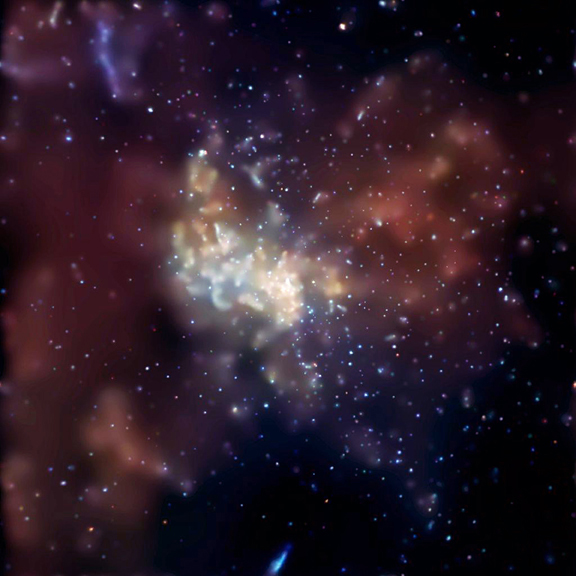
The center of the Milky Way galaxy
This image of the center of the Milky Way galaxy was taken by the Chandra X-ray Observatory. Image Credit: NASA/CXC/MIT/F.K. Baganoff et al.View Larger Image →

If Black Holes Are "Black," How Do Scientists Know They Are There?

A black hole can not be seen because strong gravity pulls all of the light into the middle of the black hole. But scientists can see how the strong gravity affects the stars and gas around the black hole. Scientists can study stars to find out if they are flying around, or orbiting, a black hole.

When a black hole and a star are close together, high-energy light is made. This kind of light can not be seen with human eyes. Scientists use satellites and telescopes in space to see the high-energy light.


Could a Black Hole Destroy Earth?

Black holes do not go around in space eating stars, moons and planets. Earth will not fall into a black hole because no black hole is close enough to the solar system for Earth to do that.
An active galaxy with light shooting out of its center
This artist's drawing shows a supermassive black hole in the center of a galaxy. The black hole is surrounded by a cloud of material that is spiraling into it. Image Credit: NASA E/PO, Sonoma State University, Aurore SimonnetView Larger Image →

Even if a black hole the same mass as the sun were to take the place of the sun, Earth still would not fall in. The black hole would have the same gravity as the sun. Earth and the other planets would orbit the black hole as they orbit the sun now.

The sun will never turn into a black hole. The sun is not a big enough star to make a black hole.

For more information head over to http://www.nasa.gov/audience/forstudents/k-4/stories/what-is-a-black-hole-k4.html

Tuesday, 11 September 2012

Ionising Radiation-What's it all about?

Ionising Radiation
Sources of radiation dose to the UK population.
The total annual equivalent dose is 0.0026 Sv,
but individual doses vary enormously.

Introduction
 
The presence of natural background radiation is an inescapable fact of life. We are all exposed to it. We breathe small amounts of the radioactive gas 'radon'. The ground and buildings around us are slightly radioactive. Our bodies contain natural radioactivity from our food and drink, and cosmic rays fall on us all the time.
The subject of radiation receives a great deal of attention in our society partly because radiation is one cause, among many, of cancer. We cannot in general sense radiation and this no doubt adds to our anxiety. However radiation can also be used for our benefit, particularly in healthcare. Most of us are familiar with chest and dental X-rays, investigation of bone fractures or other diagnostic procedures.


The insides of a molecule

What is Radiation?

Radiation is the energy carried by either electromagnetic waves or moving particles. Electromagnetic waves can vary in energy and wavelength.
Quantum mechanics predicts that very short wavelength electromagnetic waves behave as uncharged particles, called photons. Therefore the distinction between waves and particles at short wavelengths as with X-ray and gamma rays is blurred.
Ions are atoms with too few or too many electrons. Ionising radiation is radiation that has enough energy to kick electrons out of atoms and therefore produce ions. X-rays and gamma rays are forms of ionising radiation.
Ionisation can start chemical processes for example in an X-ray photographic image. On the other hand radiation induced chemical processes can in turn lead to biological effects such as the destruction of a cancer tumour.
Particles other than photons can also carry 'radiation' energy. Electrons, sometimes called beta particles, are small mass, negatively charged particles. Protons are larger mass positively charged particles. Neutrons have a similar mass to protons, but are uncharged. The particles described so far fit together to make atoms. Alpha particles are particularly stable groups of two protons and two neutrons. All types of atomic particles can carry energy.


The Electromagnetic Spectrum

Radiation Sources

Radiation sources can be split into two main types: naturally radioactive atoms and artificial sources using accelerated and/or decelerated charged particles.
Some nuclei naturally break up, because they are unstable. The process is called radioactive decay. Radioactive nuclei can be produced artificially. When the constituents of nuclei rearrange themselves to release energy and become stable they normally produce gamma rays and other particles.
Charged particles experience a force when placed in an electric field. Therefore charged particles can be accelerated to very high energy.
The sudden slowing down of charged particles produces X-rays e.g. in an X-ray set. X-rays can also be produced when atoms rearrange themselves to release energy. These are called characteristic X-rays.


Radiation Quantities and Units

Radiation is difficult to measure, we cannot detect it through any of our senses though we can measure it by indirect means. We can interpret the measurements we make in terms of the energy deposited by the radiation. The amount of energy deposited per unit mass in a material is called the 'absorbed dose'. The unit of absorbed dose is the gray (Gy), which is one joule per kilogram.
Ionising radiations differ in the way in which they interact with biological materials, so that equal absorbed doses do not always have equal biological effects. 'Equivalent dose' is the absorbed dose multiplied by a factor that takes account of the relative effectiveness in causing biological harm. The unit of equivalent dose is the sievert (Sv), which is one joule per kilogram.
For beta, gamma and X-rays, 1 Gy is the same as 1 Sv, but neutrons and alpha rays are more damaging and, for these, 1 Gy is worth between 5 Sv and 20 Sv.
The unit of radioactivity is the becquerel (Bq), this is equal to one nuclear disintegration per second.

Ranges of absorbed dose
 
Radiation Measuring Instruments

There are a wide variety of instruments used to measure different types of radiation, different energy ranges and different accuracies. Here are a few examples. In radiography such as a chest X-ray, the variation of the penetrating power of X-rays in bone and tissue gives rise to an image. It is natural to use an ion chamber to measure ionising radiation. An ionisation chamber collects the charge normally from ions in a gas. Since most of the energy absorbed by radiation eventually appears as heat, it is possible to measure the temperature rise due to radiation directly. These devices are called calorimeters. The primary standard for absorbed dose is a device of this type.
In order to characterise a radioactive material, two pieces of information are needed: the activity and the way in which the nuclei decay. The latter information depends solely on the particular radioactive nuclei present. The activity of radioactive material, however, is a measurement that needs to be made in each individual case.

Radiation Scale

Equivalent Dose (Sv)
Dose required to sterilise medical products
25 000
Typical total radiotherapy dose to cancer tumour
60
50% survival probability, whole body dose
4
Legal worker dose limit (whole body)
0.02
Average annual dose from all sources in Cornwall
0.008
Average annual dose from natural radiation
0.002
Typical chest X-ray dose
0.000 02
Average dose from a flight from UK to Spain
0.000 01


A Brief History of Radiation


1895
Röntgen discovered X-rays as the cause of fluorescence

1898
Marie and Pierre Curie discover the radioactive elements Radium and Polonium

1905
Einstein discovered the mass energy relation E = mc2

1913
Bohr suggested the idea of a nuclear atom
1910-1926
Balloon experiments in upper atmosphere confirm the presence of cosmic radiation

1942
Fermi achieved the first self-sustaining chain reaction and thereby initiated the controlled release of nuclear energy in nuclear reactors

1979
Nobel Prize awarded to Hounsfield and Cormack following invention of CT scanner
For a poster and more information, visit the Amazing NPL website below.

http://www.npl.co.uk/educate-explore/factsheets/ionising-radiation/

Friday, 7 September 2012

Formula 1 - The changing design of formula 1 cars

Evolution of the Formula One car, animated - The science of design


Animator and illustrator Rufus Blacklock animated 60 years of Formula One race car design. The outline of each year's car morphs from design to design, the engine shifts location, and the steering wheel changes shape.

He also analysed the changing shape of the steering wheel as can be seen below.

Formula 1 steering wheel design